


Stay active for life: physical activity across life stages
- PMID: 30104868
- PMCID: PMC6074830
- DOI: 10.2147/CIA.S167131
Stay active for life: physical activity across life stages
Abstract
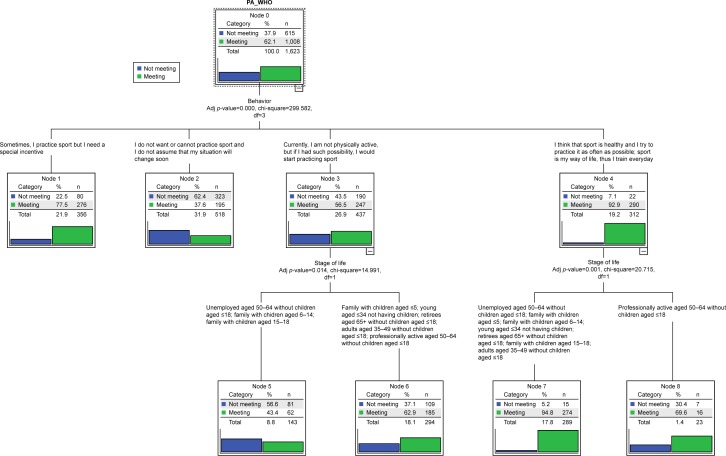
Purpose: This paper concerns participation of Poles aged 15+ years in leisure time and transport-related physical activity (PA) with a special focus on the life stages. The purpose of the paper was to analyze types of exercises, current and future behavior concerning PA, availability of sport and recreation facilities, and factors having the strongest relation with undertaking PA at a sufficient level according to pro-health recommendations of World Health Organization (WHO).
Patients and methods: A survey was carried out on the representative sample (n=2,000). Respondents were classified in accordance to their life stages with a two-step cluster analysis. Relationships between meeting the dose of PA required for health recommendations and a membership in groups of life stages were evaluated using log-linear analysis. The strength of this relationship was expressed by the odds ratio. In order to capture relationships between meeting WHO recommendations and a set of explanatory variables, a predictive model was built.
Results: Life stages and various related events have a significant relation with a decrease of PA. Among groups of a particular risk, there are professionally active and unemployed people aged 50-64 years without children as well as retirees aged 65+ years who do not meet WHO recommendations (45.3; 50.4% and 47.6%). The unemployed and retirees more frequently (p<0.0001) do not or cannot practice sport and do not think that a change of their situation is expected soon. However, 35% of professionally active people aged 50-64 years without children and 18.2% of unemployed people declare that they are currently not active but if they had the possibility, they would start practicing sport.
Conclusion: Campaigns promoting PA should be targeted at groups of a particular risk. Any attempts of increasing PA or changing tendencies of its decrease should consider life conditions of these persons, as well as their needs, motivations, and barriers.
Keywords: life stages; physical activity; professionally active 50+ without children; recommendations; retirees without children; unemployed 50+ without children.
Conflict of interest statement
Disclosure The authors report no conflicts of interest in this work.
Figures
References
-
- Allender S, Hutchinson L, Foster C. Life-change events and participation in physical activity: a systematic review. Health Promot Int. 2008;23(2):160–172. - PubMed
-
- Bell S, Lee C. Emerging adulthood and patterns of physical activity among young Australian women. Int J Behav Med. 2005;12(4):227–235. - PubMed
-
- Hirvensalo M, Lintunen T. Life-course perspective for physical activity and sports participation. Eur Rev Aging Phys Act. 2011;8(1):13–22.
-
- Allender S, Cowburn G, Foster C. Understanding participation in sport and physical activity among children and adults: a review of qualitative studies. Health Educ Res. 2006;21(6):826–835. - PubMed
MeSH terms
LinkOut - more resources
Full Text Sources
Other Literature Sources
Medical
