


Patterns of injuries and predictors of inhospital mortality in trauma patients in Saudi Arabia
- PMID: 30104908
- PMCID: PMC6074785
- DOI: 10.2147/OAEM.S166026
Patterns of injuries and predictors of inhospital mortality in trauma patients in Saudi Arabia
Abstract
Background: The aim of this study was to describe the pattern of traumatic injuries and determine the predictors of inhospital mortality in patients admitted to the emergency department.
Patients and methods: This is a retrospective cohort study of 3,786 patients with traumat injuries admitted to the emergency department of King Abdulaziz Medical City, Riyadh, Saudi Arabia, between January 2012 and December 2014. Data on patient characteristics, trauma characteristics and outcomes were extracted from medical records. A negative binomial regression model was utilized to identify significant predictors of inhospital mortality.
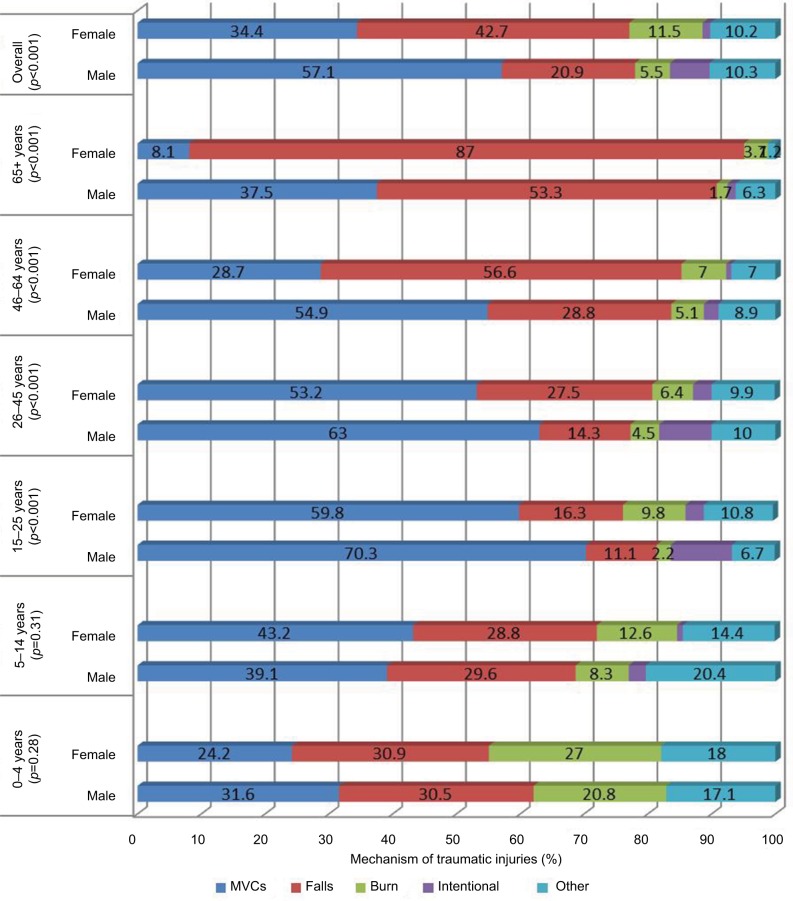
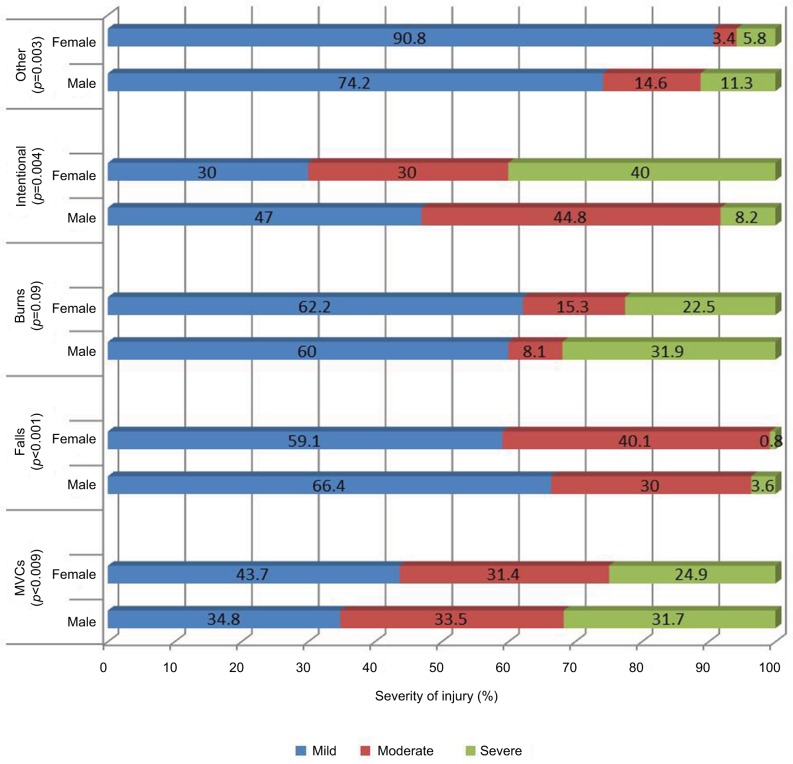
Results: Of all injured patients, 77.5% were male, 29.8% were aged 15-25 years and 25.7% were aged 26-45 years. Blunt trauma was the main mechanism of injury, including motor vehicle crashes (MVCs) in 52.0% and falls in 25.8% of patients. Most patients had injuries to the extremities (61.3%), followed by the head (32.2%), chest (16.9%) and abdomen (8.9%). Injuries were mild in 49.7% of patients, moderate in 30.2% and severe in 20.1%. The sex of the patients was significantly associated with the mechanism of injury (p<0.001), severity (p<0.001), anatomical site of injury (p<0.001), admission to the intensive care unit (p<0.001), need for trauma team activation (p<0.001) and type of transportation to hospital (p<0.001). The predictors of inhospital mortality were age (rate ratio [RR] for each 10-year increase=1.174; p<0.001), falls and burns (RR=2.337 and 1.728; p<0.001) and moderate and severe injuries (RR=6.438 and 181.780; p<0.001).
Conclusion: Our results suggest different patterns of trauma injuries according to patient age and sex. MVCs were the leading cause of injuries, but falls and burns had the highest inhospital mortality. This suggests the need for a comprehensive national education and prevention programs that address all causes of injuries.
Keywords: MVCs; Saudi; case fatality; causes of injury; injury severity; mechanism of injury.
Conflict of interest statement
Disclosure The authors report no conflicts of interest in this work.
Figures
Similar articles
-
In-hospital mortality among patients injured in motor vehicle crashes in a Saudi Arabian hospital relative to large U.S. trauma centers.Inj Epidemiol. 2014;1(1):21. doi: 10.1186/s40621-014-0021-4. Epub 2014 Aug 27. Inj Epidemiol. 2014. PMID: 26613073 Free PMC article.
-
Predicting in-hospital death among patients injured in traffic crashes in Saudi Arabia.Injury. 2014 Nov;45(11):1693-9. doi: 10.1016/j.injury.2014.05.029. Epub 2014 Jun 2. Injury. 2014. PMID: 24950798
-
Profile, outcome and predictors of mortality of abdomino-pelvic trauma patients in a tertiary intensive care unit in Saudi Arabia.Injury. 2015 Jan;46(1):94-9. doi: 10.1016/j.injury.2014.07.025. Epub 2014 Aug 7. Injury. 2015. PMID: 25152429
-
The effect of associated injuries, blood loss, and oxygen debt on death and disability in blunt traumatic brain injury: the need for early physiologic predictors of severity.J Neurotrauma. 1995 Aug;12(4):579-90. doi: 10.1089/neu.1995.12.579. J Neurotrauma. 1995. PMID: 8683609 Review.
-
Cervical spine injuries in children: a review of 103 patients treated consecutively at a level 1 pediatric trauma center.J Pediatr Surg. 2001 Aug;36(8):1107-14. doi: 10.1053/jpsu.2001.25665. J Pediatr Surg. 2001. PMID: 11479837 Review.
Cited by
-
Outcomes of Trauma Patients Present to the Emergency Department with a Shock Index of ≥1.0.J Emerg Trauma Shock. 2022 Jan-Mar;15(1):17-22. doi: 10.4103/jets.jets_86_21. Epub 2022 Apr 4. J Emerg Trauma Shock. 2022. PMID: 35431481 Free PMC article.
-
Current changes in the epidemiology of fall-related injuries in Al Ain City, United Arab Emirates.PLoS One. 2021 Sep 16;16(9):e0257398. doi: 10.1371/journal.pone.0257398. eCollection 2021. PLoS One. 2021. PMID: 34529683 Free PMC article.
-
Time to recovery and its predictors following traumatic injuries among injured victims in Dessie Comprehensive Specialized Hospital, North East of Ethiopia, 2022: a retrospective follow-up study.BMC Emerg Med. 2024 Mar 18;24(1):44. doi: 10.1186/s12873-024-00960-9. BMC Emerg Med. 2024. PMID: 38500020 Free PMC article.
-
Clinical and epidemiological characteristics of road traffic accidents patients received at 2 intensive care units in Saudi Arabia-A cross-sectional study.J Family Med Prim Care. 2021 Oct;10(10):3863-3868. doi: 10.4103/jfmpc.jfmpc_879_21. Epub 2021 Nov 5. J Family Med Prim Care. 2021. PMID: 34934693 Free PMC article.
-
Epidemiology of hand fractures at a tertiary care setting in Saudi Arabia.Saudi Med J. 2019 Jul;40(7):732-736. doi: 10.15537/smj.2019.7.24286. Saudi Med J. 2019. PMID: 31287136 Free PMC article.
References
-
- Norton R, Kobusingye O. Injuries. N Engl J Med. 2013;368(18):1723–1730. - PubMed
-
- Ruikar M. National statistics of road traffic accidents in India. JOTR. 2013;6(1):1.
-
- Aldana K, webpage on the Internet . New NHTSA Analysis Shows 2011 Traffic Fatalities Declined by Nearly Two Percent. National Highway Safety Administration; [Accessed: July 4, 2018]. Available from: https://www.nhtsa.gov/road-safety.
-
- CDC. webpage on the Internet Falls Are Leading Cause of Injury and Death in Older Americans. [Accessed 8 November, 2017]. Available from: https://www.cdc.gov/media/releases/2016/p0922-older-adult-falls.html.
LinkOut - more resources
Full Text Sources
Other Literature Sources
