. 2018 Jul 30:9:1108.
doi: 10.3389/fpls.2018.01108. eCollection 2018.

The High-Affinity Potassium Transporter EpHKT1;2 From the Extremophile Eutrema parvula Mediates Salt Tolerance

Affiliations

The High-Affinity Potassium Transporter EpHKT1;2 From the Extremophile Eutrema parvula Mediates Salt Tolerance

Akhtar Ali et al. Front Plant Sci. .

Abstract

To survive salt stress, plants must maintain a balance between sodium and potassium ions. High-affinity potassium transporters (HKTs) play a key role in reducing Na+ toxicity through K+ uptake. Eutrema parvula (formerly known as Thellungiella parvula), a halophyte closely related to Arabidopsis, has two HKT1 genes that encode EpHKT1;1 and EpHKT1;2. In response to high salinity, the EpHKT1;2 transcript level increased rapidly; by contrast, the EpHKT1;1 transcript increased more slowly in response to salt treatment. Yeast cells expressing EpHKT1;2 were able to tolerate high concentrations of NaCl, whereas EpHKT1;1-expressing yeast cells remained sensitive to NaCl. Amino acid sequence alignment with other plant HKTs showed that EpHKT1;1 contains an asparagine residue (Asn-213) in the second pore-loop domain, but EpHKT1;2 contains an aspartic acid residue (Asp-205) at the same position. Yeast cells expressing EpHKT1;1, in which Asn-213 was substituted with Asp, were able to tolerate high concentrations of NaCl. In contrast, substitution of Asp-205 by Asn in EpHKT1;2 did not enhance salt tolerance and rather resulted in a similar function to that of AtHKT1 (Na+ influx but no K+ influx), indicating that the presence of Asn or Asp determines the mode of cation selectivity of the HKT1-type transporters. Moreover, Arabidopsis plants (Col-gl) overexpressing EpHKT1;2 showed significantly higher tolerance to salt stress and accumulated less Na+ and more K+ compared to those overexpressing EpHKT1;1 or AtHKT1. Taken together, these results suggest that EpHKT1;2 mediates tolerance to Na+ ion toxicity in E. parvula and is a major contributor to its halophytic nature.

Keywords: Arabidopsis; Eutrema parvula; HKT1; Na+/K+ transporter; glycophyte; halophyte; salt tolerance.


Figures

FIGURE 1
FIGURE 1
HKT1 genes in Arabidopsis thaliana, Eutrema parvula, and Eutrema salsuginea. Eutrema parvula (Ep, also known as Schrenkiella parvula) and E. salsuginea (Es, previously known as Thellungiella halophila and Thellungiella salsugineum) are closely related to Arabidopsis. HKT1 homologs are indicated as 1; (EpHKT1;1/Tp6g07120) and 2; (EpHKT1;2/Tp6g07110) located at EpChr6, 3; (AtHKT1/At4g10310) located at AtChr4 and 4; (EsHKT1;1/pacid = 20197527), 5; (EsHKT1;2/pacid = 20197319), and 6; (EsHKT1;3/pacid = 20196940) located at EsChr3. Different colored boxes indicate the HKT1 genes in different species.
FIGURE 2
FIGURE 2
Upregulation of EpHKT1;2 expression in response to salt stress. (A,B) The expression levels of HKT1 genes under control and 150 mM salt-stress conditions were determined in 2-weeks-old E. parvula seedlings using quantitative (A) and semi-quantitative PCR (B) analysis. Error bars represent SE. Significant difference determined by Student’s t-test; (P < 0.05 and ∗∗P < 0.005). (C,D) Expression of HKT1 genes in roots and shoots. For quantitative analysis, each sample was quantified at least in triplicate. ACTIN2 was used as an internal control. Significant differences were determined by Student’s t-test; (P < 0.0001).
FIGURE 3
FIGURE 3
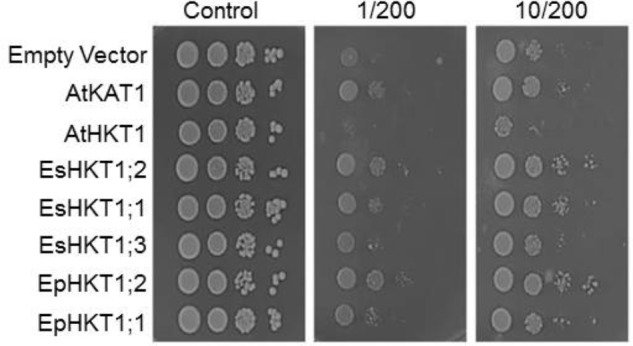
EpHKT1;2-expressing yeast cells were less sensitive to high NaCl. Yeast cells of strain AXT3K transformed with an empty vector (EV, negative control), or expressing AtKAT1 (positive control), AtHKT1, EsHKT1;1, EsHKT1;2, EsHKT1;3, EpHKT1;1, and EpHKT1;2 were grown overnight and serial decimal dilutions were spotted on SC dropout agar medium without uracil. Indicated concentrations of sodium (200 mM) and potassium (1 or 10 mM) were added to the medium. Photographs were taken after 3 days.
FIGURE 4
FIGURE 4
Presence of Asp (D) or Asn (N) in the second pore-loop region confers cation selectivity. (A) Comparison of HKT1 homologs from Arabidopsis, E. salsuginea, and E. parvula. Amino acid sequences in the second pore-loop region (PB) and the adjacent transmembrane domain (M2B) were aligned by ClustalW (http://www.ebi.ac.uk/Tools/msa/clustalw2/). The conserved glycine residues in the PB region (Mäser et al., 2002b) are indicated by an asterisk. The aspartic acid residues specific for EsHKT1;2 and EpHKT1;2 are indicated by arrows. (B) Na+-induced growth inhibition of yeast strain AXT3K. Yeast cells transformed with an empty vector (EV, negative control), or expressing AtKAT1 (positive control), AtHKT1, EsHKT1;2, EpHKT1;1, EpHKT1;2, and the mutant forms of EpHKT1;1 (EpHKT1;1N213D) and EpHKT1;2 (EpHKT1;1D205N) were grown overnight and the serial dilutions were spotted on SC dropout agar medium without uracil. Indicated concentrations of sodium (200 mM) and potassium (1 or 10 mM) were added to the medium. Photographs were taken after 3 days.
FIGURE 5
FIGURE 5
EpHKT1;2-overexpressing Arabidopsis plants are salt tolerant compared to EpHKT1;1- or AtHKT1-overexpressing plants. (A) Seeds of the wild type (Col-gl1) and indicated transgenic lines were germinated on 1XMS medium with or without the indicated concentrations of NaCl (mM) in a growth chamber under long-day conditions (16 h light, 8 h dark) and grown vertically for 1 week. Photographs were taken 1 week after germination. (B) Root growth of the plants grown under different concentration of NaCl. Plates were put vertically in a growth chamber under long-day conditions. Photographs were taken 7 days after germination. Error bars represent SE. Significant differences were determined by Student’s t-test (P < 0.005 and ∗∗P < 0.05). (C) Seeds of the wild type (Col-gl1) and indicated transgenic lines were germinated on 1XMS plates, allowed to grow for 4 days and then transferred to new plates containing 1X MS medium with different concentrations of NaCl. Photographs were taken after 1 week under NaCl stress. (D) Root growth of the 4 days transferred plants that were further allowed to grow for further 7 days under different concentrations of NaCl. Plates were put vertically in a growth chamber under long-day conditions. Photographs were taken 7 days after transfer to NaCl plates. Error bars represent SE. Significant differences were determined by Student’s t-test (P < 0.05, ∗∗P < 0.005, and ∗∗∗P < 0.001) compared with Col-gl1 under salt treatment.
FIGURE 6
FIGURE 6
Salt-stress responses of soil-grown EpHKT1;1- and EpHKT1;2-overexpressing plants compared with AtHKT1-overexpressing plants. (A) Seeds were germinated on 1XMS medium in a growth chamber under long-day conditions (16 h light, 8 h dark). One-week-old seedlings were then transferred to soil and grown for 2 more weeks. Photographs were taken before salt treatment. (B) Fresh weight of plants shown in A. (C) Two-weeks-old plants, as shown in A, were treated with 300 mM NaCl twice a week for 2 weeks. Photographs were taken at the end of salt treatment. (D) Fresh weight of plants shown in C. Error bars represent SE. Significant differences were determined by Student’s t-test (P < 0.001 and ∗∗P < 0.01) compared with Col-gl1 under salt treatment.
FIGURE 7
FIGURE 7
Na+ and K+ content in plants. Two-weeks-old seedlings of Col-gl1 and transgenic plants expressing 35S::AtHKT1, 35S::EpHKT1;1, or 35S::EpHKT1;2 in the Col-gl1 background were treated with 100 mM NaCl for 12 and 24 h in MS medium. Na+ (A) and K+ (B) contents were measured by inductively coupled plasma optical emission spectroscopy.

References

    1. Ali A., Park H. C., Aman R., Ali Z., Yun D. J. (2013). Role of HKT1 in Thellungiella salsuginea, a model extremophile plant. Plant Signal. Behav. 8:e25196. 10.4161/psb.25196 - DOI - PMC - PubMed
    1. Ali A., Raddatz N., Aman R., Kim S., Park H. C., Jan M., et al. (2016). A single amino acid substitution in the sodium transporter HKT1 associated with plant salt tolerance. Plant Physiol. 171 2112–2126. 10.1104/pp.16.00569 - DOI - PMC - PubMed
    1. Ali Z., Park H. C., Ali A., Oh D. H., Aman R., Kropornicka A., et al. (2012). TsHKT1; 2, a HKT1 homolog from the extremophile Arabidopsis relative Thellungiella salsuginea, shows K+ specificity in the presence of NaCl. Plant Physiol. 158 1463–1474. 10.1104/pp.111.193110 - DOI - PMC - PubMed
    1. An D., Chen J. G., Gao Y. Q., Li X., Chao Z. F., Chen Z. R., et al. (2017). AtHKT1 drives adaptation of Arabidopsis thaliana to salinity by reducing floral sodium content. PLoS Genet. 13:e1007086. 10.1371/journal.pgen.1007086 - DOI - PMC - PubMed
    1. Anschütz U., Becker D., Shabala S. (2014). Going beyond nutrition: regulation of potassium homeostasis as a common denominator of plant adaptive responses to environment. J. Plant Physiol. 171 670–687. 10.1016/j.jplph.2014.01.009 - DOI - PubMed

LinkOut - more resources