. 2018 Sep;8(9):e01093.
doi: 10.1002/brb3.1093. Epub 2018 Aug 14.

Hippocampal amino-3-hydroxy-5-methyl-4-isoxazolepropionic acid GluA1 (AMPA GluA1) receptor subunit involves in learning and memory improvement following treatment with Centella asiatica extract in adolescent rats

Affiliations

Hippocampal amino-3-hydroxy-5-methyl-4-isoxazolepropionic acid GluA1 (AMPA GluA1) receptor subunit involves in learning and memory improvement following treatment with Centella asiatica extract in adolescent rats

Nor Aqilah Binti Mohd Yusuf Yeo et al. Brain Behav. 2018 Sep.

Abstract

Introduction: Centella asiatica is an herbal plant that contains phytochemicals that are widely believed to have positive effects on cognitive function. The adolescent stage is a critical development period for the maturation of brain processes that encompass changes in physical and psychological systems. However, the effect of C. asiatica has not been extensively studied in adolescents. The aim of this study was therefore to investigate the effects of a C. asiatica extract on the enhancement of learning and memory in adolescent rats.

Methods: The locomotor activity, learning, and memory were assessed by using open field test and water T-maze test. This study also examined changes in neuronal cell morphology using cresyl violet and apoptosis staining. We also performed immunohistochemical study to analyse the expression of the glutamate AMPA receptor (α-amino-3-hydroxy-5-methyl-4-isoxazolepropionic acid) GluA1 subunit and the GABA receptor (γ-Aminobutyric Acid) subtype GABAA α1 subunit in the hippocampus of the same animals.

Results: We found no significant changes in locomotor activity (p > 0.05). The water T-maze data showed that 30 mg/kg dose significantly (p < 0.05) improved learning, memory, and the memory consolidation phase but had no effect on reversal learning (p > 0.05). Histological data revealed no neuronal morphological changes. Immunohistochemical analysis revealed increased expression of the AMPA GluA1 receptor subunit but there was no effect on GABAA receptor α1 subunit expression in the CA1 and CA2 subregions of the hippocampus.

Conclusions: The C. asiatica extract therefore improved hippocampus-dependent spatial learning and memory in a dose-dependent manner in rats through the GluA1-containing AMPA receptor in the CA1 and CA2 sub regions of the hippocampus.

Keywords: Centella asiatica; AMPA receptor; GABA receptor; adolescent; hippocampus; learning and memory.


Figures

Figure 1
Figure 1
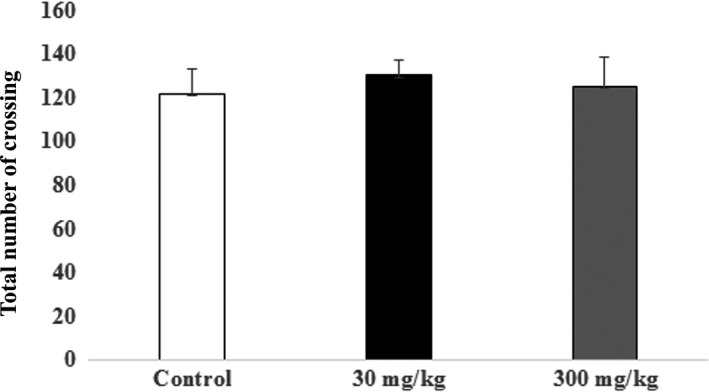
Open field test: Locomotor activity of rats was assessed in an open field test following 14 days of treatment with the extract of Centella asiatica. The graph shows the mean (±SEM) of the total number of crossing in the open field test. One‐way ANOVA showed no significant changes between control and treatments animals (> 0.05) with Cronbach's alpha: 0.999
Figure 2
Figure 2
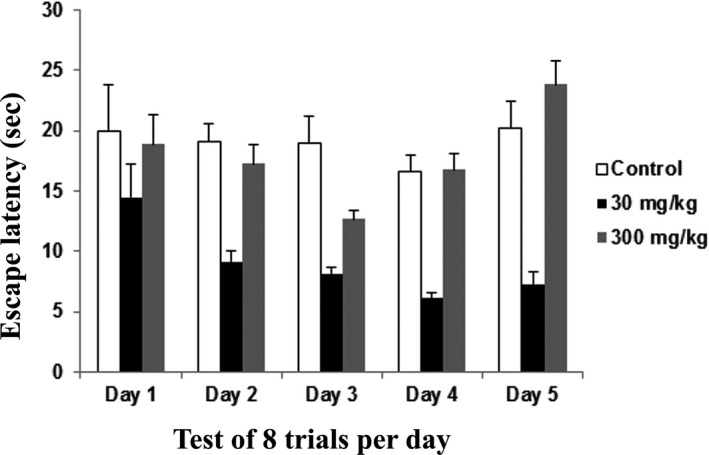
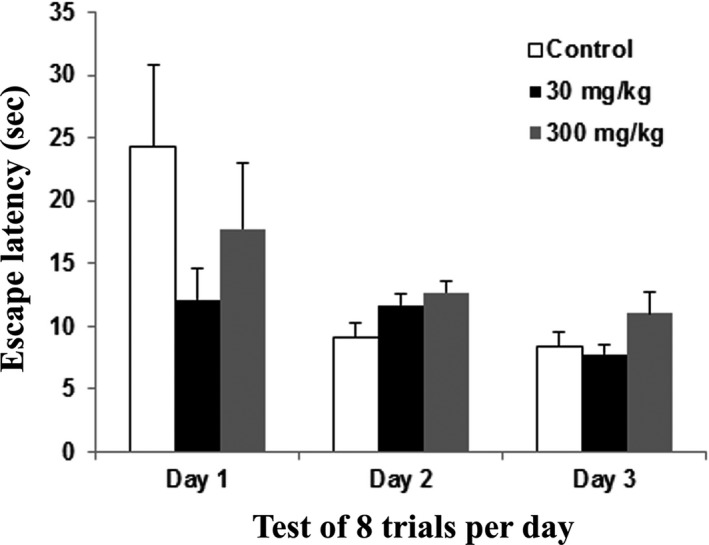
Water T maze – Learning acquisition phase of rats following 14 days of administration of the extract of Centella asiatica was assessed in water T‐maze. The graph shows the mean (±SEM) of escape latency of learning acquisition phase (sec) from day 1 to day 5. Two‐way repeated ANOVA showed significant (*) changes between control and treatments animals (< 0.05) with Cronbach's alpha: 0.977
Figure 3
Figure 3
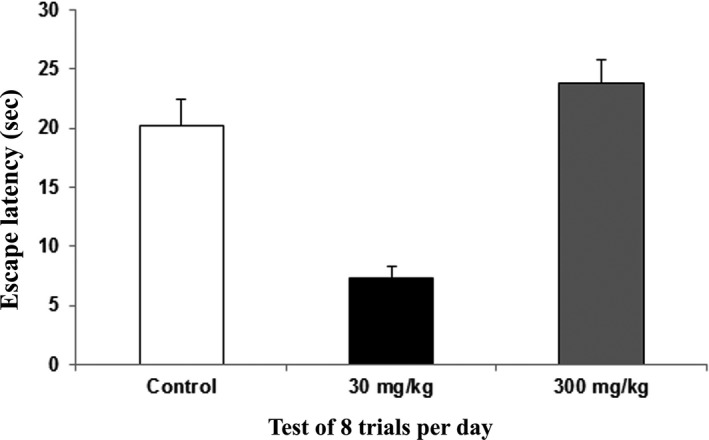
Water T‐maze – The memory phase of the rats following 14 days of administration of the extract of Centella asiatica was assessed with the water T‐maze. The graph shows the mean (±SEM) of escape latency of memory phase (sec). One way ANOVA showed significant (*) changes between the control and treatment animals (< 0.05) with Cronbach's alpha: 0.996
Figure 4
Figure 4
Water T‐maze – The memory consolidation phase of rats following 14 days of administration of the extract of Centella asiatica was assessed with the water T‐maze. The graph shows the mean (±SEM) of escape latency in the probe trial for memory consolidation. One way ANOVA showed significant (*) changes between the control and treatment animals (< 0.05) with Cronbach's alpha: 1.000
Figure 5
Figure 5
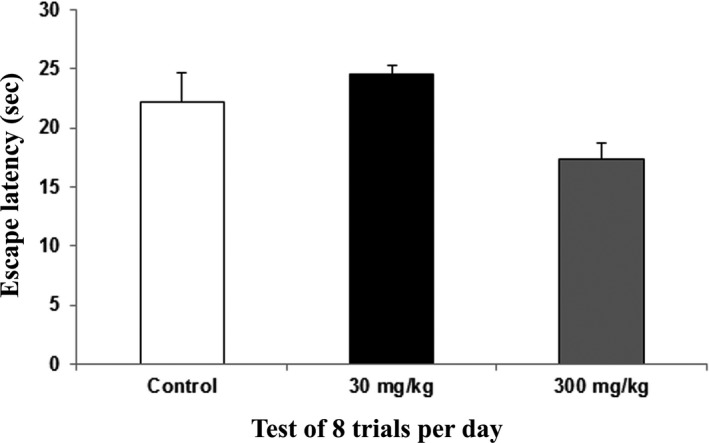
Water T‐maze – Reversal learning phase of rats following 14 days of administration of the extract of Centella asiatica was assessed with the water T‐maze. The graph shows the mean (±SEM) of escape latency in the reversal learning test. One way ANOVA showed no significant changes between the control and treatment animals (> 0.05) with Cronbach's alpha: 1.000
Figure 6
Figure 6
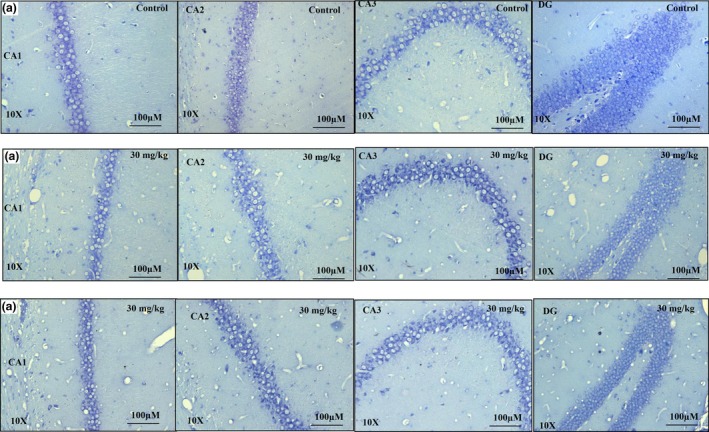
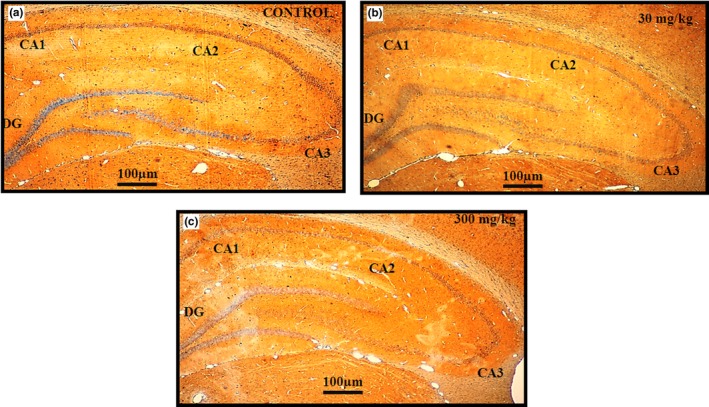
Cresyl violet stained sections of rat hippocampus subregions CA1, CA2, CA3, and DG from control (n = 5) (A), 30 mg/kg (n = 5) (B), and 300 mg/kg (n = 5) (C) groups following 14 days of administration of the extract of Centella asiatica. No significant changes in morphology were observed between control and treatment animals. All three blinded investigators agreed on their observations. Scale bar = 100 μm
Figure 7
Figure 7
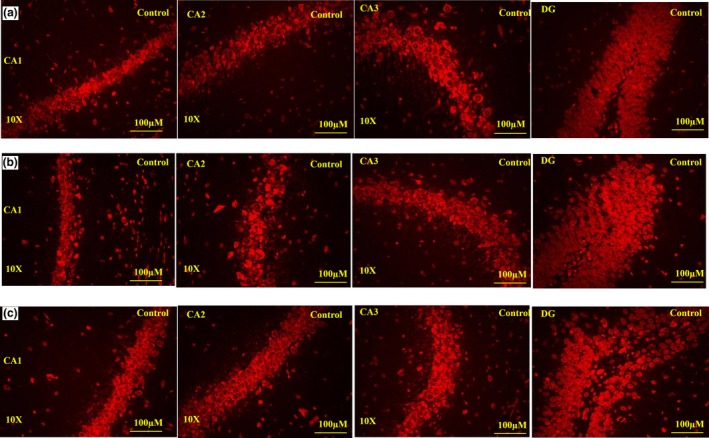
Apoptosis staining: Effect of administration of the extract of Centella asiatica (CA) for 14 days on the rat hippocampus sub regions CA1, CA2, CA3, and DG in control (n = 5) (A), 30 mg/kg (n = 5) (B), and 300 mg/kg (n = 5) (C) groups. No apoptosis occurred in the control or treatment animals. All three blinded investigators agreed on their observations. Scale bar = 100 μm
Figure 8
Figure 8
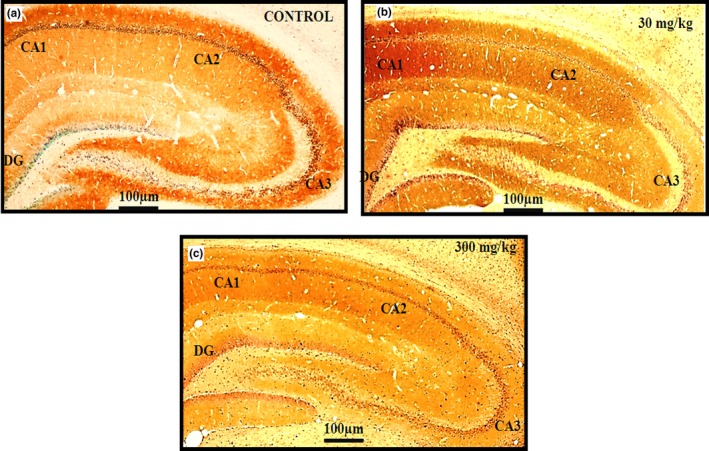
HRP/DAB staining – Immunohistochemical analysis for detection of the qualitative expression of the glutamate AMPA GluA1 receptor distribution in sections of rats hippocampus subregions CA1, CA2, CA3, and DG in control (n = 5) (A), 30 mg/kg (n = 5) (B), and 300 mg/kg (n = 5) (C) groups following 14 days of treatment with the extract of Centella asiatica. Image (A) shows moderate expression (++), (B) strong expression (+++) and (C) mild expression (+). The cells and tissues were labeled with the chromogen 3‐3‐diaminobenzidine (DAB). Three blinded investigators gave the same scale value in their observations. Cohen kappa: 1.000. Scale bar = 100 μm
Figure 9
Figure 9
HRP/DAB staining – Immunohistochemical analysis for qualitative detection of the expression of the GABAA α1 receptor subunit distribution in sections of rat hippocampus sub regions CA1, CA2, CA3, and DG in control (n = 5) (A), 30 mg/kg (n = 5) (B), and 300 mg/kg (n = 5) (C) groups of rats following 14 days of administration of the extract of Centella asiatica. Images (A, B, C) show moderate expression (++), with no significant difference between the control and treatment groups. The cells and tissues were labeled with the chromogen 3‐3‐diaminobenzidine (DAB). Three blinded investigators agreed on their observations. Scale bar = 100 μm

References

    1. Abas, F. , Khatib, A. , Shaari, K. , & Lajis, N. H. (2014). Chemical characterization and antioxidant activity of three medicinal Apiaceae species. Industrial Crops and Products, 55, 238–247.
    1. Abdulla, M. A. , Al‐Bayaty, F. H. , Younis, L. T. , & Hassan, M. A. (2010). Anti‐ulcer activity of Centella asiatica leaf extract against ethanol‐induced gastric mucosal injury in rats. Journal of Medicinal Plants Research, 4(13), 1253–1259.
    1. Al‐Rahbi, B. , Zakaria, R. , Othman, Z. , Hassan, A. , Ismail, Z. I. M. , & Muthuraju, S. (2014). Tualang honey supplement improves memory performance and hippocampal morphology in stressed ovariectomized rats. Acta Histochemica, 116(1), 79–88. 10.1016/j.acthis.2013.05.004 - DOI - PubMed
    1. Anggono, V. , & Huganir, R. L. (2012). Regulation of AMPA receptor trafficking and synaptic plasticity. Current Opinion in Neurobiology, 22(3), 461–469. 10.1016/j.conb.2011.12.006 - DOI - PMC - PubMed
    1. Arain, M. , Haque, M. , Johal, L. , Mathur, P. , Nel, W. , Rais, A. , … Sharma, S. (2013). Maturation of the adolescent brain. Neuropsychiatric Disease and Treatment, 9, 449–461. - PMC - PubMed

Publication types

LinkOut - more resources