. 2018 Sep 1;7(9):giy101.
doi: 10.1093/gigascience/giy101.

The genome of the golden apple snail Pomacea canaliculata provides insight into stress tolerance and invasive adaptation

Affiliations

The genome of the golden apple snail Pomacea canaliculata provides insight into stress tolerance and invasive adaptation

Conghui Liu et al. Gigascience. .

Abstract

Background: The golden apple snail (Pomacea canaliculata) is a freshwater snail listed among the top 100 worst invasive species worldwide and a noted agricultural and quarantine pest that causes great economic losses. It is characterized by fast growth, strong stress tolerance, a high reproduction rate, and adaptation to a broad range of environments.

Results: Here, we used long-read sequencing to produce a 440-Mb high-quality, chromosome-level assembly of the P. canaliculata genome. In total, 50 Mb (11.4%) repeat sequences and 21,533 gene models were identified in the genome. The major findings of this study include the recent explosion of DNA/hAT-Charlie transposable elements, the expansion of the P450 gene family, and the constitution of the cellular homeostasis system, which contributes to ecological plasticity in stress adaptation. In addition, the high transcriptional levels of perivitelline genes in the ovary and albumen gland promote the function of nutrient supply and defense ability in eggs. Furthermore, the gut metagenome also contains diverse genes for food digestion and xenobiotic degradation.

Conclusions: These findings collectively provide novel insights into the molecular mechanisms of the ecological plasticity and high invasiveness.


Figures
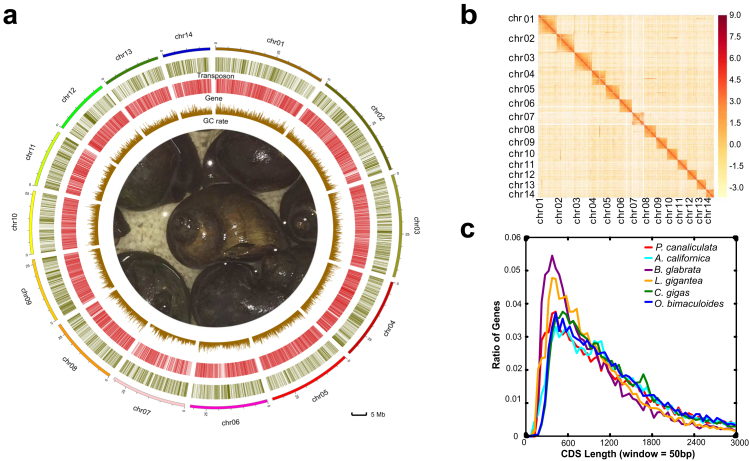
Figure 1:
Figure 1:
The genome characteristics of P. canaliculata. (a) Circos plot showing the genomic features. Track 1: 14 linkage groups of the genome; track 2: distribution of transposon elements in chromosomes; track 3: protein-coding genes located on chromosomes; track 4: distribution of Guanine and Cytosine (GC) contents. (b) A genome-wide contact matrix from Hi-C data between each pair of the 14 chromosomes using a 100-kb window size. The color value indicates the base 2 logarithm of the number of valid reads (log2[valid reads]). (c) Distribution of coding DNA sequence length in six closely related species.
Figure 2:
Figure 2:
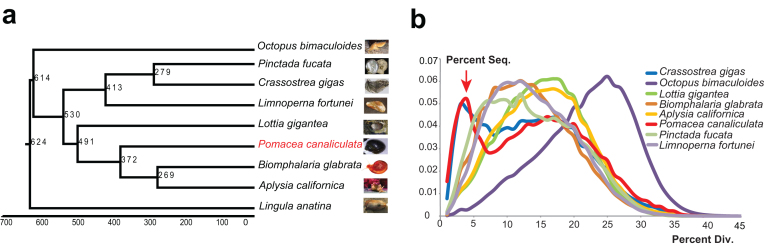
Evolutionary genomic analysis of P. canaliculata. (a) Phylogenetic placement of P. canaliculata within the dated tree of molluscs. The estimated divergence time is shown at each branching point, and P. canaliculata is shown in red. (b) Distribution of divergence rate for the class of DNA transposons in mollusc genomes. The divergence rate was calculated by comparing all transposable element (TE) sequences identified in the genome to the corresponding consensus sequence in each TE subfamily. The red arrow indicates that P. canaliculata and C. gigas had a recent explosion of TEs at a divergence rate of ∼4%.
Figure 3:
Figure 3:
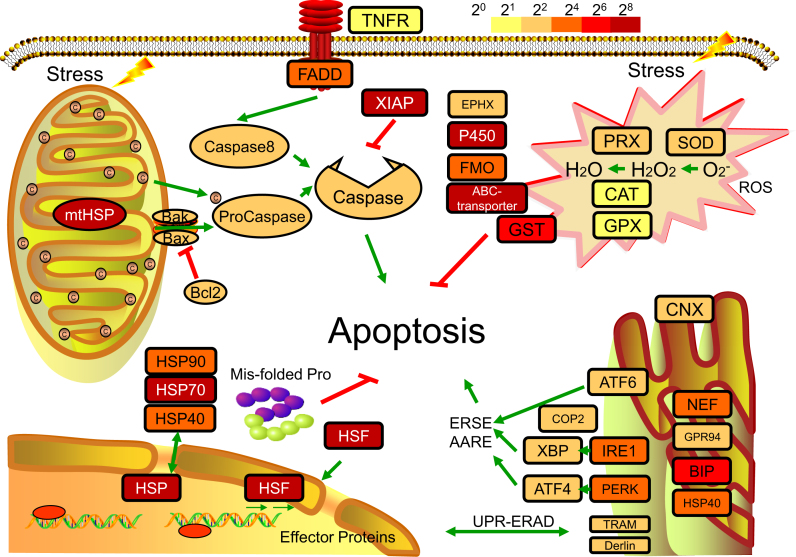
The cellular homeostasis system in P. canaliculata. The unfolded protein response (UPR) system includes HSPs and HSF in the heat shock response and CNX, NEF, GRP94, BIP, HSP40, ATF6, IRE1, PERK, COP2, XBP, ATF4, TRAM, and Derlin in the endoplasmic reticulum unfolded protein response (UPR-ERAD). Apoptotic pathways include XIAPs, Bcl2, caspases, TNFR, and FADD. The antioxidant systems include PRX, SOD, CAT, and GPX. The xenobiotic biotransformation system includes EPHX3, P450, FMO, and ABC transporter. The colors of the boxes for gene families represent the degree of upregulation (FPKM-stimulus/FPKM-control) as an overall result of stress, including heat, cold, heavy metal, and air exposure. Pathways and genes were obtained based on KEGG annotation.
Figure 4:
Figure 4:
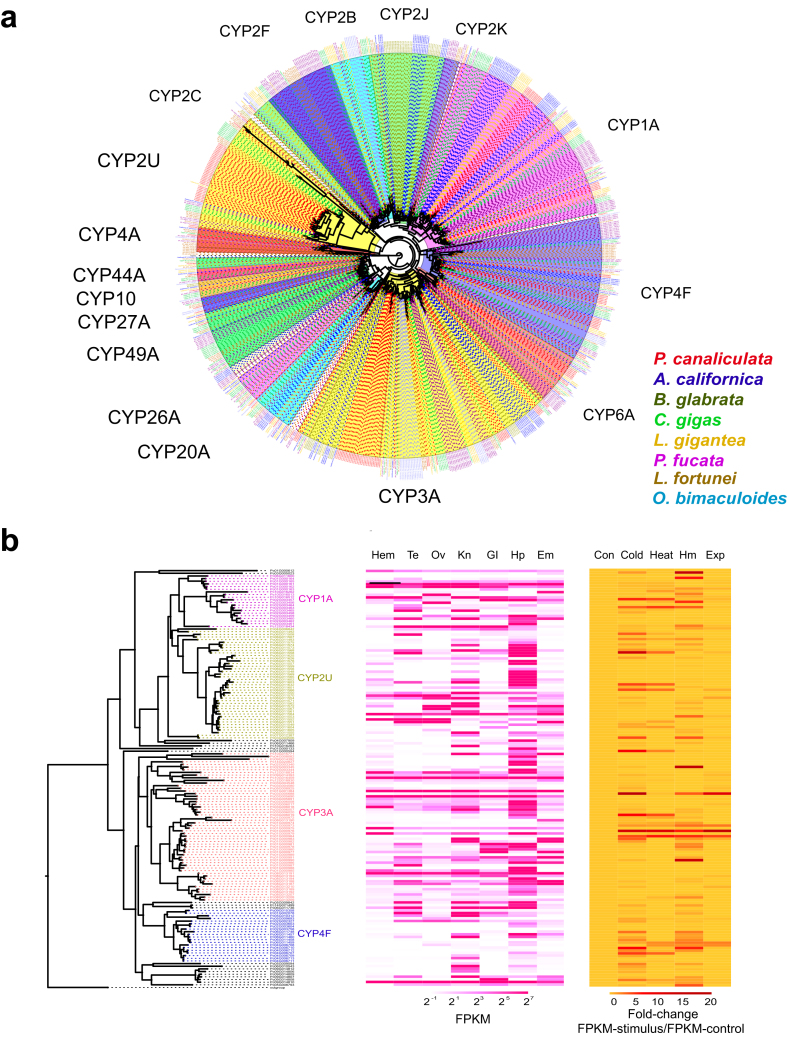
The expansion of the P450 gene family in P. canaliculata. (a) Phylogenetic tree demonstrating orthologous and paralogous relationships of all P450 genes from eight species including P. canaliculata, A. californica, B. glabrata, C. gigas, L. fortunei, L. gigantea, O. bimaculoides, and P. fucata. P450 genes from eight species were obtained based on Pfam annotation (Interpro) with an E-value of 10−5. Clades are labeled by P450 subfamily names. The tree was constructed using the maximum likelihood method in MEGA7, and the branch length scale indicates the average number of residue substitutions per site. (b) Phylogenetic tree of P450 genes in P. canaliculata, which is a subset of the phylogenetic tree for the species, and their heat map of expression (FPKM) in tissues (Hem, hemocytes; Te, testis; Ov, ovary and albumen gland; Kn, kidney; Gl, gill; Hp, hepatopancreas; Em, embryo) and heat map of induced expression (FPKM-stimulus/FPKM-control) under stress (Con: control; heat; cold; Hm: heavy metal; Exp: air exposure).
Figure 5:
Figure 5:
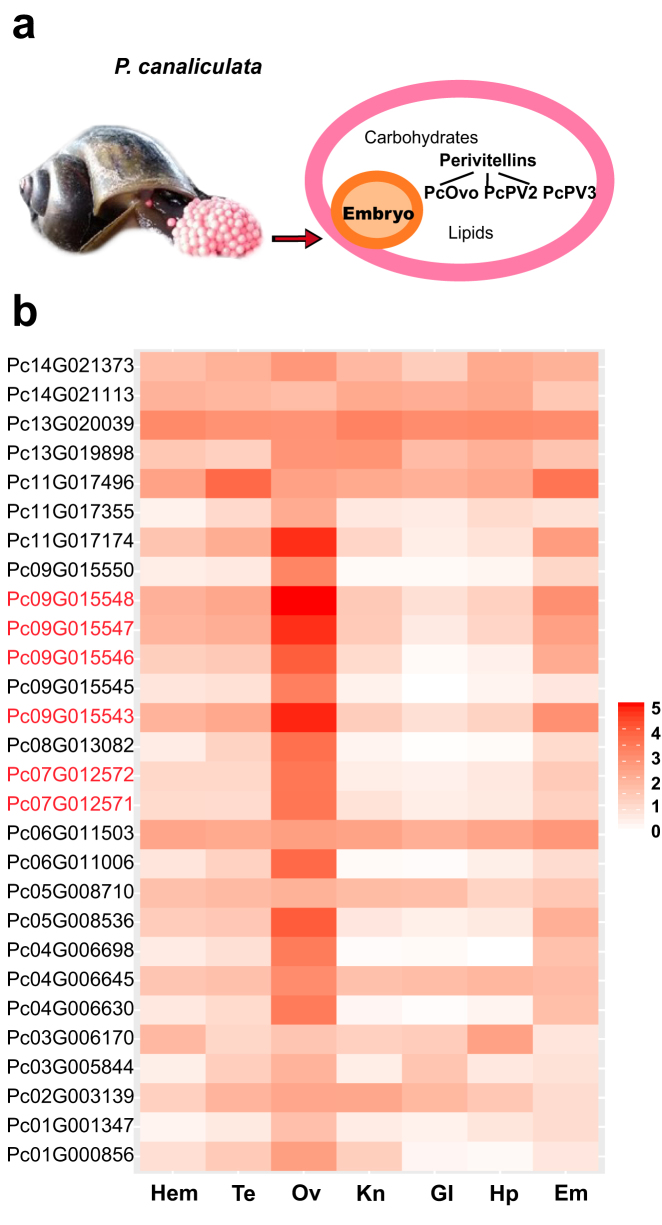
The composition and expression of the P. canaliculata perivitellines in different tissues. (a) Perivitelline fluid (PVF) lies under the eggshell and surrounds the embryo. It contains carbohydrates, lipids, and proteins. The proteins are also known as perivitellines and are classified into three categories, PcOvo, PcPV2, and PcPV3. (b) The displayed expression value of PVF proteins is the base 10 logarithm of FPKM (log10FPKM). The genes marked in red encode perivitellines. The tissues examined are abbreviated as follows: Hem, hemocytes; Te, testis; Ov, ovary and albumen gland; Kn, kidney; Gl, gill; Hp, hepatopancreas; Em, embryo.

References

    1. Lowe S, Browne M, Boudjelas S, et al. 100 of the World's Worst Invasive Alien Species: A Selection from the Global Invasive Species Database. Auckland, New Zealand: World Conservation Union (IUCN); 2000.
    1. Ranamukhaarachchi SL, Wickramasinghe S. Golden apple snails in the world: introduction, impact, and control measures. Global advances in ecology and management of golden apple snails. 2006:133–52.
    1. Naylor R. Invasions in agriculture: assessing the cost of the golden apple snail in Asia. Royal Swedish Academy of Sciences. 1996;25:443–8.
    1. Berthold T. Vergleichende Anatomie, Phylogenie und historische Biogeographie der Ampullariidae: (Mollusca, Gastropoda) 1991.
    1. Howells RG, Burlakova LE, Karatayev AY et al. , Native and introduced Ampullaridae in North America: history, status, and ecology. Global advances in ecology and management of golden apple snails 2006 73-112.

Publication types