. 2018 Sep;28(9):1405-1414.
doi: 10.1101/gr.237362.118. Epub 2018 Aug 14.

Human proteins that interact with RNA/DNA hybrids

Affiliations

Human proteins that interact with RNA/DNA hybrids

Isabel X Wang et al. Genome Res. 2018 Sep.

Abstract

RNA/DNA hybrids form when RNA hybridizes with its template DNA generating a three-stranded structure known as the R-loop. Knowledge of how they form and resolve, as well as their functional roles, is limited. Here, by pull-down assays followed by mass spectrometry, we identified 803 proteins that bind to RNA/DNA hybrids. Because these proteins were identified using in vitro assays, we confirmed that they bind to R-loops in vivo. They include proteins that are involved in a variety of functions, including most steps of RNA processing. The proteins are enriched for K homology (KH) and helicase domains. Among them, more than 300 proteins preferred binding to hybrids than double-stranded DNA. These proteins serve as starting points for mechanistic studies to elucidate what RNA/DNA hybrids regulate and how they are regulated.


Figures

Figure 1.
Figure 1.
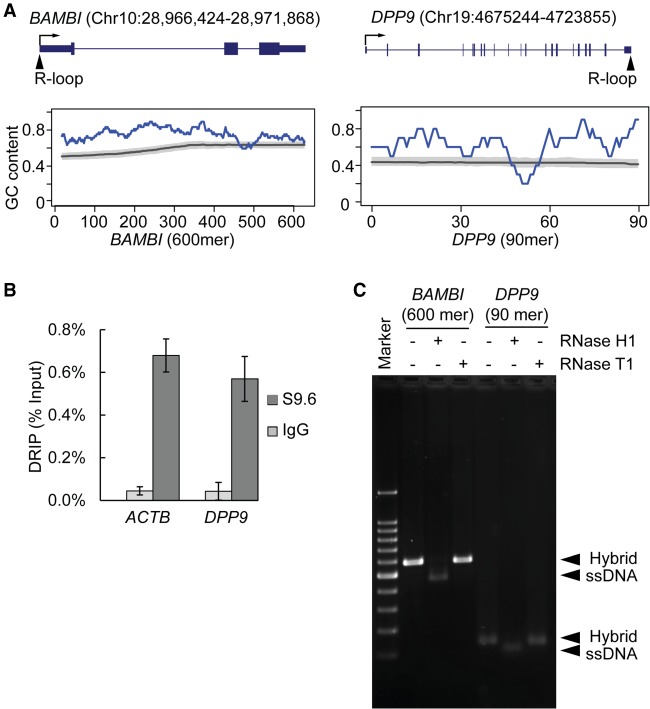
R-loops at GC-rich regions in the BAMBI promoter and DPP9 3′ UTR. (A) Location and GC content of sequences underlying R-loops in BAMBI and DPP9. (Top) R-loop location is marked on gene models of BAMBI and DPP9. Boxes represent exons, and lines represent introns. Arrows show transcription start site and direction of transcription. (Bottom) GC content of the 600-mer and 90-mer sequences corresponding to RNA sequence in the R-loops (blue line). GC content is calculated as (G + C)/(G + C + A + U) in the 50-nt sliding window for 600-mer or 10-nt sliding window for 90-mer. Genome background of GC content is calculated from corresponding regions of 14,587 RefSeq genes that are at least 2 kb long and 1 kb away from neighboring genes. The gray line represents median GC content, and the shade represents ±10%. (B) The S9.6 antibody specifically pulled down R-loops at the 3′ UTR of DPP9. DRIP was carried out using an S9.6 antibody or nonspecific IgG. Precipitated DNA was amplified using primers specific for DPP9 3′ UTR. Primers specific for a previously reported R-loop region at the 3′ UTR of ACTB were used as positive control. (Error bars) SEM of triplicates. (C) Integrity of the RNA/DNA hybrid was confirmed using RNase H1 and RNase T1. As expected, RNase H1 specifically digested RNA in the hybrids, leaving ssDNA as a product. RNase T1, which is specific for ssRNA, did not cleave the hybrids.
Figure 2.
Figure 2.
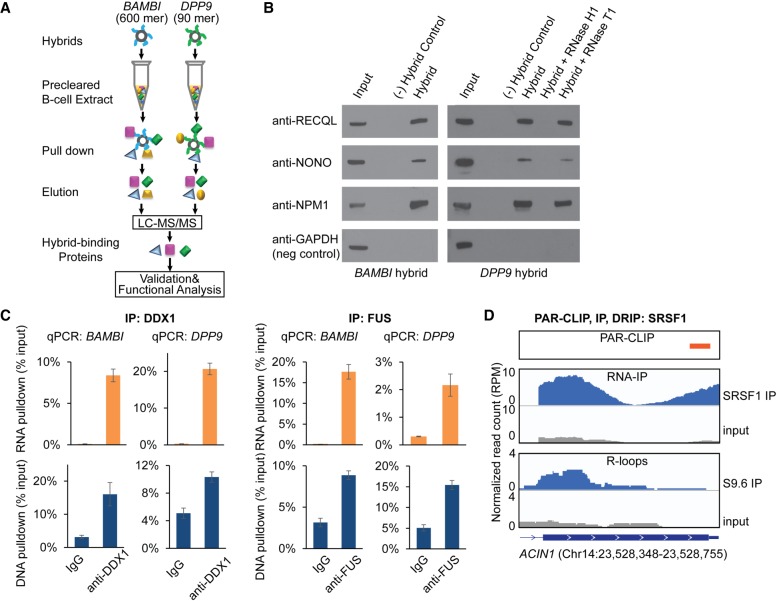
Identification of proteins that bind specifically to RNA/DNA hybrids. (A) Schematic of the experimental procedure. Biotinylated hybrids were conjugated to streptavidin beads and incubated with B-cell extracts. The proteins pulled down by hybrids were identified through proteomic analysis (LC-MS/MS). Only proteins that were bound by both hybrids were retained for further analysis. (B) Hybrid-binding proteins identified by proteomic analysis were validated by Western blot. B-cell extract (input) was incubated with no hybrid as a negative control, BAMBI or DPP9 hybrid, DPP9 hybrid pretreated with RNase H1 or RNase T1, respectively. Proteins were pulled down by biotinylated hybrids and analyzed by Western blot. Interactions with the pulled down proteins were eliminated by RNase H1 digestion but were not affected by RNase T1 digestion. (C) Validation of protein-hybrid interaction by reverse pull down. DDX1 and FUS and their associated hybrids were pulled down by anti-DDX1 and anti-FUS antibodies, respectively. RNA and DNA were purified from precipitates and quantified by qPCR using primers annealing to DPP9 or BAMBI hybrids. Input amount was normalized against copy numbers of DNA and transcripts. (Error bars) SEM of triplicates. (D) Colocalization of SRSF1 binding with R-loops. SRSF1 binding to the ACIN1 transcript was identified by PAR-CLIP and RNA-IP using an anti-SRSF1 antibody, and R-loops were identified by S9.6 DRIP. IGV viewer screenshots of data showing sequence reads from PAR-CLIP, RNA-IP, and DRIP-seq.
Figure 3.
Figure 3.
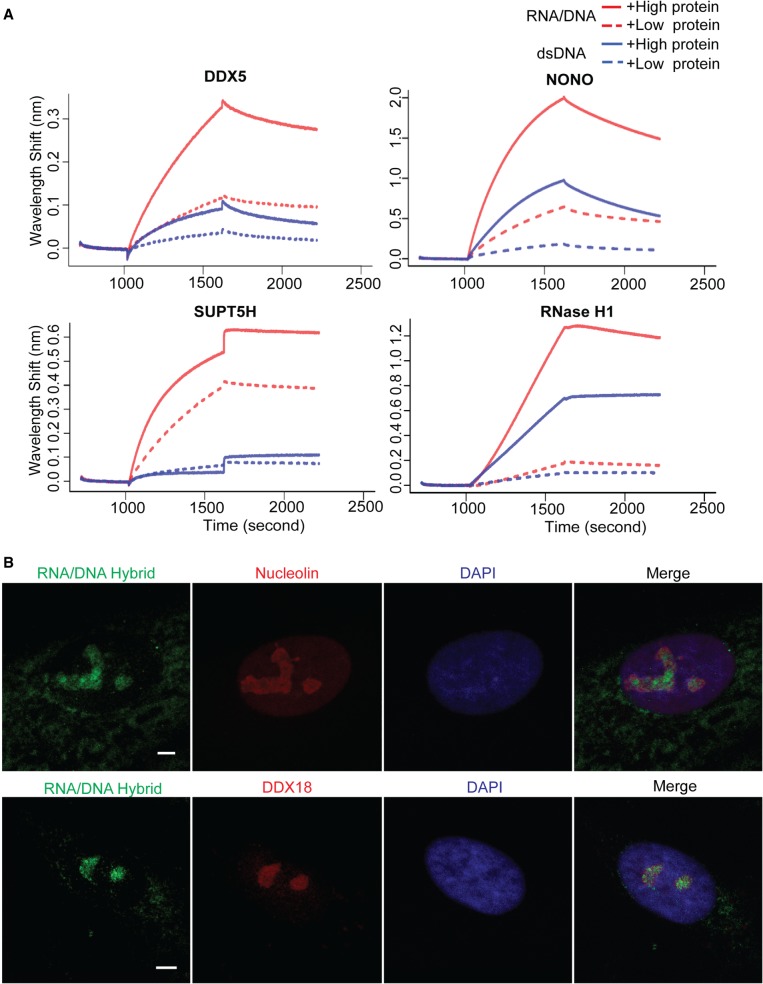
Validation of protein and hybrid interaction. (A) The protein and hybrid interaction is shown by biolayer interferometry. Binding of DPP9 RNA/DNA hybrid (red lines) or dsDNA (blue lines) to high concentration (solid lines) or low concentration (dotted lines) of each protein was measured. These proteins showed more avid binding to RNA/DNA hybrid than to dsDNA. Baseline was recorded from 0 to 1000 sec, association of protein with dsDNA or RNA/DNA hybrid from 1000 to 1600 sec, followed by dissociation. (B) Immunofluorescence staining in primary human fibroblasts showing colocalization of nucleolin and DDX18 (red) with the R-loops stained by S9.6 RNA/DNA hybrid antibody (green). DAPI staining is in blue. (Scale bar) 1 µm.

References

    1. Abdouni HS, King JJ, Ghorbani A, Fifield H, Berghuis L, Larijani M. 2018. DNA/RNA hybrid substrates modulate the catalytic activity of purified AID. Mol Immunol 93: 94–106. - PubMed
    1. Antanaviciute A, Baquero-Perez B, Watson CM, Harrison SM, Lascelles C, Crinnion L, Markham AF, Bonthron DT, Whitehouse A, Carr IM. 2017. m6aViewer: software for the detection, analysis, and visualization of N6-methyladenosine peaks from m6A-seq/ME-RIP sequencing data. RNA 23: 1493–1501. - PMC - PubMed
    1. Baker TA, Kornberg A. 1988. Transcriptional activation of initiation of replication from the E. coli chromosomal origin: an RNA-DNA hybrid near oriC. Cell 55: 113–123. - PubMed
    1. Baltz AG, Munschauer M, Schwanhäusser B, Vasile A, Murakawa Y, Schueler M, Youngs N, Penfold-Brown D, Drew K, Milek M, et al. 2012. The mRNA-bound proteome and its global occupancy profile on protein-coding transcripts. Mol Cell 46: 674–690. - PubMed
    1. Benevides JM, Wang AH, Rich A, Kyogoku Y, van der Marel GA, van Boom JH, Thomas GJ. 1986. Raman spectra of single crystals of r(GCG)d(CGC) and d(CCCCGGGG) as models for A DNA, their structure transitions in aqueous solution, and comparison with double-helical poly(dG)·poly(dC). Biochemistry (Mosc) 25: 41–50. - PubMed

Publication types