


Evaluation of Information Sources in Plastic Surgery Decision-making
- PMID: 30109166
- PMCID: PMC6084688
- DOI: 10.7759/cureus.2773
Evaluation of Information Sources in Plastic Surgery Decision-making
Abstract
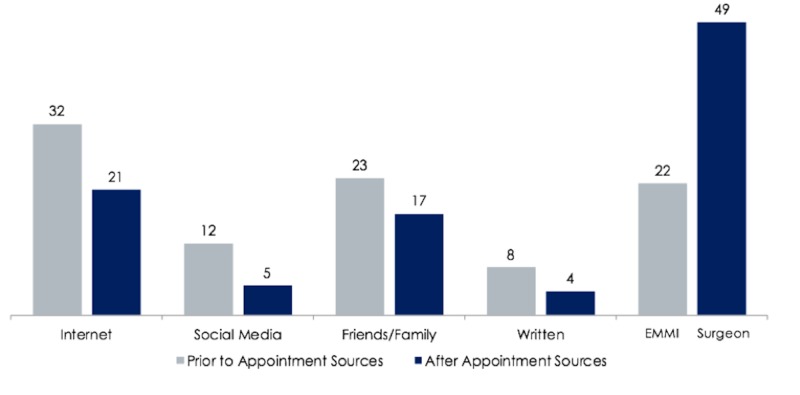
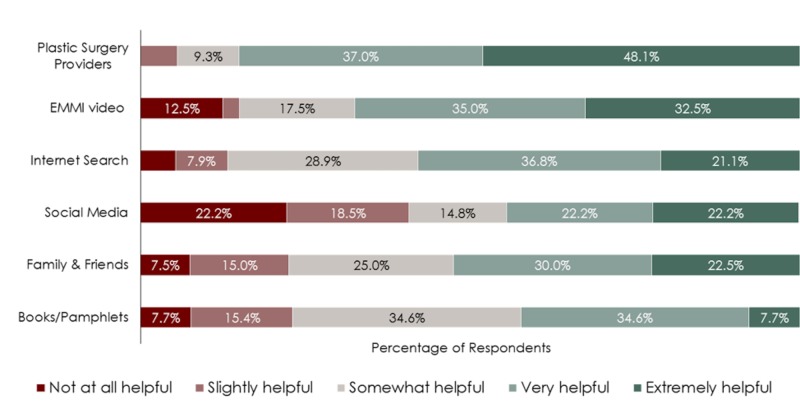
Background Today, patients can access a myriad of information sources regarding plastic surgery procedures prior to meeting with a surgeon. Despite their widespread use, the role of these sources in a patient's decision-making remains undefined. We hypothesized that the physician remains the key information source for patients making surgical decisions in plastic surgery, but that other sources may deliver important insights and prove helpful to varying degrees. We also explored motivations for this outside information search and any differences in perceived value among patients. Methods We administered a survey regarding various information sources to our breast reconstruction, reduction, and abdominoplasty patients. Responses were compared between surgery groups and demographic groups. Ordinal logistic regression analysis was used to determine the impact of patient characteristics on helpfulness rank of different sources. Results Survey results were obtained from 58 patients, of whom 10 (17.2%) had abdominoplasty, 35 (60.3%) breast reconstruction, and 13 (22.4%) breast reduction. The most popular information sources prior to the first surgical appointment were Internet searches (56.9%) and family/friends/other patients (39.7%). After the initial appointment, the most useful sources were plastic surgeons (84.5%), and the Internet (36.2%). Most patients (73.5%) still sought outside information after their appointment. On a Likert-type scale of helpfulness, plastic surgeons ranked 4.28/5, followed by the web-based patient education platform, 3.73 and the Internet, 3.6. A total of 63% of participants listed plastic surgeons as their single most important source of information. In ordinal logistic regression analysis, non-white race was significantly associated with higher rank of surgeon helpfulness (p < 0.05). Relative to low-income patients, income $50-100k (p < 0.05) and $100k+ (p < 0.05) were associated with lower rank of surgeon helpfulness. Conclusions Most patients seek outside information prior to visiting with a surgeon from the Internet, social media, or family and friends. Patients consider plastic surgeons their most valuable information source overall, though still in need of supplementation for varying reasons. Additionally, certain demographic differences affect patient perception of information sources, and this is an important factor for surgeons to consider as they approach educating patients.
Keywords: informed consent; internet; patient education; patient satisfaction; plastic surgery information sources; web-based education.
Conflict of interest statement
The authors have declared that no competing interests exist.
Figures
References
-
- Informed consent: how much and what do patients understand? Falagas ME, Korbila IP, Giannopoulou KP, Kondilis BK, Peppas G. Am J Surg. 2009;198:420–435. - PubMed
-
- Use of the Internet and ratings of information sources for medical decisions: results from the DECISIONS survey. Couper MP, Singer E, Levin CA, Fowler FJ Jr, Fagerlin A, Zikmund-Fisher BJ. Med Decis Making. 2010;30:106–114. - PubMed
-
- Decision-making in breast cancer surgery: where do patients go for information? Schmidt H, Cohen A, Mandeli J, Weltz C, Port ER. http://www.ingentaconnect.com/content/sesc/tas/2016/00000082/00000005/ar.... Am Surg. 2016;82:397–402. - PubMed
LinkOut - more resources
Full Text Sources
Other Literature Sources