


Liquified Petroleum Gas (LPG) Supply and Demand for Cooking in Northern Ghana
- PMID: 30109459
- PMCID: PMC6267523
- DOI: 10.1007/s10393-018-1351-4
Liquified Petroleum Gas (LPG) Supply and Demand for Cooking in Northern Ghana
Abstract
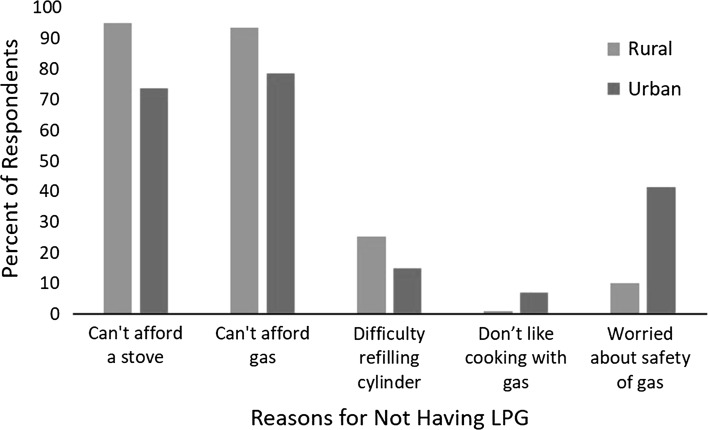
Like many other countries, Ghana relies on biomass (mainly wood and charcoal) for most of its cooking needs. A national action plan aims to expand liquefied petroleum gas (LPG) access to 50% of the country's population by 2020. While the country's southern urban areas have made progress toward this goal, LPG use for cooking remains low in the north. The aim of this cross-sectional study was to characterize the current state of the LPG market in this area and examine opportunities and barriers to scale up LPG adoption. We interviewed 16 LPG suppliers (stove, cylinder, and fuel vendors) as well as 592 households in the Kassena-Nankana Districts (KND) of Ghana. We find large rural-urban differences in LPG uptake: less than 10% of rural households own LPG stoves compared with over half of urban households. Awareness of LPG is high across the region, but accessibility of fuel supply is highly limited, with just one refilling station located in the KND. Affordability is perceived as the main barrier to LPG adoption, and acceptability is also limited by widespread concerns about the safety of cooking with LPG. Transitioning to a cylinder recirculation model, and providing more targeted subsidies and credit options, should be explored to expand access to cleaner cooking in this region.
Keywords: Behavior change; Cookstoves; Fuel supply; Household energy; Liquefied petroleum gas (LPG); Technology adoption.
Figures
References
-
- Adogla-Bessa D (2017). Implement Cylinder Circulation Program - Nana Addo Orders. Ghana News. October 13, 2017. http://citifmonline.com/2017/10/13/implement-cylinder-circulation-progra.... Accessed 01 Nov 2018
-
- Anderson J, Markides C. Strategic innovation at the base of the pyramid. MIT Sloan Management Review. 2007;49(1):83.
-
- Beltramo Theresa, Blalock Garrick, Levine David I., Simons Andrew M. The effect of marketing messages and payment over time on willingness to pay for fuel-efficient cookstoves. Journal of Economic Behavior & Organization. 2015;118:333–345. doi: 10.1016/j.jebo.2015.04.025. - DOI
-
- Cecelski E, Matinga M (2014) Cooking with gas: why women in developing countries want LPG and how they can get it. In: Report developed for the World LP Gas Association by ENERGIA International Network on Gender and Sustainable Energy. https://www.wlpga.org/wp-content/uploads/2015/09/2014-cooking-with-lp-ga.... Accessed 17 July 2018
Publication types
MeSH terms
Substances
LinkOut - more resources
Full Text Sources
Other Literature Sources
