Intermittent hypoxia, brain glyoxalase-1 and glutathione reductase-1, and anxiety-like behavior in mice
- PMID: 30110090
- PMCID: PMC6899376
- DOI: 10.1590/1516-4446-2017-2310
Intermittent hypoxia, brain glyoxalase-1 and glutathione reductase-1, and anxiety-like behavior in mice
Abstract
Objective: Sleep apnea has been associated with anxiety, but the mechanisms of the sleep apnea-anxiety relationship are unresolved. Sleep apnea causes oxidative stress, which might enhance anxiety-like behavior in rodents. To clarify the apnea-anxiety connection, we tested the effect of intermittent hypoxia, a model of sleep apnea, on the anxiety behavior of mice.
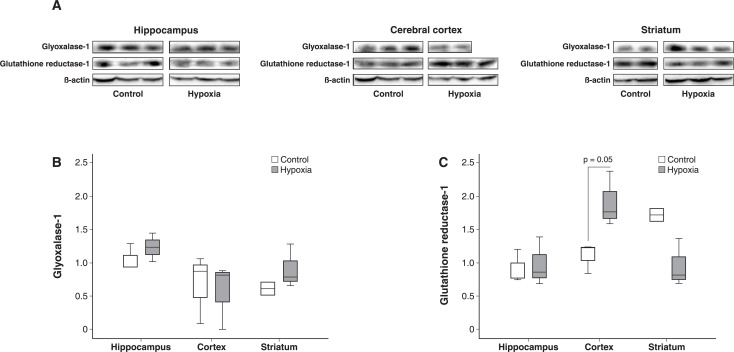
Methods: The rodents were exposed daily to 480 one-minute cycles of intermittent hypoxia to a nadir of 7±1% inspiratory oxygen fraction or to a sham procedure with room air. After 7 days, the mice from both groups were placed in an elevated plus maze and were video recorded for 10 min to allow analysis of latency, frequency, and duration in open and closed arms. Glyoxalase-1 (Glo1) and glutathione reductase-1 (GR1) were measured in the cerebral cortex, hippocampus, and striatum by Western blotting.
Results: Compared to controls, the intermittent hypoxia group displayed less anxiety-like behavior, perceived by a statistically significant increase in the number of entries and total time spent in open arms. A higher expression of GR1 in the cortex was also observed.
Conclusion: The lack of a clear anxiety response as an outcome of intermittent hypoxia exposure suggests the existence of additional layers in the anxiety mechanism in sleep apnea, possibly represented by sleepiness and irreversible neuronal damage.
Conflict of interest statement
DM is co-owner of a sleep medicine clinic. GNP is currently an employee of Springer Nature, although this position has no relation with the present article or any of this author’s academic activities. The other authors report no conflicts of interest.
Figures
References
-
- Rajaratnam SM, Barger LK, Lockley SW, Shea SA, Wang W, Landrigan CP, et al. Sleep disorders, health, and safety in police officers. JAMA. 2011;306:2567–78. - PubMed
-
- Canessa N, Castronovo V, Cappa SF, Aloia MS, Marelli S, Falini A, et al. Obstructive sleep apnea: brain structural changes and neurocognitive function before and after treatment. Am J Respir Crit Care Med. 2011;183:1419–26. - PubMed
-
- Bardwell WA, Berry CC, Ancoli-Israel S, Dimsdale JE. Psychological correlates of sleep apnea. J Psychosom Res. 1999;47:583–96. - PubMed
-
- Bardwell WA, Norman D, Ancoli-Israel S, Loredo JS, Lowery A, Lim W, et al. Effects of 2-week nocturnal oxygen supplementation and continuous positive airway pressure treatment on psychological symptoms in patients with obstructive sleep apnea: a randomized placebo-controlled study. Behav Sleep Med. 2007;5:21–38. - PubMed
-
- American Academy of Sleep Medicine . International classification of sleep disorders, 3rd ed. Darien: American Academy of Sleep Medicine; 2014.
MeSH terms
Substances
LinkOut - more resources
Full Text Sources
Other Literature Sources
Medical
Research Materials
Miscellaneous