


doi: 10.1371/journal.pone.0200759.
eCollection 2018.
Optimization of fluorophores for chemical tagging and immunohistochemistry of Drosophila neurons
Affiliations
- PMID: 30110347
- PMCID: PMC6093644
- DOI: 10.1371/journal.pone.0200759
Item in Clipboard
Optimization of fluorophores for chemical tagging and immunohistochemistry of Drosophila neurons
PLoS One.
.
Abstract
The use of genetically encoded 'self-labeling tags' with chemical fluorophore ligands enables rapid labeling of specific cells in neural tissue. To improve the chemical tagging of neurons, we synthesized and evaluated new fluorophore ligands based on Cy, Janelia Fluor, Alexa Fluor, and ATTO dyes and tested these with recently improved Drosophila melanogaster transgenes. We found that tissue clearing and mounting in DPX substantially improves signal quality when combined with specific non-cyanine fluorophores. We compared and combined this labeling technique with standard immunohistochemistry in the Drosophila brain.
Conflict of interest statement
The authors have declared that no competing interests exist.
Figures
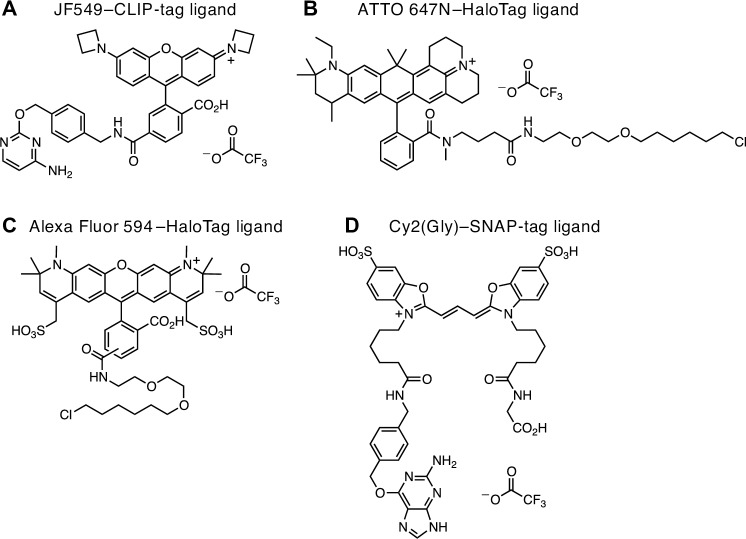
(A) JF549–CLIP-tag ligand. (B) ATTO 647N–HaloTag ligand. (C) Alexa Fluor 594–HaloTag ligand. (D) Cy2(Gly)–SNAP-tag ligand.
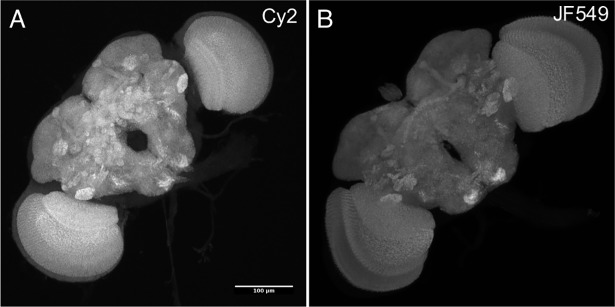
brp-SNAP flies had brains removed, fixed, and incubated for 15 minutes with (A) Cy2 SNAP-tag ligand, or (B) JF549 SNAP-tag ligand. Cy2 samples had additional 4 hour 4% post-fixation, improving their morphology during dehydration and DPX mounting.
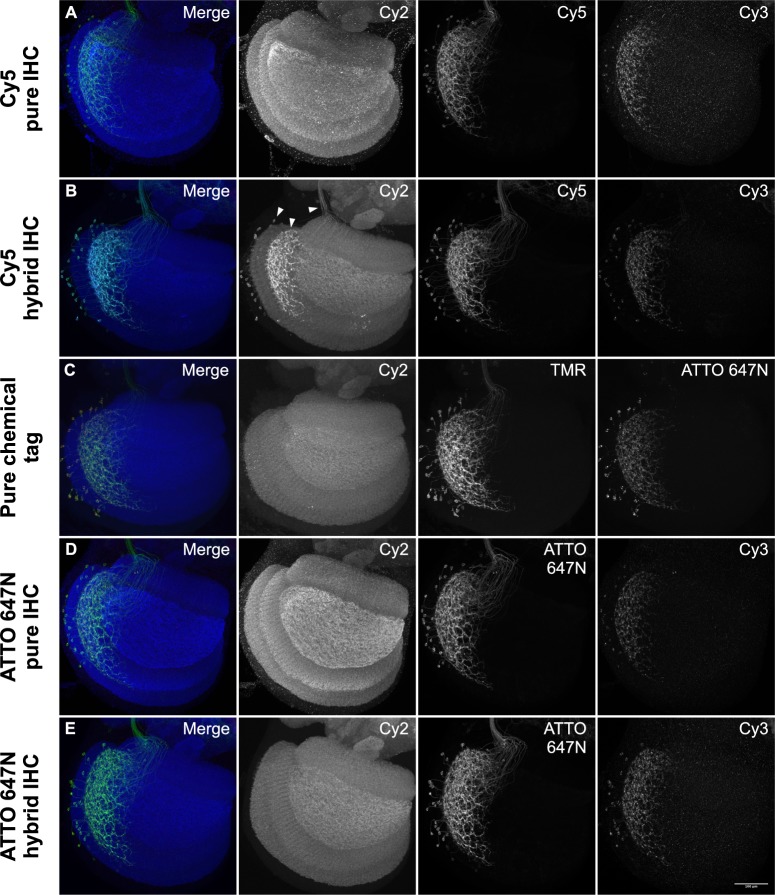
All samples show the Drosophila left optic lobe imaged at 63X. Each image is independently scaled for optimal intensity. (A). Polarity pure IHC: Split GAL4 SS02565 was crossed to w;; 5XUAS-IVS-myr::smFLAG in VK00005, pJFRC51-3XUAS-IVS-Syt::smHA in su(Hw)attP1 and was labeled over a period of 13 days with nc82 mouse anti-Brp/Cy2 anti-mouse, rabbit anti-HA/Cy3 anti-rabbit, and rat anti-FLAG/Cy5 anti-rat. (B). Polarity hybrid IHC: SS02565 was crossed to w; brp-SNAP; 5XUAS-IVS-myr::smFLAG in VK00005, pJFRC51-3XUAS-IVS-Syt::smHA in su(Hw)attP1 and labeled with Cy2 SNAP-tag ligand for 15 minutes, followed by rabbit anti-HA/Cy3 anti-rabbit, and rat anti-FLAG/Cy5 anti-rat over 6 days. Arrowheads indicate bleed-through of Cy5 into Cy2 channel. (C). Polarity pure chemical tag: SS02565 was crossed to w; brp-SNAP; UAS-myr::4xCLIPf in VK00005, UAS-Syt::Halo7 in VK0027 and labeled for 15 minutes with Cy2 SNAP-tag ligand, TMR CLIP-tag ligand, and ATTO 647N HaloTag ligand. (D). Polarity ATTO 647N pure IHC: As in (A) but with ATTO 647N instead of Cy5. (E). Polarity ATTO 647N hybrid IHC: As in (B) but with ATTO 647N instead of Cy5.
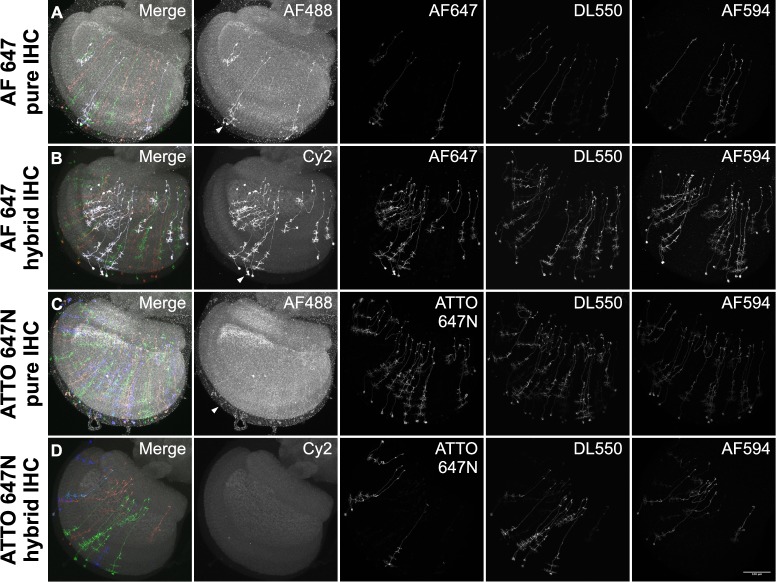
All samples show the Drosophila left optic lobe imaged at 63X. Each image is independently scaled for optimal intensity. Arrowheads indicate bleed-through into Cy2/AF488 channel. (A). MCFO pure IHC: Split GAL4 SS00313 was crossed to 57C10-Flp2 in attp18;; pJFRC201-10XUAS>STOP>myr::smGFP-HA in VK00005, pJFRC240-10XUAS>STOP>myr::smGFP-V5-THS-10XUAS>STOP>myr::smGFP-FLAG in su(Hw)attP1, and was labeled with nc82 mouse anti-Brp/Alexa Fluor 488 anti-mouse, rat anti-FLAG/Alexa Fluor 647 anti-rat, rabbit anti-HA/Alexa Fluor 594 anti-rabbit, and DyLight 550 mouse anti-V5 over a period of 7 days. (B). MCFO hybrid IHC: SS00313 was crossed to 57C10-Flp2 in attp18; brp-SNAP; pJFRC201-10XUAS>STOP>myr::smGFP-HA in VK00005, pJFRC240-10XUAS>STOP>myr::smGFP-V5-THS-10XUAS>STOP>myr::smGFP-FLAG in su(Hw)attP1 and labeled for 15 minutes with Cy2 SNAP-tag ligand, followed by rat anti-FLAG/Alexa Fluor 647 anti-rat, rabbit anti-HA/Alexa Fluor 594 anti-rabbit, and DyLight 550 mouse anti-V5 over a period of 6 days. (C). MCFO ATTO 647N pure IHC: As in (A) but with ATTO 647N instead of Alexa Fluor 647. (D). MCFO ATTO 647N hybrid IHC: As in (B) but with ATTO 647N instead of Alexa Fluor 647.
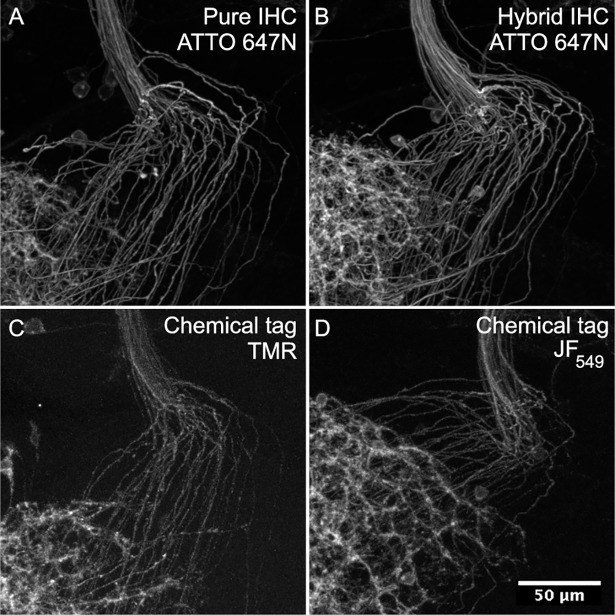
All samples show the same region of projections crossing from the left optic lobe to the central brain. Only the neuronal membrane channel is shown, and is labeled via antibodies in (A-B) and CLIP-tag in (C-D). (A) SS02565 was crossed to w;; 5XUAS-IVS-myr::smFLAG in VK00005, pJFRC51-3XUAS-IVS-Syt::smHA in su(Hw)attP1 and brains were labeled with pure IHC, including rat anti-FLAG and ATTO 647N goat anti-rat antibodies over a period of 13 days. (B) SS02565 was crossed to w; brp-SNAP; 5XUAS-IVS-myr::smFLAG in VK00005, pJFRC51-3XUAS-IVS-Syt::smHA in su(Hw)attP1 and brains were labeled with hybrid IHC, including rat anti-FLAG and ATTO 647N goat anti-rat antibodies over a period of 6 days. (C) SS02565 was crossed to w; brp-SNAP; UAS-myr::4xCLIPf in VK00005, UAS-Syt::Halo7 in VK0027 and brains were labeled for 15 minutes with pure chemical tags, including TMR CLIP-tag ligand. (D) SS02565 was crossed to w; brp-SNAP; UAS-myr::4xCLIPf in VK00005, UAS-Syt::Halo7 in VK0027 and brains were labeled for 15 minutes with pure chemical tags, including JF549 CLIP-tag ligand.
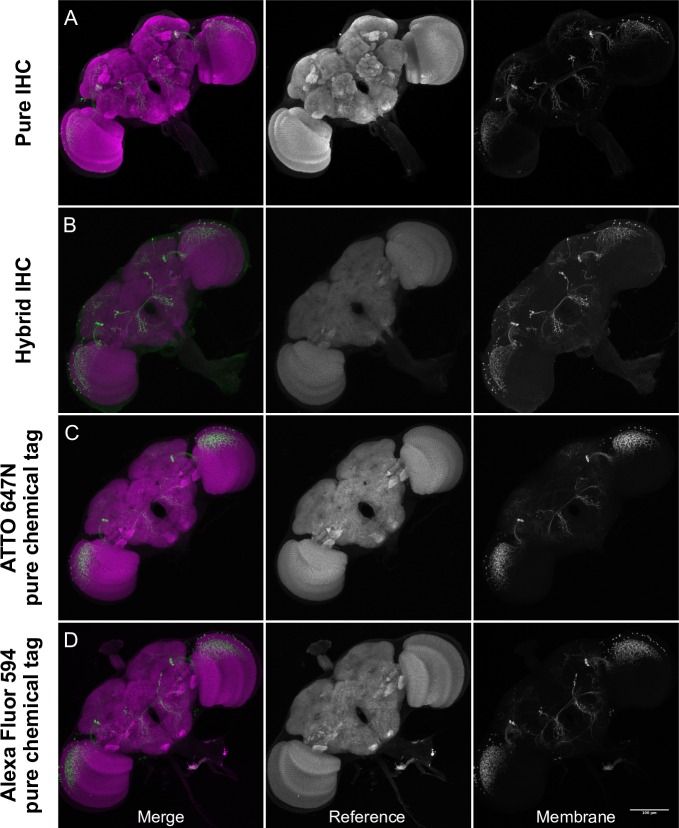
(A) SS02565 was crossed to 20XUAS-Cs-Chrimson-mVenus trafficked in attP18 and brains were labeled with pure IHC over a period of 7 days.(B) SS02565 was crossed to 20XUAS-Cs-Chrimson-mVenus trafficked in attP18; brp-SNAP and brains were labeled with hybrid IHC over a period of 7 days.(C) SS02565 was crossed to brp-SNAP; UAS-7xHalo7::CAAX in VK0005 and brains were labeled for 15 minutes with pure chemical tags, including ATTO 647N HaloTag ligand. (D) SS02565 was crossed to brp-SNAP; UAS-myr-Halo2 in attP2 and brains were labeled for 15 minutes with pure chemical tags, including Alexa Fluor 594 HaloTag ligand.
References
-
- Coons AH, Creech HJ, Jones RN, 1941. Immunological Properties of an Antibody Containing a Fluorescent Group. Proc Soc Exp Biol Med. 1941; 47: 200–202.
-
- Erichsen JT, Reiner A, Karten HJ. Co-occurrence of substance P-like and Leu-enkephalin-like immunoreactivities in neurones and fibres of avian nervous system. Nature. 1982; 295: 407–10. - PubMed
-
- Mayersbach HV. Principles and limitations of immunohistochemical methods. J R Microsc Soc. 1967; 87: 295–308. - PubMed
Publication types
MeSH terms
Substances
Grants and funding
LinkOut - more resources
Full Text Sources
Other Literature Sources
Molecular Biology Databases
