. 2018 Aug 15;13(8):e0201092.
doi: 10.1371/journal.pone.0201092. eCollection 2018.

Antidepressive and anxiolytic effects of ostruthin, a TREK-1 channel activator

Affiliations

Antidepressive and anxiolytic effects of ostruthin, a TREK-1 channel activator

Ancy Joseph et al. PLoS One. .

Abstract

We screened a library of botanical compounds purified from plants of Vietnam for modulators of the activity of a two-pore domain K+ channel, TREK-1, and we identified a hydroxycoumarin-related compound, ostruthin, as an activator of this channel. Ostruthin increased whole-cell TREK-1 channel currents in 293T cells at a low concentration (EC50 = 5.3 μM), and also activity of the TREK-2 channel (EC50 = 3.7 mM). In contrast, ostruthin inhibited other K+ channels, e.g. human ether-à-go-go-related gene (HERG1), inward-rectifier (Kir2.1), voltage-gated (Kv1.4), and two-pore domain (TASK-1) at higher concentrations, without affecting voltage-gated potassium channel (KCNQ1 and 3). We tested the effect of this compound on mouse anxiety- and depression-like behaviors and found anxiolytic activity in the open-field, elevated plus maze, and light/dark box tests. Of note, ostruthin also showed antidepressive effects in the forced swim and tail suspension tests, although previous studies reported that inhibition of TREK-1 channels resulted in an antidepressive effect. The anxiolytic and antidepressive effect was diminished by co-administration of a TREK-1 blocker, amlodipine, indicating the involvement of TREK-1 channels. Administration of ostruthin suppressed the stress-induced increase in anti-c-Fos immunoreactivity in the lateral septum, without affecting immunoreactivity in other mood disorder-related nuclei, e.g. the amygdala, paraventricular nuclei, and dorsal raphe nucleus. Ostruthin may exert its anxiolytic and antidepressive effects through a different mechanism from current drugs.


Conflict of interest statement

The authors have declared that no competing interests exist.

Figures
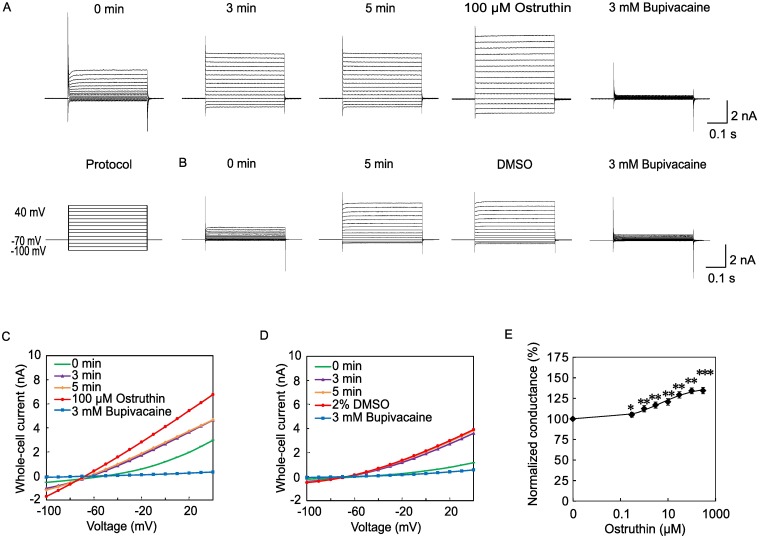
Fig 1
Fig 1. Activation of TREK-1 currents by ostruthin.
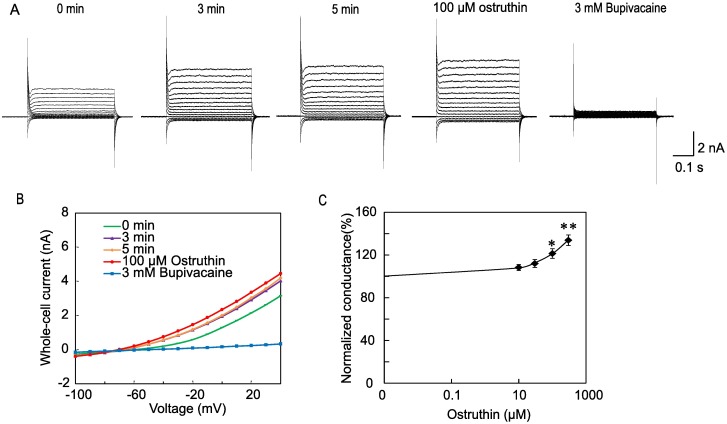
(A) Run-up and ostruthin-induced increases in whole-cell TREK-1 currents. Step-pulses, which are indicated in the protocol, evoked outward rectified currents immediately after whole-cell access was made (0 min). Because of the run-up, the whole-cell TREK currents increased gradually and reached a plateau at 3 min, without further increase by 5 min. Application of 100 μM ostruthin increased TREK currents (100 μM ostruthin). Application of 3 mM bupivacaine blocked the currents nearly completely. (B) DMSO had no effect, serving as a negative control. (C and D) The current-voltage relationship of the whole-cell TREK-1 currents recorded from ostruthin- and DMSO-treated cells. The whole cell currents were increased from 0 to 3 min and stayed the same at 5 min. The current was increased by the addition of ostruthin and that was completely inhibited by bupivacaine. Contrastingly, DMSO had no effect on the current. (E) The concentration-response curve of ostruthin. The EC50 was found to be 5.3 μM. (n = 5).
Fig 2
Fig 2. Activation of TREK-2 currents by ostruthin.
(A and B) Run-up and activation of TREK-2 channel currents. Whole cell TREK-2 channel currents expressed in 293T cells showed a run-up, which ceased within 3 min. Ostruthin, which was applied 5 min after the whole-cell access, activated TREK-2 channel currents at 100 μM. The activated current was inhibited by bupivacaine nearly completely. (C) The concentration-response curve of ostruthin on the TREK-2 currents. The EC50 was found to be 3.7 mM. (n = 5).
Fig 3
Fig 3. Inhibitory effect on other K+ channels.
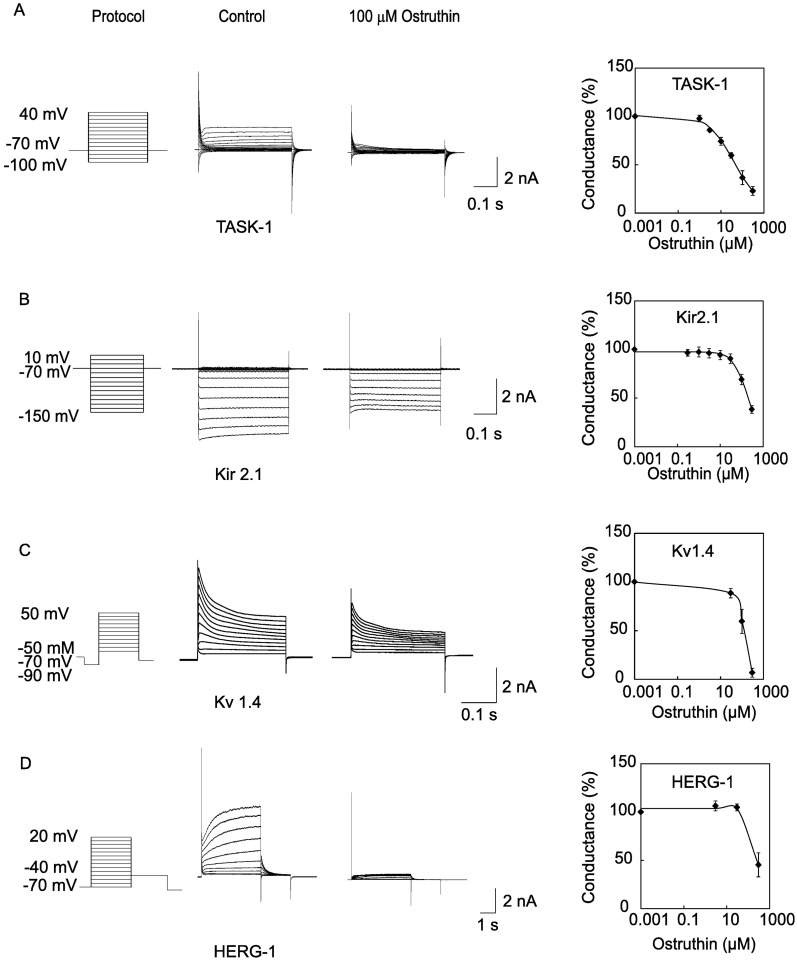
(A) Inhibition of TASK-1 currents. Whole cell TASK-1 currents, expressed in a 293T cell line, were evoked by step-pulses, as indicated in the protocol. The application of 100 μM ostruthin inhibited TASK-1 currents in a concentration-dependent manner (n = 10). (B) Inhibition of Kir2.1 currents. Kir2.1 currents were evoked the step pulses, and application of 100 μM ostruthin decreased the currents by approximately 60% (n = 5). (C) Inhibition of Kv1.4 currents. Kv1.4 channel currents expressed in a 293T cells were evoked by depolarizing step pulses with a preceding hyperpolarizing pulse. Ostruthin inhibited the currents (n = 5). (D) Inhibition of HERG-1 currents. HERG-1 currents were measured as the outward tail current after the depolarizing step pulses, as shown in the protocol (n = 5).
Fig 4
Fig 4. Anxiolytic effect of ostruthin.
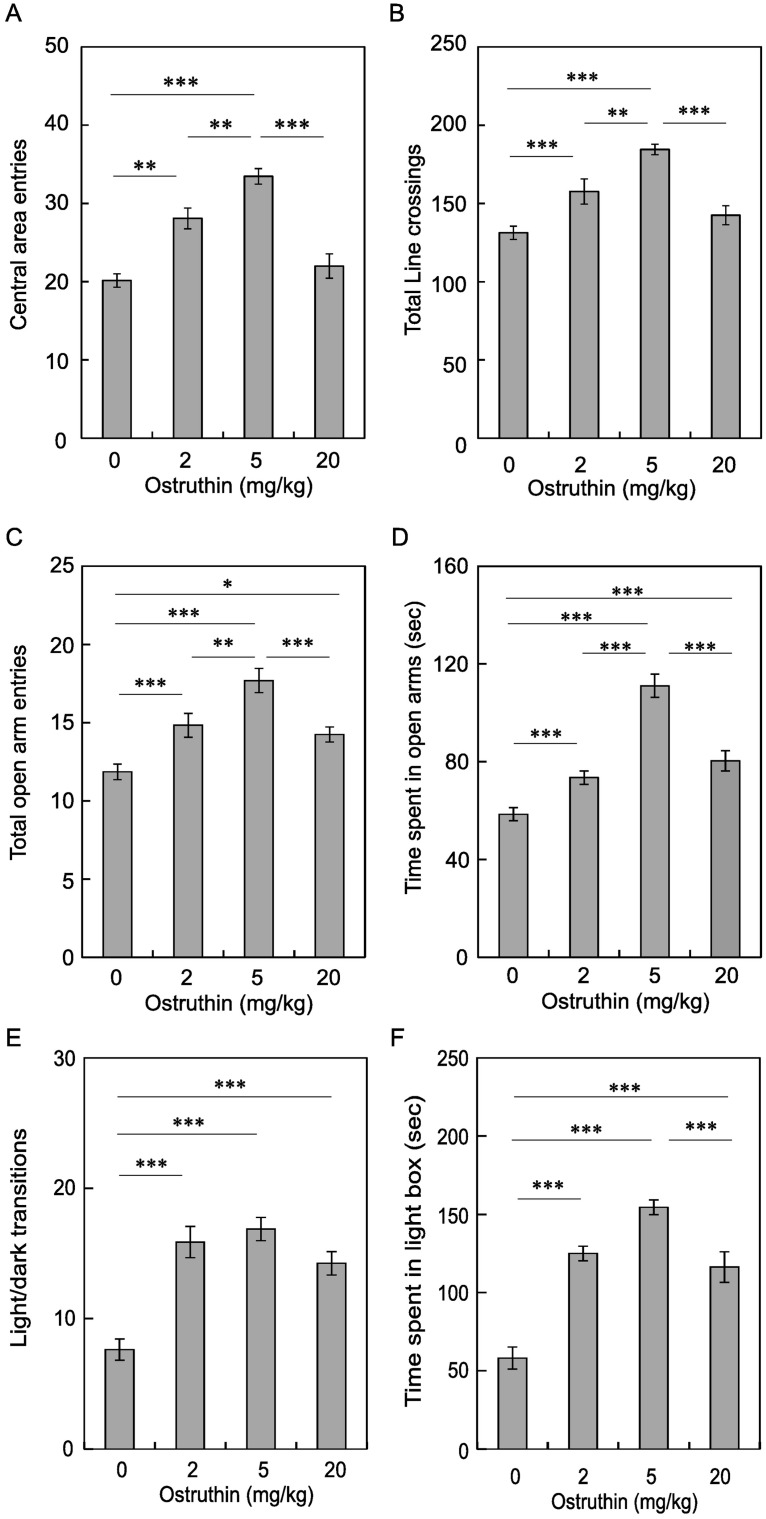
(A and B) Effect of ostruthin on the anxiety-like behavior of mice was examined using the open field test. Total numbers of entries into the central area (A) and line crossings (B) made in 5 minutes were recorded. (C and D) Anxiolytic effect in the elevated plus maze. The number of entries into the open arms (C) and time spent in the open arms (D) in 5 minutes were measured. (E and F) Anxiolytic effect in the light/dark box test. The number of transitions between the light and dark boxes (E) and time spent in the light box (F) in 5 minutes were measured. All the experiments were done 30 min after the administration of PBS (0) or the indicated dose of ostruthin.
Fig 5
Fig 5. Antidepressive effect of ostruthin.
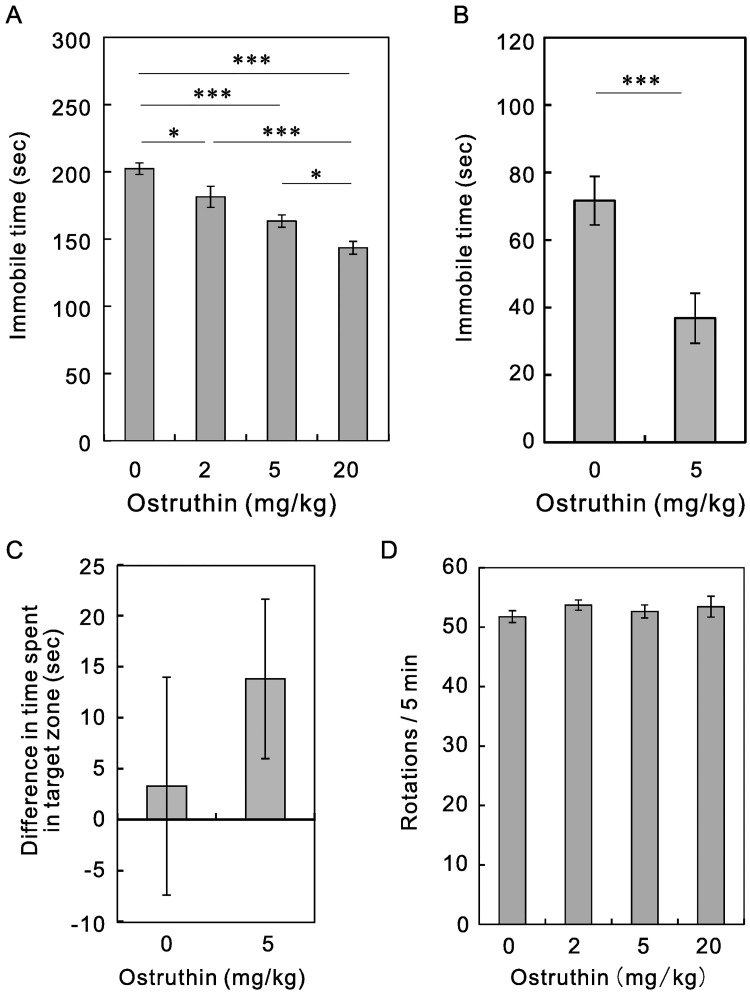
(A) Effect of ostruthin on the depression-like behavior of mice was examined using the forced-swim test. The amount of time spent immobile in the last 4 min of the swimming period (6 min) was recorded. Administration of ostruthin 30 min before test significantly reduced the time spent immobile in a dose-dependent manner. (B) Antidepressive effect of ostruthin in the tail-suspension test. The amount of time spent immobile was recorded for 5 min. (C) Insignificant effect on social defeat stress test. After the exposure to aggressor ICR mice for 9 days, C57BL/6J test mouse was placed in an open-field arena. Firstly the time spent around the empty enclosure and subsequently that with an unfamiliar ICR mouse was measured. The former duration was subtracted from the later. (D) Lack of effect on voluntary motility. After the end of the elevated plus maze, mice were subjected to voluntary wheel running test for 5 min. All experiments were carried out 30 min after the administration of PBS (0) or the indicated dose of ostruthin.
Fig 6
Fig 6. Effect of co-administration of amlodipine on the anxiolytic and antidepressive effects of ostruthin.
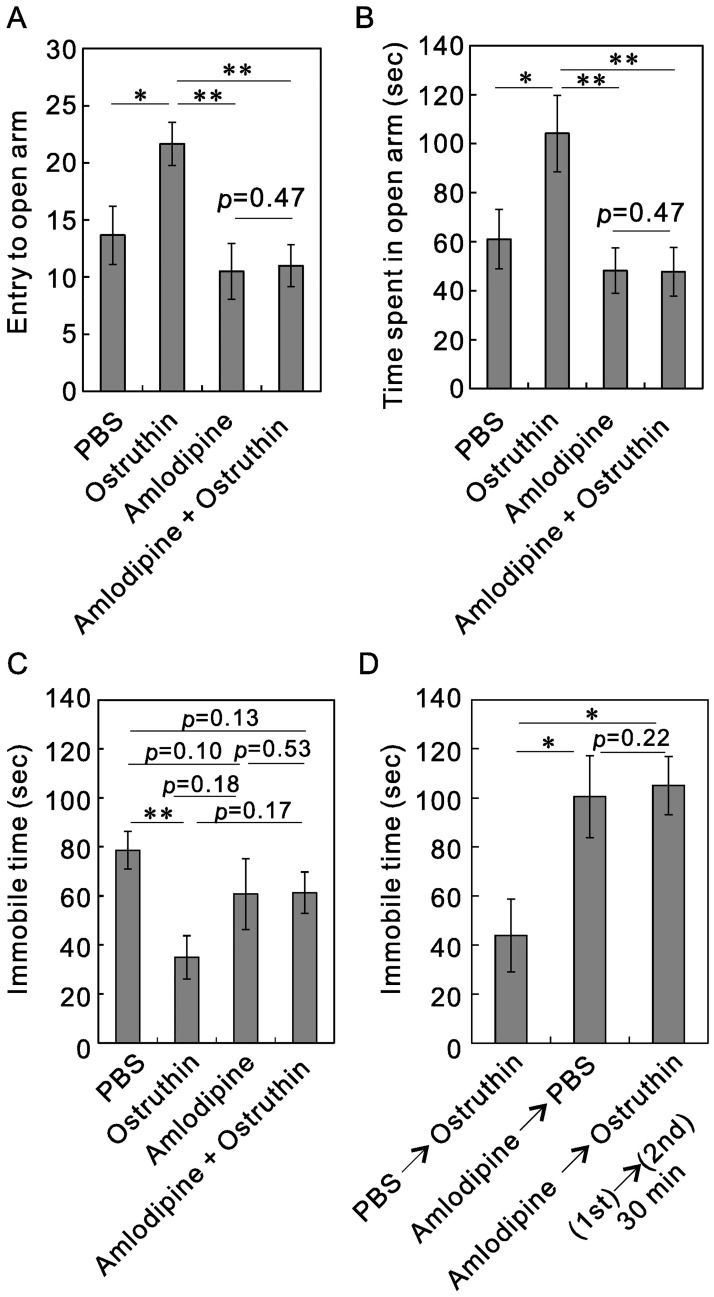
(A and B) Blockade of the anxiolytic effect of ostruthin by co-administration of amlodipine in the elevated plus maze. Mice were administrated the compounds 30 min before the test. Although administration of ostruthin increased the number of entries into the open arm (A) and the time spent on the open arm (B), co-administration with amlodipine blocked the increase. (C) Blockade of the antidepressive effect of ostruthin by co-administration of amlodipine in the tail suspension test. Although administration of ostruthin decreased the immobile time, it did not do so in the presence of amlodipine. (D) Pre-administration of amlodipine effectively blocked the antidepressive effect of ostruthin compared with pre-administration of PBS.
Fig 7
Fig 7. Stress-induced increase in anti-c-Fos immunoreactivity and suppression by ostruthin in the LS.
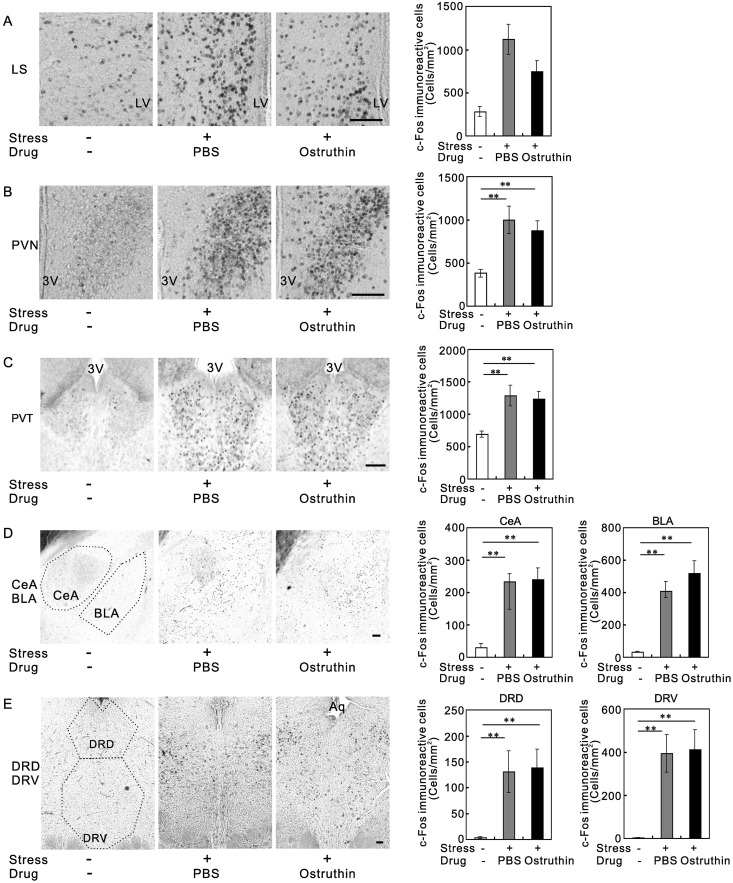
(A) Anti-c-Fos immunoreactivity in the LS of non-treated and stressed mice. Anti-c-Fos-immunoreactivity was increased by stress-treatment, and the increase was suppressed by ostruthin. (B-E) The numbers of anti-c-Fos-immunoreactive cells were also increased by stress-treatment in the hypothalamic paraventricular nucleus (B), thalamic paraventricular nucleus (C), central and basolateral amygdala (D), and dorsal and ventral dorsal raphe nuclei (E). Ostruthin did not suppress the increase in these nuclei. LV indicates the position of the lateral ventricle; 3V, third ventricle; Aq, central aqueduct; CeA, central amygdala; BLA, basolateral amygdala; DRD, dorsal raphe nuclei; DRV, ventral raphe nuclei. (ANOVA followed by Bonferroni test; *, p<0.05; **, p < 0.01; ***, p<0.005; n = 4; Bar, 100 μm).

References

    1. Owen R, Tyrer P. Benzodiazepine dependence. Drugs. 1983;25(4):385–98. - PubMed
    1. McIntyre RS, Filteau M-J, Martin L, Patry S, Carvalho A, Cha DS, et al. Treatment-resistant depression: definitions, review of the evidence, and algorithmic approach. Journal of affective disorders. 2014;156:1–7. 10.1016/j.jad.2013.10.043 - DOI - PubMed
    1. Enyedi P, Czirják G. Molecular background of leak K+ currents: two-pore domain potassium channels. Physiological reviews. 2010;90(2):559–605. 10.1152/physrev.00029.2009 - DOI - PubMed
    1. Fink M, Duprat F, Lesage F, Reyes R, Romey G, Heurteaux C, et al. Cloning, functional expression and brain localization of a novel unconventional outward rectifier K+ channel. The EMBO Journal. 1996;15(24):6854–62. - PMC - PubMed
    1. Talley EM, Solórzano G, Lei Q, Kim D, Bayliss DA. CNS distribution of members of the two-pore-domain (KCNK) potassium channel family. Journal of Neuroscience. 2001;21(19):7491–505. - PMC - PubMed

Publication types

MeSH terms