


Multiple birth rates of Korea and fetal/neonatal/infant mortality in multiple gestation
- PMID: 30110380
- PMCID: PMC6093695
- DOI: 10.1371/journal.pone.0202318
Multiple birth rates of Korea and fetal/neonatal/infant mortality in multiple gestation
Abstract
Objective: This study was conducted to analyze recent trends of multiple birth rates (MBR) and fetal/neonatal/infant mortalities according to the number of gestations in Korea.
Methods: Data from 2009 to 2015 of live births, infant deaths and stillbirths were obtained from the Korean Vital Statistics. Neonatal mortality rate (NMR), infant mortality rate (IMR), and fetal mortality rate (FMR) in singleton, twin and triplet pregnancies were analyzed according to gestational period (GP; ≤ 23, 24-27, 28-31, and 32-36 weeks).
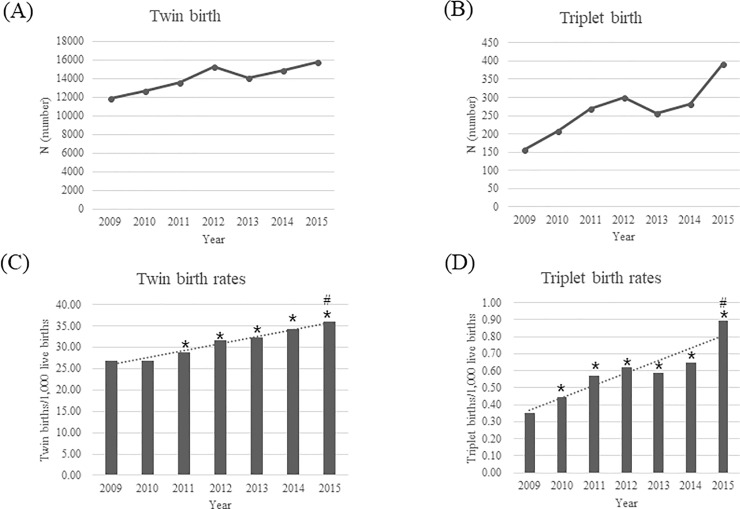
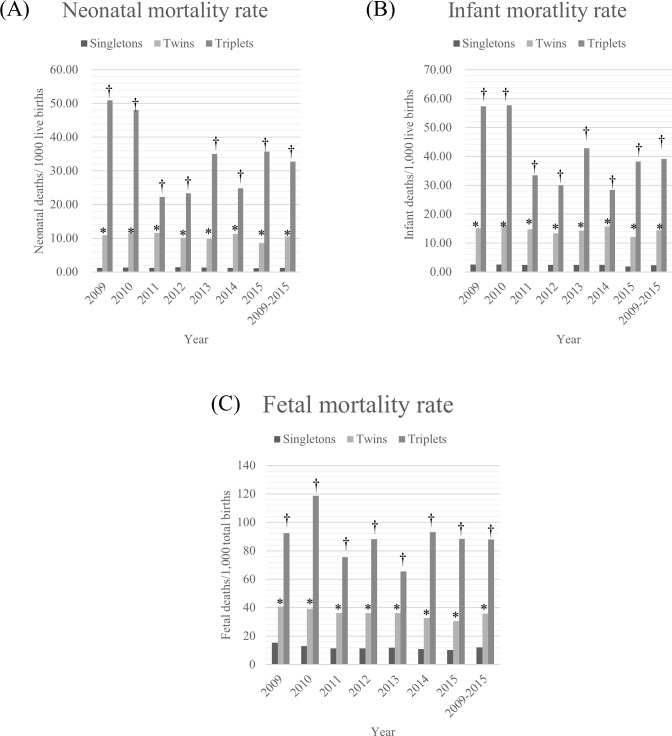
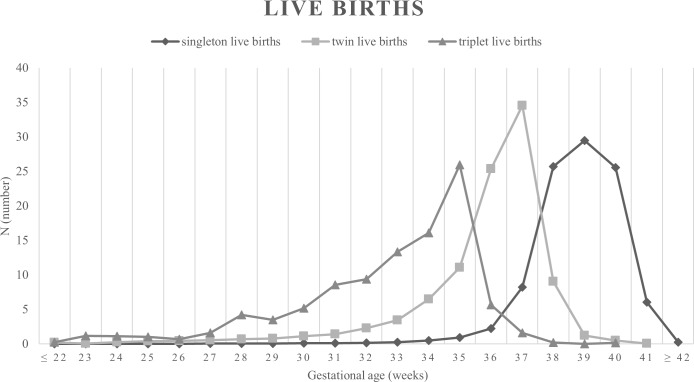
Results: From 2009 to 2015, twin and triplet birth rates increased 34.5% and 154.3%, respectively. In twin births, NMR and FMR have been decreased significantly (from 10.92 to 8.62, p = 0.034 and from 41.00 to 30.55, p< 0.001, respectively), but IMR did not show significant decrease. There was no significant change of NMR, IMR, and FMR, in triplet births. Overall, in singleton, twin, and triplet births, NMR was 1.26 ± 0.09, 10.6 ± 1.12, and 34.32 ± 11.72, respectively, and IMR was 2.38 ± 0.26, 14.52 ± 1.38, and 41.13 ± 12.2, respectively. FMRs were 12 ± 1.73, 35.99 ± 3.55, and 88.85 ± 16.55, respectively, in singleton, twin, and triplet pregnancies. In spite of decreasing trends in overall mortalities, the odds ratios of NMRs and IMRs in 2015 were approximately 9-fold and 6-fold higher, respectively, in twin births, and approximately 37-fold and 20-fold higher, respectively, in triplet births, than those in singleton births. There were no significant differences in odds ratios of NMRs and IMRs at GP 32-36 among single, twin, and triplet births, although the odds ratios of FMR at GP 32-36 in triplet gestation was significantly higher than those in singleton and twin gestation.
Conclusion: Neonatal/infant mortality in multiple births is still significantly high, which is mainly related with preterm birth. Close fetal monitoring is needed to prevent fetal death in triplet pregnancies, after 32 gestational weeks.
Conflict of interest statement
The authors have declared that no competing interests exist.
Figures
References
-
- Blondel B. Increase in twin maternities and consequences on health. J Gynecol Obstet Biol Reprod (Paris) 2009;38:S7–17. - PubMed
-
- Wang YA, Chambers GM, Sullivan EA. Assisted reproductive technology in Australia and New Zealand 2008 Assisted reproduction technology series no. 14. Cat. no. PER 49. Canberra: AIHW, 2010.
Publication types
MeSH terms
LinkOut - more resources
Full Text Sources
Other Literature Sources
