Review
. 2018 Dec 1;315(6):F1519-F1525.
doi: 10.1152/ajprenal.00211.2018. Epub 2018 Aug 15.

GLP-1 receptor agonists in diabetic kidney disease: from the patient-side to the bench-side

Affiliations
Review

GLP-1 receptor agonists in diabetic kidney disease: from the patient-side to the bench-side

Brad P Dieter et al. Am J Physiol Renal Physiol. .

Abstract

Diabetic kidney disease (DKD), one of the most common and severe microvascular complications of diabetes, is the leading cause of chronic kidney disease and end-stage kidney disease worldwide. Since the development of renin-angiotensin system inhibition nearly three decades ago, no new therapeutic agents have received regulatory approval for treatment of DKD. Glucagon-like peptide-1 (GLP-1) receptor agonists, a class of newer antihyperglycemic agents, have shown promise for prevention of DKD onset and progression. This perspective summarizes clinical and experimental observations to give insight into biological mechanisms beyond glycemic control, such as natriuresis and anti-inflammatory actions, for preservation of kidney function in patients with diabetes.

Keywords: albuminuria; anti-inflammatory therapy; diabetes; end-stage renal disease.


Figures
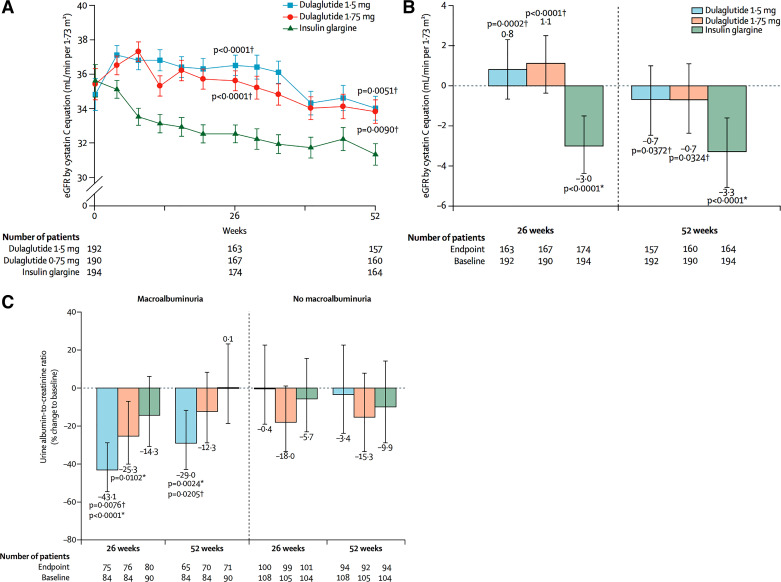
Fig. 1.
Fig. 1.
Values estimated by chronic kidney disease epidemiology collaboration equation by cystatin C or creatinine. A: data presented as estimated glomerular filtration rate (eGFR) values by geometric least squares mean from log-transformed analysis. B: data presented as actual untransformed change from baseline in eGFR values [least squares mean, 95% confidence interval (CI)]. C: actual untransformed data macroalbuminuria status at baseline, with values presented as LSM (95% CI). *Versus baseline. †Versus insulin glargine. [Modified from Tuttle et al. (36) with permission from Elsevier.]
Fig. 2.
Fig. 2.
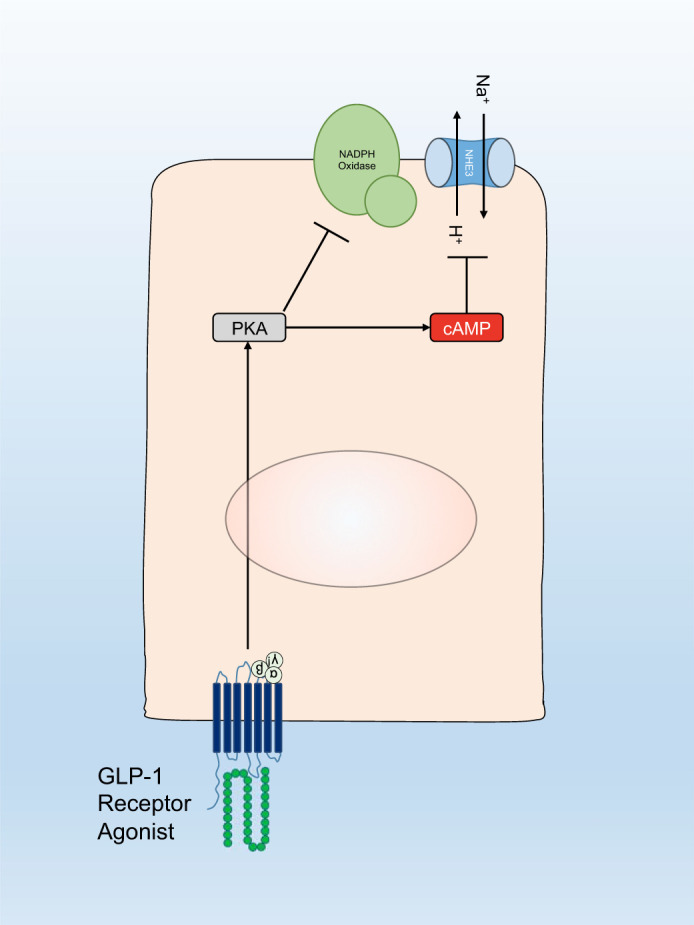
Conceptual model of hypothesized mechanisms for activation of natriuretic and antioxidant mechanisms by glucagon-like peptide 1 (GLP-1) receptor agonists. GLP-1 receptor agonists inhibit Na+/H+ exchanger 3 (NHE3) via a protein kinase A (PKA) and cyclic adenosine monophosphate (cAMP) dependent pathway to induce natriuresis. Antioxidant effects of GLP-1 receptor agonists occur through activation of protein kinase A and inhibition of nicotinamide adenine dinucleotide phosphate (NADPH) oxidase.

References

    1. Afkarian M, Sachs MC, Kestenbaum B, Hirsch IB, Tuttle KR, Himmelfarb J, de Boer IH. Kidney disease and increased mortality risk in type 2 diabetes. J Am Soc Nephrol 24: 302–308, 2013. doi: 10.1681/ASN.2012070718. - DOI - PMC - PubMed
    1. Bode B. An overview of the pharmacokinetics, efficacy and safety of liraglutide. Diabetes Res Clin Pract 97: 27–42, 2012. doi: 10.1016/j.diabres.2011.12.015. - DOI - PubMed
    1. Bunck MC, Diamant M, Eliasson B, Cornér A, Shaginian RM, Heine RJ, Taskinen MR, Yki-Järvinen H, Smith U. Exenatide affects circulating cardiovascular risk biomarkers independently of changes in body composition. Diabetes Care 33: 1734–1737, 2010. doi: 10.2337/dc09-2361. - DOI - PMC - PubMed
    1. Carraro-Lacroix LR, Malnic G, Girardi AC. Regulation of Na+/H+ exchanger NHE3 by glucagon-like peptide 1 receptor agonist exendin-4 in renal proximal tubule cells. Am J Physiol Renal Physiol 297: F1647–F1655, 2009. doi: 10.1152/ajprenal.00082.2009. - DOI - PubMed
    1. Collins AJ, Foley RN, Gilbertson DT, Chen SC. United States Renal Data System public health surveillance of chronic kidney disease and end-stage renal disease. Kidney Int Suppl (2011) 5: 2–7, 2015. doi: 10.1038/kisup.2015.2. - DOI - PMC - PubMed

Publication types

MeSH terms

LinkOut - more resources