


Age and African-American race impact the validity and reliability of the asthma control test in persistent asthmatics
- PMID: 30111326
- PMCID: PMC6094875
- DOI: 10.1186/s12931-018-0858-0
Age and African-American race impact the validity and reliability of the asthma control test in persistent asthmatics
Abstract
Background: The Asthma Control Test (ACT) is widely used to assess asthma control, yet the validity and reliability of the test have not been specifically evaluated in adolescents or African-Americans. We conducted a prospective psychometric study of the ACT in African-American (AA) and non-African-American (nAA) adolescents with persistent asthma, with emphasis on the clinical utility of the test for medical decision making.
Methods: Participants completed the ACT and performed spirometry. A physician conducted a guidelines-based assessment of asthma control, blinded to the ACT score. Study procedures were repeated 6-8 weeks later. The ACT-based asthma control assessment was compared to physician assessment.
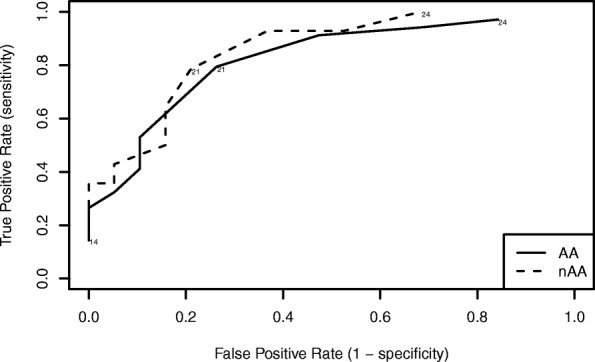
Results: For baseline and follow-up visits, internal consistency, as measured using Cronbach's alpha, was 0.80 and 0.81 in AA teens and 0.80 and 0.83 in nAA teens. Intraclass correlation coefficients were 0.59 and 0.76 in AA and nAA teens, respectively, with stable asthma control over time. Agreement between ACT and physician assessment was moderate in AA teens and fair in nAA teens. An ACT score of ≤19 showed reduced sensitivity for not well controlled asthma in both groups, while a score of ≤21 had the greatest area under the ROC curve. ACT scores were marginally responsive to change in control status.
Conclusions: Concerns for the ACT's ability to detect uncontrolled asthma in adolescents emphasizes the need for a more comprehensive evaluation of asthma control in clinical settings. A higher threshold ACT score to define not well controlled asthma may be needed if the ACT is to be used for medical decision making.
Trial registration: ClinicalTrials.gov: NCT02671643 , NCT02662413 .
Keywords: Adolescent; African-American; Asthma; Control; Questionnaire; Reliability; The asthma control test (ACT); Validity.
Conflict of interest statement
Ethics approval and consent to participate
This study was conducted in accordance with the Declaration of Helsinki and was approved by the University of North Carolina’s Biomedical Institutional Review Board (#14–1532, #15–1804). Written informed consent and assent were obtained from participating children and their guardians.
Consent for publication
Not applicable.
Competing interests
The authors declare that they have no competing interests.
Publisher’s Note
Springer Nature remains neutral with regard to jurisdictional claims in published maps and institutional affiliations.
Figures
References
-
- Moorman JE, Rudd RA, Johnson CA, King M, Minor P, Bailey C, et al. National surveillance for asthma--United States, 1980-2004. MMWR Surveill Summ. 2007;56(8):1–54. - PubMed
-
- Akinbami LJ, Moorman JE, Bailey C, Zahran HS, King M, Johnson CA, et al. Trends in asthma prevalence, health care use, and mortality in the United States, 2001-2010. NCHS Data Brief. 2012;(94):1–8. - PubMed
-
- Mayrides MRL. Ethnic disparities in the burden and treatment of asthma. Washington, DC: Asthma and Allergy Foundation of America and National Pharmaceutical Council; 2005. pp. 1–60.
MeSH terms
Associated data
Grants and funding
LinkOut - more resources
Full Text Sources
Other Literature Sources
Medical
