


Safer tattooing interventions in prisons: a systematic review and call to action
- PMID: 30111364
- PMCID: PMC6094923
- DOI: 10.1186/s12889-018-5867-x
Safer tattooing interventions in prisons: a systematic review and call to action
Abstract
Background: Worldwide more than ten million people are detained at any given time. Between 5 and 60% of people experiencing incarceration report receipt of a tattoo in prison - mostly clandestine, which is associated with risks of blood-borne infections (BBIs). Although safer tattooing techniques are effective in preventing BBI transmission and available to the general population, there is limited knowledge about the impact of safer tattooing strategies in prisons in terms of health outcomes, changes in knowledge and behaviors, and best practice models for implementation. The objective of this research was to identify and review safer tattooing interventions.
Methods: We conducted a systematic review of the literature. Studies of all design types were included if they were published until 27 June 2018, the population was incarcerated adults, they reported quantitative outcomes, and were published in English, French, or Spanish.
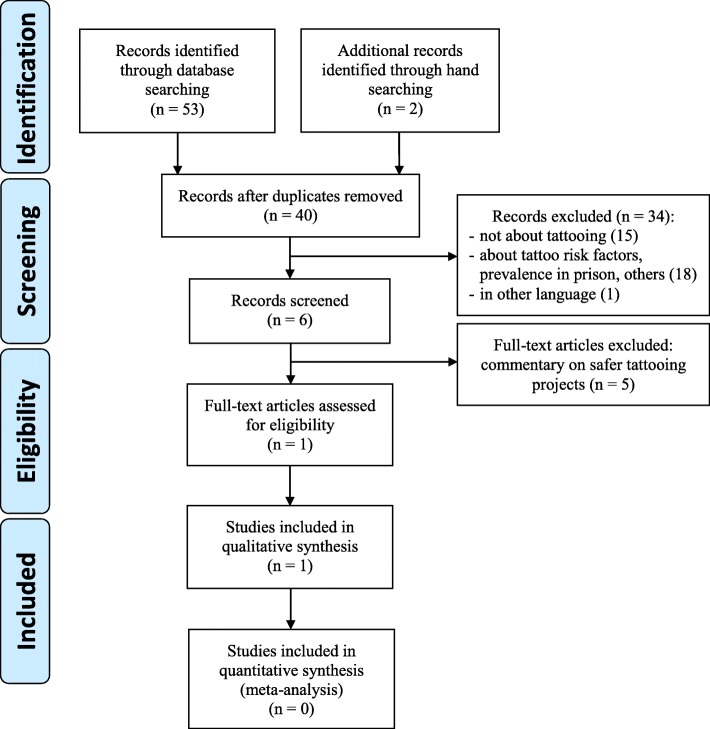
Results: Of 55 papers retrieved from the initial search, no peer-reviewed article was identified. One paper from the grey literature described a multi-site pilot project in Canada. Its evaluation suggested that the project was effective in enhancing knowledge of incarcerated people and prison staff on standard precautions, had the potential to reduce harm, provided vocational opportunities, and was feasible although enhancements were needed to improve implementation issues and efficiency.
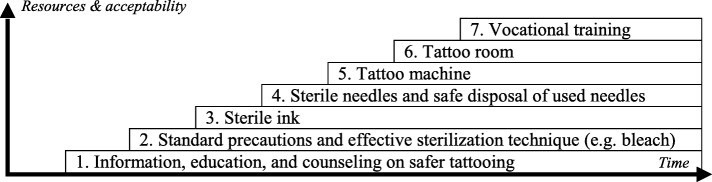
Conclusions: Although access to preventive services, including to safer tattooing interventions, is a human right and recommended by United Nations agencies as part of a comprehensive package of harm reduction interventions in prisons, this review identified only a few promising strategies for safer tattooing interventions in carceral settings. We call upon governments, criminal justice authorities, non-governmental organizations, and academic institutions to implement safer tattooing projects that adhere to the following guiding principles: i) integration of methodologically-rigorous implementation research; ii) involvement of key stakeholders (incarcerated people, prison authorities, research partners) in the project design, implementation, and research; iii) integration into a comprehensive package of BBI prevention, treatment, and care, using a stepwise approach that considers local resources and acceptability; and iv) publication and dissemination of findings, and scaling up efforts.
Prospero registration: CRD42017072502 .
Keywords: Call to action; Detention; Harm reduction; Human rights; Prison; Safer tattooing; Stepwise approach.
Conflict of interest statement
Ethics approval and consent to participate
Not applicable.
Consent for publication
Not applicable.
Competing interests
The authors declare that they have no competing interests.
Publisher’s Note
Springer Nature remains neutral with regard to jurisdictional claims in published maps and institutional affiliations.
Figures
References
-
- Walmsley R. Institute for Criminal Policy Research. 2016. World prison brief.
-
- Butler T, Richters J, Yap L, Papanastasiou C, Richards A, Schneider K, Grant L, Smith A, Donovan B. Sexual health and behaviour of Queensland prisoners with Queensland and New South Wales comparisons. Perth and Sydney: National Drug Research Institute, Curtin University, Perth, and School of Public Health and Community Medicine, University of New South Wales, Sydney, Australia; 2010.
Publication types
MeSH terms
LinkOut - more resources
Full Text Sources
Other Literature Sources
Miscellaneous
