Review
. 2018 Aug 15;19(8):2412.
doi: 10.3390/ijms19082412.

Is TAK1 a Direct Upstream Kinase of AMPK?

Affiliations
Review

Is TAK1 a Direct Upstream Kinase of AMPK?

Dietbert Neumann. Int J Mol Sci. .

Abstract

Alongside Liver kinase B1 (LKB1) and Ca2+/Calmodulin-dependent protein kinase kinase 2 (CaMKK2), Transforming growth factor-β (TGF-β)-activated kinase 1 (TAK1) has been suggested as a direct upstream kinase of AMP-activated protein kinase (AMPK). Several subsequent studies have reported on the TAK1-AMPK relationship, but the interpretation of the respective data has led to conflicting views. Therefore, to date the acceptance of TAK1 as a genuine AMPK kinase is lagging behind. This review provides with argumentation, whether or not TAK1 functions as a direct upstream kinase of AMPK. Several specific open questions that may have precluded the consensus are discussed based on available data. In brief, TAK1 can function as direct AMPK upstream kinase in specific contexts and in response to a subset of TAK1 activating stimuli. Further research is needed to define the intricate signals that are conditional for TAK1 to phosphorylate and activate AMPKα at T172.

Keywords: AMPK; AMPK kinase; TAK1; phosphorylation.


Conflict of interest statement

The author declares no conflict of interest. The funders had no role in the writing of the manuscript and in the decision to publish.

Figures
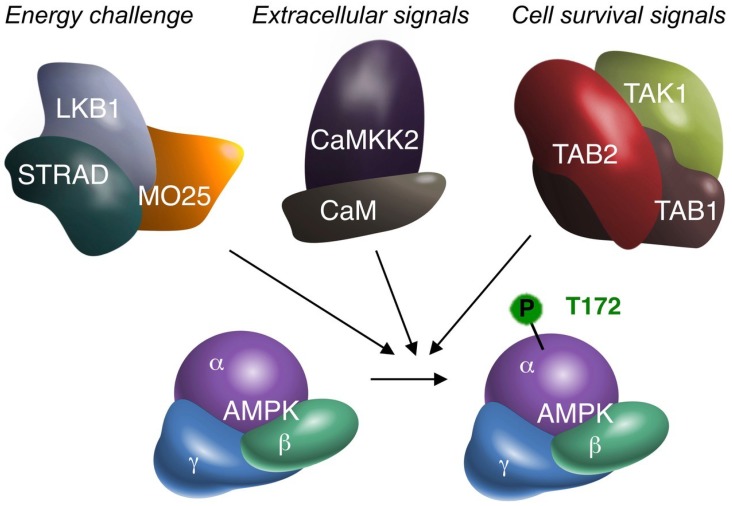
Figure 1
Figure 1
The three alternative AMPK kinases. Biochemical (cell-free), cell biological (in vitro) and animal (in vivo) experimentation suggest that TAK1 can activate AMPKα by phosphorylation of the critical T172 residue. Summative evidence therefore supports TAK1 as an additional AMPK upstream kinase, besides LKB1 and CaMKK2. AMPK may receive (simultaneous) activation from all three upstream kinases. The original signal leading to AMPK activation may differ per upstream kinase, as suggested above. All four kinases are depicted with their accessory subunits, as functional protein complexes. The requirement of TAB1/TAB2/TAB3 for AMPK activation has not been fully elucidated. However, to date TAB1 and/or TAB2 are the most likely candidates. TAB1 may also bind to AMPK independent of TAK1 [30]. MO25: mouse protein 25; STRAD: STE20-related kinase adapter protein; CaM: Calmodulin.

References

    1. Hardie D.G. Molecular pathways: Is AMPK a friend or a foe in cancer? Clin. Cancer Res. 2015;21:3836–3840. doi: 10.1158/1078-0432.CCR-14-3300. - DOI - PMC - PubMed
    1. Lopez M., Nogueiras R., Tena-Sempere M., Dieguez C. Hypothalamic AMPK: A canonical regulator of whole-body energy balance. Nat. Rev. Endocrinol. 2016;12:421–432. doi: 10.1038/nrendo.2016.67. - DOI - PubMed
    1. Day E.A., Ford R.J., Steinberg G.R. AMPK as a therapeutic target for treating metabolic diseases. Trends Endocrinol. Metab. 2017;28:545–560. doi: 10.1016/j.tem.2017.05.004. - DOI - PubMed
    1. Salt I.P., Hardie D.G. AMP-activated protein kinase: An ubiquitous signaling pathway with key roles in the cardiovascular system. Circ. Res. 2017;120:1825–1841. doi: 10.1161/CIRCRESAHA.117.309633. - DOI - PMC - PubMed
    1. Hardie D.G., Ross F.A., Hawley S.A. AMPK: A nutrient and energy sensor that maintains energy homeostasis. Nat. Rev. Mol. Cell Biol. 2012;13:251–262. doi: 10.1038/nrm3311. - DOI - PMC - PubMed

Substances

LinkOut - more resources
