


Impact of neoadjuvant therapy on postoperative outcomes after pancreaticoduodenectomy
- PMID: 30114330
- PMCID: PMC6653597
- DOI: 10.1002/jso.25183
Impact of neoadjuvant therapy on postoperative outcomes after pancreaticoduodenectomy
Abstract
Background: Surgical resection provides the only potentially curative treatment of pancreatic cancer. Neoadjuvant chemotherapy and/or radiation (NAT) is used to downstage patients with borderline resectable tumors. The objective of this study was to examine the postoperative morbidity and mortality of NAT after pancreaticoduodenectomy (PD) for pancreatic ductal adenocarcinoma (PDA).
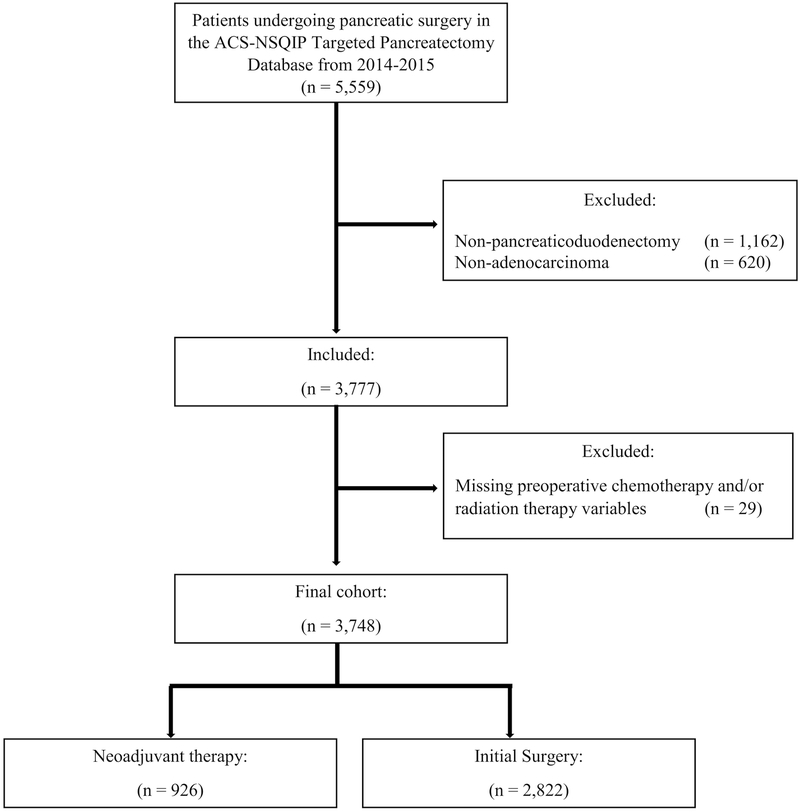
Methods: Using the American College of Surgeons-National Surgical Quality Improvement Project Targeted Pancreatectomy data, we identified patients who underwent a PD for PDA from 2014 to 2015. Patients were grouped by receipt of NAT 90 days before PD. Bivariable and multivariable analyses was used to compare postoperative outcomes.
Results: A total of 3748 patients with PDA underwent PD; 926 (24.7%) received NAT. Those in the NAT group had more major vein resections, and longer operating times (all P < 0.001). On pathologic staging, those in the NAT group had smaller tumors (T1, 10.9% vs 5.1%; P < 0.001) and fewer nodes positive (N0, 49% vs 28%; P < 0.001). There were no differences in 30-day postoperative mortality or overall complications. On multivariable analysis, patients who received NAT had a lower likelihood of pancreatic fistula (OR, 0.67; P < 0.001).
Conclusion: NAT does not increase the overall postoperative morbidity or mortality of PD for PDA. There is a decreased likelihood of pancreatic fistulas in patients that receive neoadjuvant therapy.
Keywords: Whipple postoperative complications; neoadjuvant therapy; pancreatic cancer; pancreaticoduodenectomy outcomes; postoperative pancreatic fistula.
© 2018 Wiley Periodicals, Inc.
References
-
- Siegel RL, Miller KD, Jemal A. Cancer Statistics, 2017. CA: a cancer journal for clinicians. 2017;67(1):7–30. - PubMed
-
- Jemal A, Bray F, Center MM, Ferlay J, Ward E, Forman D. Global cancer statistics. CA: a cancer journal for clinicians. 2011;61(2):69–90. - PubMed
-
- Richter A, Niedergethmann M, Sturm JW, Lorenz D, Post S, Trede M. Long-term results of partial pancreaticoduodenectomy for ductal adenocarcinoma of the pancreatic head: 25-year experience. World J Surg. 2003;27(3):324–329. - PubMed
-
- Kuhlmann KF, de Castro SM, Wesseling JG, et al. Surgical treatment of pancreatic adenocarcinoma; actual survival and prognostic factors in 343 patients. European journal of cancer (Oxford, England : 1990). 2004;40(4):549–558. - PubMed
MeSH terms
Grants and funding
LinkOut - more resources
Full Text Sources
Other Literature Sources
Medical
