


Engaging pregnant women in observational research: a qualitative exploratory study
- PMID: 30115019
- PMCID: PMC6097433
- DOI: 10.1186/s12884-018-1966-z
Engaging pregnant women in observational research: a qualitative exploratory study
Abstract
Background: Recruitment of pregnant women to population health research can be challenging, especially if the research topic is sensitive. While many pregnant women may be inherently interested in research about pregnancy, there is the possibility that the nature and timing of the project may give rise to anxiety in some women, especially if the topic is sensitive or it brings about new awareness of potential pregnancy complications. Research staff undertaking recruitment need to be skilled at strategies to manage the environment, and have well developed communication and interpersonal skills to explain and promote the study and facilitate each woman's informed decision-making regarding participation. However, the skills needed by recruitment staff to successfully engage pregnant women with a research topic are not well understood. This study aimed to address this evidence gap by providing insight into the dynamics between a pregnant woman and recruitment staff at the time of the offer to participate in an observational study about alcohol use in pregnancy.
Methods: Naturalistic inquiry guided a qualitative exploratory descriptive approach. Experienced recruitment staff from the Asking Questions about Alcohol in Pregnancy (AQUA) study (Muggli et al., BMC Pregnancy Childbirth 14:302, 2014) participated in individual semi-structured interviews and were asked about their experiences and approaches to engaging pregnant women. Interviews were transcribed verbatim and analysed using inductive content analysis.
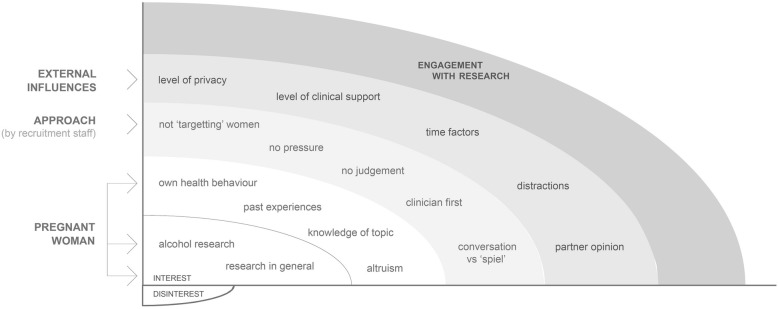
Results: Pregnant women brought with them an inherent interest or disinterest in alcohol research, or in research in general, which formed the basis for engagement. Women responded favourably to the invitation to participate being delivered without pressure, and as part of a two-way conversation. Engagement with a sensitive topic such as alcohol use in pregnancy was facilitated by a non-judgmental and non-targeted approach. Influences such as privacy, distractions, partner's opinion, time factors and level of clinical support either facilitated or hindered a woman's engagement with the research.
Conclusions: These results provide an in-depth explanation of barriers and enablers to recruitment of pregnant women in antenatal clinics to studies that may inform strategies and the training of recruitment staff.
Keywords: Alcohol use in pregnancy; Perinatal research; Recruitment.
Conflict of interest statement
Ethics approval and consent to participate
Ethics approval was granted by Royal Children’s Hospital Human Research Ethics Committee, Parkville, Australia (approval number 32157A). All participants were provided information sheets and participants provided informed, written consent prior to any data collection.
Consent for publication
Not applicable.
Competing interests
The authors declare that they have no competing interests.
Publisher’s Note
Springer Nature remains neutral with regard to jurisdictional claims in published maps and institutional affiliations.
Figures
References
-
- Kerver JM, Elliott MR, Norman GS, Sokol RJ, Keating DP, Copeland GE, Johnson CC, Cislo KK, Alcser KH, Kruger-Ndiaye SR, et al. Pregnancy recruitment for population research: the National Children's study vanguard experience in Wayne County, Michigan. Paediatr Perinat Epidemiol. 2013;27(3):303–311. doi: 10.1111/ppe.12047. - DOI - PMC - PubMed
MeSH terms
Grants and funding
LinkOut - more resources
Full Text Sources
Other Literature Sources
Medical
Miscellaneous
