


Genetics of suicide attempts in individuals with and without mental disorders: a population-based genome-wide association study
- PMID: 30116032
- PMCID: PMC7515833
- DOI: 10.1038/s41380-018-0218-y
Genetics of suicide attempts in individuals with and without mental disorders: a population-based genome-wide association study
Abstract
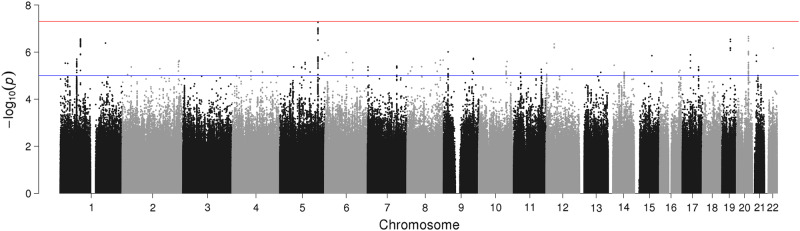
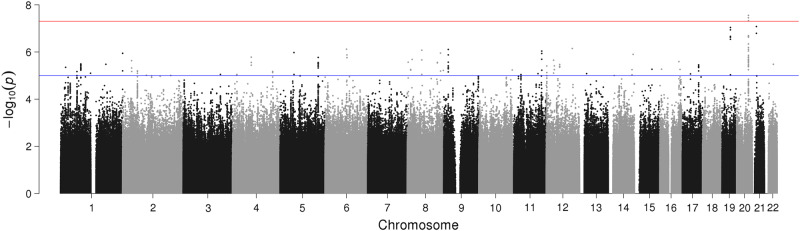
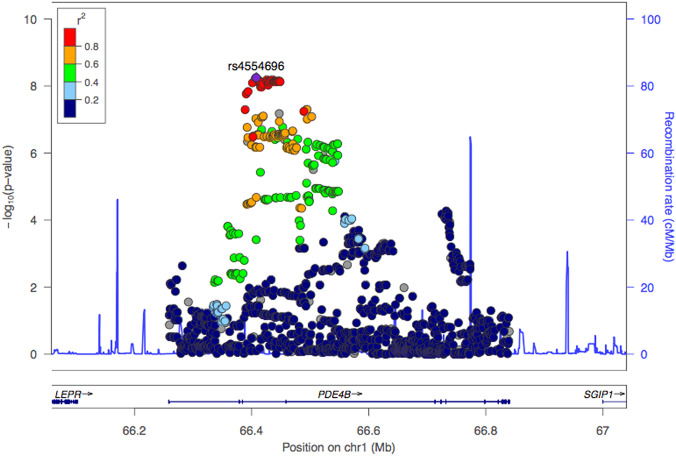
Family studies have shown an aggregation of suicidal behavior in families. Yet, molecular studies are needed to identify loci accounting for genetic heritability. We conducted a genome-wide association study and estimated single nucleotide polymorphisms (SNP) heritability for a suicide attempt. In a case-cohort study, national data on all individuals born in Denmark after 1981 and diagnosed with severe mental disorders prior to 2013 (n = 57,377) and individuals from the general population (n = 30,000) were obtained. After quality control, the sample consisted of 6024 cases with an incidence of suicide attempt and 44,240 controls with no record of a suicide attempt. Suggestive associations between SNPs, rs6880062 (p-value: 5.4 × 10⁻⁸) and rs6880461 (p-value: 9.5 × 10⁻⁸), and suicide attempt were identified when adjusting for socio-demographics. Adjusting for mental disorders, three significant associations, all on chromosome 20, were identified: rs4809706 (p-value: 2.8 × 10⁻⁸), rs4810824 (p-value: 3.5 × 10⁻⁸), and rs6019297 (p-value: 4.7 × 10⁸). Sub-group analysis of cases with affective disorders revealed SNPs associated with suicide attempts when compared to the general population for gene PDE4B. All SNPs explained 4.6% [CI-95: 2.9-6.3%] of the variation in suicide attempt. Controlling for mental disorders reduced the heritability to 1.9% [CI-95: 0.3-3.5%]. Affective and autism spectrum disorders exhibited a SNP heritability of 5.6% [CI-95: 1.9-9.3%] and 9.6% [CI-95: 1.1-18.1%], respectively. Using the largest sample to date, we identified significant SNP associations with suicide attempts and support for a genetic transmission of suicide attempt, which might not solely be explained by mental disorders.
Conflict of interest statement
The authors declare that they have no conflict of interest.
Figures
References
-
- World Health Organization. Preventing suicide—a global imperative. Geneva: WHO; 2014.
-
- Runeson B, Asberg M. Family history of suicide among suicide victims. Am J Psychiatry. 2003;160:1525–6. - PubMed
Publication types
MeSH terms
Grants and funding
LinkOut - more resources
Full Text Sources
Other Literature Sources
Medical
