. 2018 Jun 25;11(2):169-180.
doi: 10.3400/avd.ra.17-00118.

Multiple Roles of Tenascins in Homeostasis and Pathophysiology of Aorta

Affiliations

Multiple Roles of Tenascins in Homeostasis and Pathophysiology of Aorta

Kyoko Imanaka-Yoshida et al. Ann Vasc Dis. .

Abstract

Tenascins are a family of large extracellular matrix (ECM) glycoproteins. Four family members (tenascin-C, -R, -X, and -W) have been identified to date. Each member consists of the same types of structural domains and exhibits time- and tissue-specific expression patterns, suggesting their specific roles in embryonic development and tissue remodeling. Among them, the significant involvement of tenascin-C (TNC) and tenascin-X (TNX) in the progression of vascular diseases has been examined in detail. TNC is strongly up-regulated under pathological conditions, induced by a number of inflammatory mediators and mechanical stress. TNC has diverse functions, particularly in the regulation of inflammatory responses. Recent studies suggest that TNC is involved in the pathophysiology of aneurysmal and dissecting lesions, in part by protecting the vascular wall from destructive mechanical stress. TNX is strongly expressed in vascular walls, and its distribution is often reciprocal to that of TNC. TNX is involved in the stability and maintenance of the collagen network and elastin fibers. A deficiency in TNX results in a form of Ehlers-Danlos syndrome (EDS). Although their exact roles in vascular diseases have not yet been elucidated, TNC and TNX are now being recognized as promising biomarkers for diagnosis and risk stratification of vascular diseases.

Keywords: aortic aneurysm; aortic dissection; inflammation; tenascin-C; tenascin-X.


Figures
None
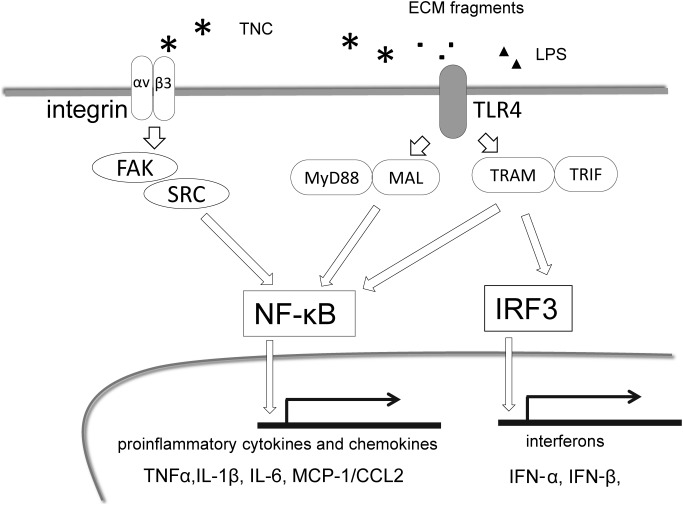
Fig. 1 Major proinflammatory signaling pathways by TNC. Activated TLR4 by TNC, ECM fragments as well as LPS induce two downstream signaling pathways. Nuclear translocation of NFκB and translation of proinflammatory cytokines/chemokines are induced mediated by MyD88/MAL. MyD88-independent signaling activates NFκB and IRF, inducing interferon synthesis. TNC also stimulates inflammatory cells through integrin αvβ3/FAK/Src/NFκB. MAL: myeloid differentiation factor 88 (MyD88) adaptor-like protein; TRAM: TLR-4 signaling adaptor; TRIF: Toll/IL-IR domain-containing adaptor-inducing IFN-β; IRF: Interferon regulatory factor
None
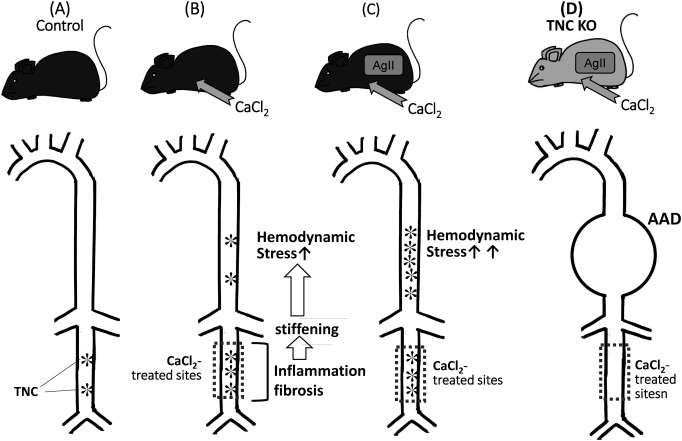
Fig. 2 A protective role of TNC in the aorta from destructive mechanical stress. (A) TNC is constitutively expressed in the abdominal aorta of normal adult mice. (B) Application of CaCl2 to the infrarenal aorta causes inflammation and fibrosis, resulting in stiffness in the treated sites and enhancement of hemodynamic stress on the suprarenal aorta, which induces TNC expression. (C) Infusion of angiotensin II into (B) increases blood pressure and augments hemodynamic stress in the upper aorta, which strongly up-regulates TNC. (D) Application of the strong hemodynamic stress using a combination of a CaCl2 treatment and AgII infusion to the TNC KO causes AAD.
None
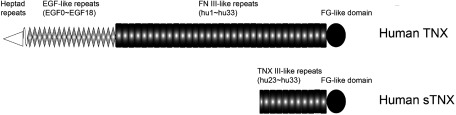
Fig. 3 Structure of human TNX and serum form of TNX (sTNX). Human TNX consists of a cysteine-rich segment (heptad repeats) at the amino terminus, 18.5 EGF-like repeats (EGF0–EGF18), 33 FNIII-like repeats (hu1–hu33), and a FG-like domain at the carboxyl terminus. Human sTNX consists of the C-terminal part of full-length TNX, namely, 10.5 FNIII-like repeats (hu23–hu33) and a FG-like domain.

References

    1. Tucker RP, Drabikowski K, Hess JF, et al. Phylogenetic analysis of the tenascin gene family: evidence of origin early in the chordate lineage. BMC Evol Biol 2006; 6: 60. - PMC - PubMed
    1. Adams JC, Chiquet-Ehrismann R, Tucker RP. The evolution of tenascins and fibronectin. Cell Adh Migr 2015; 9: 22-33. - PMC - PubMed
    1. Bornstein P. Diversity of function is inherent in matricellular proteins: an appraisal of thrombospondin 1. J Cell Biol 1995; 130: 503-6. - PMC - PubMed
    1. Mohler ER 3rd. Mechanisms of aortic valve calcification. Am J Cardiol 2004; 94: 1396-402. - PubMed
    1. Murphy-Ullrich JE, Sage EH. Revisiting the matricellular concept. Matrix Biol 2014; 37: 1-14. - PMC - PubMed

LinkOut - more resources