


Review of Transmetatarsal Amputations in the Management of Peripheral Arterial Disease in an Asian Population
- PMID: 30116413
- PMCID: PMC6094039
- DOI: 10.3400/avd.oa.17-00123
Review of Transmetatarsal Amputations in the Management of Peripheral Arterial Disease in an Asian Population
Abstract
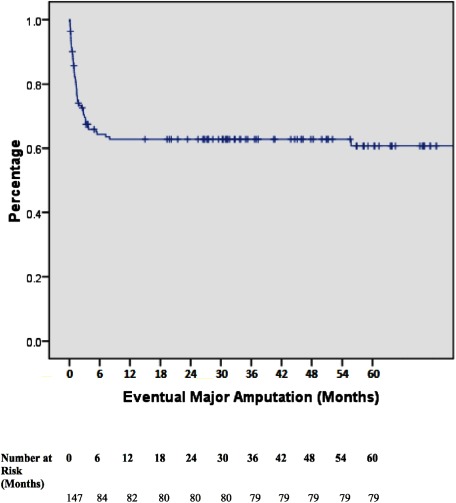
Objective: To evaluate outcomes after transmetatarsal amputation (TMA) in peripheral arterial disease (PAD) limb salvage in an Asian population and identify risk factors associated with TMA failure. Methodology: A retrospective review of 147 patients with PAD, who had undergone TMA between 2008 and 2014, was carried out. Univariate and multivariate analysis were used to identify predictors of TMA failure. Kaplan-Meier survival analysis was used to calculate major amputation and all-cause mortality rates. Results: The mean age was 66 years. 92% were diabetic patients and 78% had preceded angioplasty. 56% of TMAs were healed via secondary intention, 8% required subsequent split-thickness skin graft closure, 24% required further debridement while 37% had wounds, which failed to heal and required below-knee amputations (BKA). Multivariate analysis showed that diabetes is the only independent predictor of TMA failure (odds ratio (OR) 7.11, p=0.064). Patients with TMA failure were at increased risk of developing nosocomial infections (p=0.025) and faced a higher risk of 30-day re-admission rate (p=0.002). Conclusion: The success rate for PAD limb salvage TMA was 63% and diabetes was an independent predictor of TMA failure. Patients with TMA failure were at increased risks of nosocomial infections, and 30-day re-admissions; hence the risks and benefits of TMA for diabetic foot limb salvage must be individualized for each patient.
Keywords: amputation; diabetic foot; limb salvage; peripheral arterial disease; transmetatarsal amputation.
Figures
References
-
- Kullo IJ, Rooke TW. Peripheral artery disease. N Engl J Med 2016; 374: 861-71. - PubMed
-
- An epidemic of risk factors for cardiovascular disease. Lancet 2011; 377: 527. - PubMed
-
- Smith GD, Shipley MJ, Rose G. Intermittent claudication, heart disease risk factors, and mortality. The Whitehall study. Circulation 1990; 82: 1925-31. - PubMed
-
- Fowkes FGR, Rudan D, Rudan I, et al. Comparison of global estimates of prevalence and risk factors for peripheral artery disease in 2000 and 2010: a systematic review and analysis. Lancet 2013; 382: 1329-40. - PubMed
LinkOut - more resources
Full Text Sources
Other Literature Sources