


Body mass index, calcium supplementation and risk of colorectal adenomas
- PMID: 30117164
- PMCID: PMC6294679
- DOI: 10.1002/ijc.31803
Body mass index, calcium supplementation and risk of colorectal adenomas
Abstract
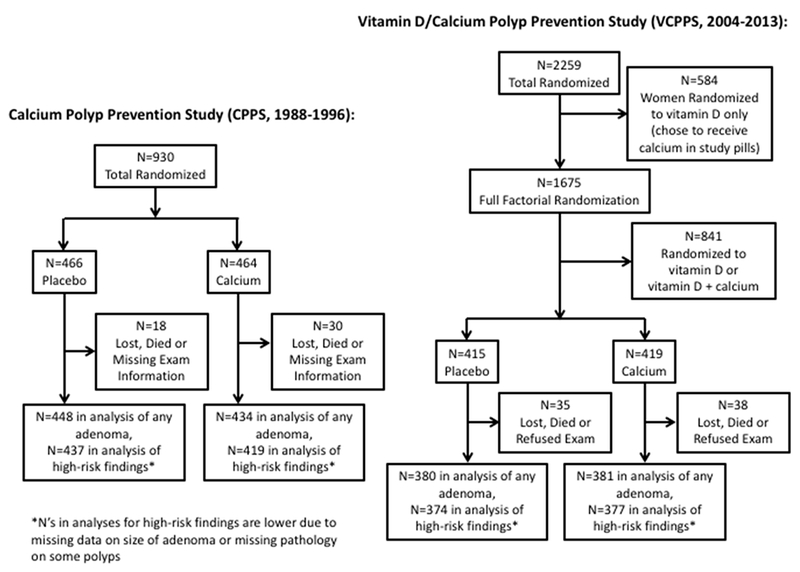
Calcium supplementation (1,200 mg/day) did not significantly reduce colorectal adenomas in our recent randomized, controlled trial (Vitamin D/Calcium Polyp Prevention Study, VCPPS, 2004-2013) in contrast to our previous trial (Calcium Polyp Prevention Study, CPPS, 1988-1996). To reconcile these findings, we identified participant characteristics that differed between the study populations and modified the effect of calcium supplementation on adenomas or high-risk findings (advanced or multiple adenomas). Compared to the CPPS, more participants in the VCPPS were obese (body mass index (BMI) ≥30 kg/m2 ; 37.5% vs. 24.4%) and fewer had normal BMI (BMI <25 kg/m2 ; 18.5% vs. 31%). BMI appeared to modify the effect of calcium supplementation on adenomas and especially on high risk-findings: in the VCPPS, there was a 44% reduction in high-risk findings among individuals whose BMI was normal (RR = 0.56, 95% CI = 0.26-1.23), but not among overweight (RR = 1.09, 95% CI = 0.62-1.91) or obese (RR = 1.54, 95% CI = 0.92-2.57) individuals (pinteraction = 0.03). Similarly, in the CPPS, there was a 56% reduction in high-risk findings among individuals whose BMI was normal (RR = 0.44, 95% CI = 0.26-0.74), but not among overweight (RR = 0.87, 95% CI = 0.55-1.39) or obese (RR = 1.02, 95% CI = 0.57-1.82) individuals (pinteraction = 0.02). Standardization of each trial's findings to the BMI distribution in the other attenuated calcium's protective effect on adenomas in the CPPS but enhanced it in the VCPPS. In conclusion, 1,200 mg/day calcium supplementation may reduce risk of colorectal adenomas among those with normal BMI but not in overweight or obese individuals; and differences in BMI distribution partially account for the apparent difference in calcium efficacy between the two trials.
Keywords: body mass index; calcium supplementation; clinical trial; colorectal adenoma.
© 2018 UICC.
Conflict of interest statement
Conflicts of Interest:
Dr. Lund receives research support from the PhRMA Foundation to the University of North Carolina at Chapel Hill. Dr. Lund’s spouse is a full-time paid employee of GlaxoSmithKline (which markets calcium supplements).
Dr. Westreich is a consultant for Sanofi Pasteur pharmaceutical company.
Dr Ahnen serves on the Data and Safety Monitoring Committee for Cancer Prevention Pharmaceuticals, and the Speakers Bureau for Ambry Genetics.
Dr. Burke receives research support from Cancer Prevention Pharmaceuticals and Ferring Pharmaceuticals, and she is a consultant for Sucampo Pharmaceuticals, Salix Pharmaceuticals and Aries Pharmaceuticals.
Dr. Baron, along with Dartmouth College, holds a use patent for the chemopreventive use of calcium (currently not licensed, formerly licensed by Pfizer). Pfizer provided the study tablets at no cost to the VCCPS.
The remaining authors report no potential conflicts of interest.
References
-
- Huncharek M, Muscat J, Kupelnick B. Colorectal cancer risk and dietary intake of calcium, vitamin D, and dairy products: a meta-analysis of 26,335 cases from 60 observational studies. Nutr Cancer 2009; 61: 47–69. - PubMed
-
- Keum N, Aune D, Greenwood DC, et al. Calcium intake and colorectal cancer risk: dose-response meta-analysis of prospective observational studies. Int J Cancer 2014; 135: 1940–8. - PubMed
-
- Keum N, Lee DH, Greenwood DC, et al. Calcium intake and colorectal adenoma risk: dose-response meta-analysis of prospective observational studies. Int J Cancer 2015; 136: 1680–7. - PubMed
-
- Heine-Broring RC, Winkels RM, Renkema JM, et al. Dietary supplement use and colorectal cancer risk: a systematic review and meta-analyses of prospective cohort studies. Int J Cancer 2015; 136: 2388–401. - PubMed
-
- Baron JA, Beach M, Mandel JS, et al. Calcium supplements for the prevention of colorectal adenomas. Calcium Polyp Prevention Study Group. N Engl J Med 1999; 340: 101–7. - PubMed
Publication types
MeSH terms
Substances
Grants and funding
LinkOut - more resources
Full Text Sources
Other Literature Sources
Medical
