


Adhesion awareness in 2016: An update of the national survey of surgeons
- PMID: 30118503
- PMCID: PMC6097683
- DOI: 10.1371/journal.pone.0202418
Adhesion awareness in 2016: An update of the national survey of surgeons
Abstract
Background and aims: Adhesions, that form in 60-80% of all abdominal operations, can cause complications such as chronic abdominal pain, small-bowel obstruction, female infertility, and the need for adhesiolysis in future surgeries. Our 2010 Adhesion Awareness survey demonstrated that despite the huge clinical impact of adhesions; adhesion-related complications were seldom mentioned in the informed consent. Six years later, a follow-up survey was conducted to assess the progress on awareness on adhesion-related complications in the Netherlands.
Material and methods: The 2010 Adhesion Awareness survey was repeated after a literature update. The knowledge regarding adhesions; the use of anti-adhesive agents and involvement in the informed consent process were assessed. Surgeons and surgical trainees were contacted by e-mail. The data was analysed using a Chi-square or Mann-Whitney U test and corrected for multiple testing.
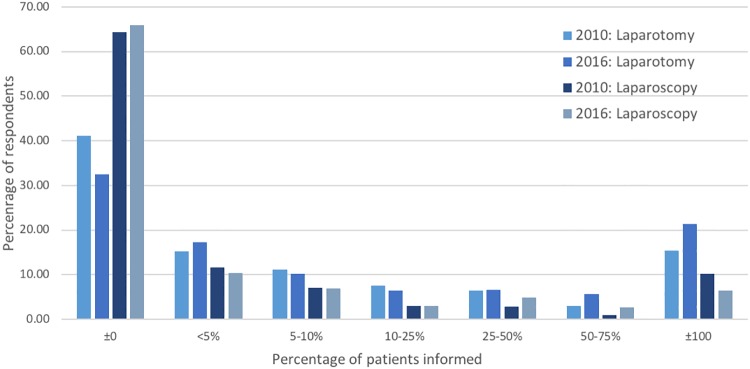
Results: The response rate was 32.6%, similar to the survey in 2010 (34.4%). 88.1% agreed with the clinical relevance of adhesions, comparable to 2010 (89.8%). The score on the knowledge test was 38.8% (2010: 37.2%). Involvement of adhesion-related complications in the informed consent process increased, although 32.5% almost never mentions adhesions. In 2016, 42.4% reported a correct occurrence of bowel lesions during adhesiolysis, higher than in 2010 (P<0.001).
Conclusions: The adhesion awareness did not increase in six years, despite the efforts made. However, an increased awareness regarding adhesiolysis related complications was detected. Improvement of knowledge and behavior is essential to narrowing the gap between the impact of adhesions as a major complication of abdominal surgery and the limited adhesion awareness.
Conflict of interest statement
The authors have declared that no competing interests exist.
Figures
References
-
- Parker MC, Ellis H, Moran BJ, Thompson JN, Wilson MS, Menzies D, et al. Postoperative adhesions: ten-year follow-up of 12,584 patients undergoing lower abdominal surgery. Dis Colon Rectum. 2001;44(6):822–29; discussion 9–30. . - PubMed
MeSH terms
LinkOut - more resources
Full Text Sources
Other Literature Sources
Medical
Miscellaneous
