. 2018 Aug 17;37(1):195.
doi: 10.1186/s13046-018-0871-7.

MAP17 predicts sensitivity to platinum-based therapy, EGFR inhibitors and the proteasome inhibitor bortezomib in lung adenocarcinoma

Affiliations

MAP17 predicts sensitivity to platinum-based therapy, EGFR inhibitors and the proteasome inhibitor bortezomib in lung adenocarcinoma

Irene Ferrer et al. J Exp Clin Cancer Res. .

Abstract

Background: The high incidence and mortality of lung tumours is a major health problem. Therefore, the identification both of biomarkers predicting efficacy for therapies in use and of novel efficacious therapeutic agents is crucial to increase patient survival. MAP17 (PDZK1IP1) is a small membrane-bound protein whose upregulation is reported as a common feature in tumours from diverse histological origins. Furthermore, MAP17 is correlated with tumour progression.

Methods: We assessed the expression of MAP17 in preclinical models, including cell lines and patient-derived xenografts (PDXs), assessing its correlation with sensitivity to different standard-of-care drugs in lung adenocarcinoma, as well as novel drugs. At the clinical level, we subsequently correlated MAP17 expression in human tumours with patient response to these therapies.

Results: We show that MAP17 expression is induced during lung tumourigenesis, particularly in lung adenocarcinomas, and provide in vitro and in vivo evidence that MAP17 levels predict sensitivity to therapies currently under clinical use in adenocarcinoma tumours, including cisplatin, carboplatin and EGFR inhibitors. In addition, we show that MAP17 expression predicts proteasome inhibitor efficacy in this context and that bortezomib, an FDA-approved drug, may be a novel therapeutic approach for MAP17-overexpressing lung adenocarcinomas.

Conclusions: Our results indicate a potential prognostic role for MAP17 in lung tumours, with particular relevance in lung adenocarcinomas, and highlight the predictive pot0065ntial of this membrane-associated protein for platinum-based therapy and EGFR inhibitor efficacy. Furthermore, we propose bortezomib treatment as a novel and efficacious therapy for lung adenocarcinomas exhibiting high MAP17 expression.

Keywords: Biomarkers; Lung cancer; PDZK1IP1; Treatment efficacy.


Conflict of interest statement

Ethics approval and consent to participate

Written informed consent was provided by all patients. This project was approved by the Research Ethics Committee of the Hospital Universitario 12 Octubre (Madrid, Spain) (CEI 16/297).

Procedures involving animals were approved by the Animal Protection Committee of the Comunidad Autónoma de Madrid (Approval ID: PROEX 084/15).

Consent for publication

All authors have reviewed the manuscript and given consent for publication.

Competing interests

All authors declare they have no competing interests.

Publisher’s Note

Springer Nature remains neutral with regard to jurisdictional claims in published maps and institutional affiliations.

Figures

Fig. 1
Fig. 1
MAP17 upregulation occurs during lung tumourigenesis and is preferentially detected in lung adenocarcinomas. a Representative images of MAP17-stained lung tumour samples. b MAP17 mRNA expression in non-tumour (Normal), adenocarcinoma (ADC) and squamous cell carcinoma (SCC) samples from the TCGA Lung Cancer cohort. c MAP17 promoter and gene methylation in non-tumour and NSCLC samples (See Additional file 1: Table S2). Observed methylation changes (log2 ratio). Statistically significant differences (adjusted p-value < 0.05) of methylation levels with respect to those of the control (non-tumour) group were considered. The upper schematic represents the main location of probes for promoter or gene analysis. Below are comparative values of expression
Fig. 2
Fig. 2
Prognostic analysis of MAP17 expression in NSCLC. a Analysis of the risk (left) and survival probability (right) based on MAP17 expression in lung cancer tumours from the Lung Metabase [38]. Red: high risk; Green: low risk. b Analysis of the risk (left) and survival probability (right) based on MAP17 expression in lung cancer tumours from the NCI directors challenge consortium database [39]. Red: high risk; Green: low risk. c Analysis of survival probability based on MAP17 expression in adenocarcinoma or squamous carcinoma lung cancer tumours from the Lung Metabase database. D) Analysis of survival probability based on adjuvant radiotherapy treatment based on MAP17 expression in lung cancer tumours from the Lung Metabase database (n = 1053)
Fig. 3
Fig. 3
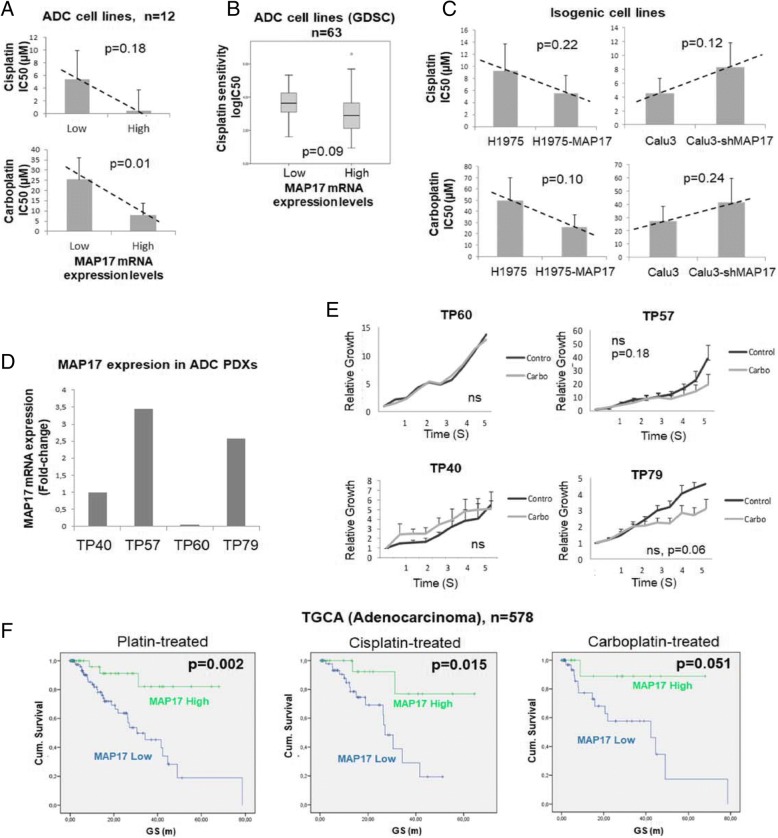
MAP17 expression predicts platin sensitivity in lung adenocarcinoma. a Correlation of cisplatin (up) and carboplatin (down) sensitivity in lung adenocarcinoma cell lines based on MAP17 expression. b Correlation of cisplatin sensitivity in adenocarcinoma cell lines based on MAP17 expression, with data obtained from the GDSC database. c Cisplatin (up) and carboplatin (down) sensitivity in MAP17-overexpressing and MAP17-silenced lung adenocarcinoma cell lines. d Determination of MAP17 mRNA expression in lung adenocarcinoma PDXs. e Tumour growth assessment of carboplatin-treated adenocarcinoma PDXs with differential MAP17 expression. f Kaplan-Meier overall survival curves for lung adenocarcinoma patients from the TCGA database (Additional file 1: Table S6) treated with cisplatin, carboplatin, or both. Patients were divided based on MAP17 expression levels into two groups, below or above the 75th percentile of expression
Fig. 4
Fig. 4
MAP17 expression predicts sensitivity to erlotinib in lung adenocarcinoma. a Erlotinib sensitivity in lung adenocarcinoma cell lines based on MAP17 mRNA expression. b Erlotinib sensitivity in one MAP17-overexpressing and one MAP17-silenced lung adenocarcinoma cell lines. c Analysis of sensitivity to different EGFR inhibitors in lung adenocarcinoma cell lines based on MAP17 expression using data from the GDSC database. Determination of MAP17 expression (d) and EGFR activation (e) in lung adenocarcinoma PDXs. (F) Tumour growth assessment in erlotinib-treated adenocarcinoma PDXs with differential MAP17 expression. g Response to erlotinib or gefitinib treatment in adenocarcinoma patients (Additional file 1: Table S3) with tumours harbouring low or high MAP17 mRNA expression. Expression was considered as high with values above the median value (left) or the 75th percentile (right)
Fig. 5
Fig. 5
MAP17 expression predicts sensitivity to bortezomib in lung adenocarcinoma. a Bortezomib sensitivity in low-, medium- and high-MAP17-expressing lung adenocarcinoma cell lines. b Sensitivity of low- and high-MAP17-expressing adenocarcinoma cell lines to bortezomib and to another proteasome inhibitor, MG132, obtained from the GDSC database. c Bortezomib sensitivity in the Calu-3 lung adenocarcinoma cell line after MAP17silencing and in the H1975 lung adenocarcinoma cell line after MAP17 overexpression. d Assessment of MAP17 mRNA expression in adenocarcinoma PDX models. e Tumour growth assessment (left) and survival analysis (right) in three bortezomib-treated adenocarcinoma PDXs with differential MAP17 expression. f Western blot showing activation of oncogenic signalling- and autophagy-related pathways in bortezomib-treated and control adenocarcinoma PDX models

References

    1. Siegel RL, Miller KD, Jemal A. Cancer statistics, 2017. CA Cancer J Clin. 2017;67:7–30. doi: 10.3322/caac.21387. - DOI - PubMed
    1. Herbst RS, Heymach JV, Lippman SM. Lung cancer. N Engl J Med. 2008;359:1367–1380. doi: 10.1056/NEJMra0802714. - DOI - PMC - PubMed
    1. Siegel RL, Miller KD, Jemal A. Cancer statistics, 2016. CA Cancer J Clin. 2016;66:7–30. doi: 10.3322/caac.21332. - DOI - PubMed
    1. Quintanal-Villalonga A, Paz-Ares L, Ferrer I, Molina-Pinelo S. Tyrosine kinase receptor landscape in lung Cancer: Therapeutical implications. Dis Markers. 2016;2016:9214056. doi: 10.1155/2016/9214056. - DOI - PMC - PubMed
    1. Tan WL, Jain A, Takano A, Newell EW, Iyer NG, Lim WT, Tan EH, Zhai W, Hillmer AM, Tam WL, Tan DSW. Novel therapeutic targets on the horizon for lung cancer. Lancet Oncol. 2016;17:e347–e362. doi: 10.1016/S1470-2045(16)30123-1. - DOI - PubMed

MeSH terms