


Work-relatedness of lumbosacral radiculopathy syndrome: Review and dose-response meta-analysis
- PMID: 30120136
- PMCID: PMC6161552
- DOI: 10.1212/01.wnl.0000544322.26939.09
Work-relatedness of lumbosacral radiculopathy syndrome: Review and dose-response meta-analysis
Abstract
Objective: Clinicians need to know whether lumbosacral radiculopathy syndrome (LRS) can be attributed to work. This review describes what work-related risk factors are associated with LRS.
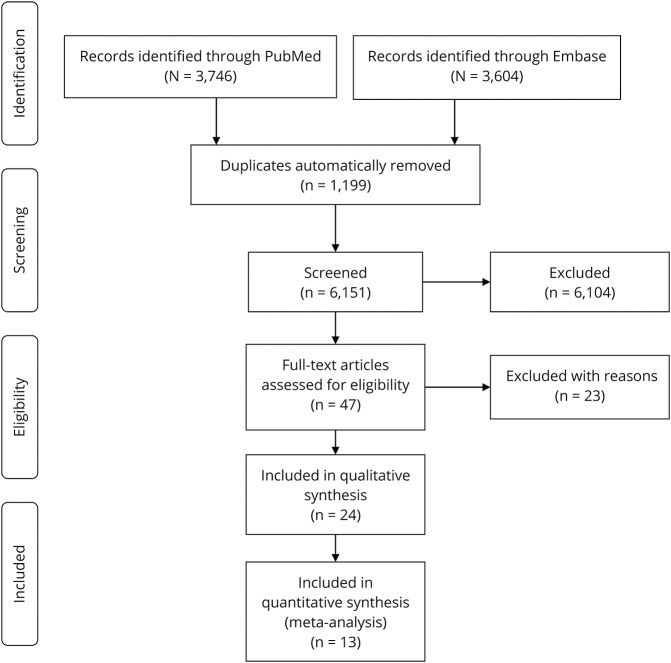
Methods: A systematic review was performed in PubMed and Embase. Inclusion criteria were that LRS was diagnosed by a clinician and workers exposed to work-related risk factors were compared to workers less or not exposed. A quality assessment and a meta-analysis were performed, including a dose-response analysis.
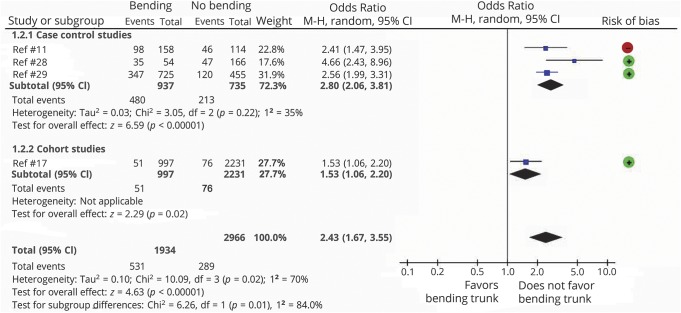
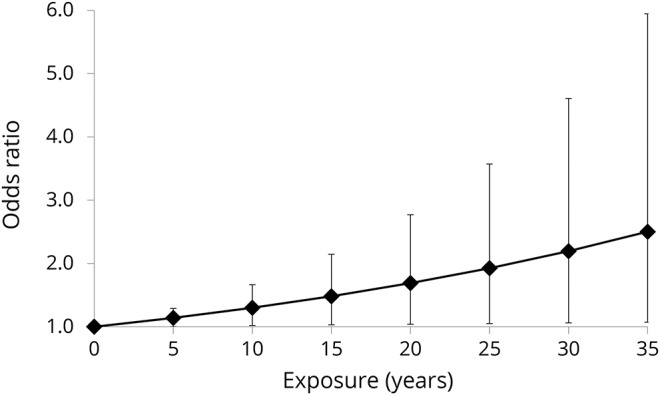
Results: The search resulted in 7,350 references and 24 studies that fulfilled the inclusion criteria: 19 studies were rated as having a high risk of bias and 5 as having a low risk of bias. The median number of LRS patients per study were 209 (interquartile range 124-504) and the total number of participants was 10,142. The meta-analysis revealed significant associations with heavy physically demanding work (odds ratio [OR] 2.03, 95% confidence interval [CI] 1.48-2.79), bending or twisting of the trunk (OR 2.43, 95% CI 1.67-3.55), and lifting and carrying in combination with bending or twisting of the trunk (OR 2.84, 95% CI 2.18-3.69). No significant associations were found for professional driving (OR 1.46, 95% CI 0.90-2.35) or sitting (OR 1.08, 95% CI 0.49-2.38). A dose-response relation was present per 5 years of exposure for bending (OR 1.12, 95% CI 1.04-1.20), lifting (OR 1.08, 95% CI 1.02-1.14) and the combination of bending and lifting (OR 1.14, 95% CI 1.01-1.29).
Conclusions: Moderate to high-quality evidence is available that LRS can be classified as a work-related disease depending on the level of exposure to bending of the trunk or lifting and carrying. Professional driving and sitting were not significantly associated with LRS.
Copyright © 2018 The Author(s). Published by Wolters Kluwer Health, Inc. on behalf of the American Academy of Neurology.
Figures
References
-
- Boschman JS, Brand T, Frings-Dresen MH, van der Molen HF. Improving the assessment of occupational diseases by occupational physicians. Occup Med 2017;67:13–19. - PubMed
-
- Coenen P, Gouttebarge V, van der Burght AS, et al. The effect of lifting during work on low back pain: a health impact assessment based on a meta-analysis. Occup Environ Med 2014;71:871–877. - PubMed
-
- Johanning E. Whole-body vibration-related health disorders in occupational medicine–an international comparison. Ergonomics 2015;58:1239–1252. - PubMed
Publication types
MeSH terms
LinkOut - more resources
Full Text Sources
Other Literature Sources
Medical
