


More vection means more velocity storage activity: a factor in visually induced motion sickness?
- PMID: 30120498
- PMCID: PMC6223881
- DOI: 10.1007/s00221-018-5340-1
More vection means more velocity storage activity: a factor in visually induced motion sickness?
Abstract
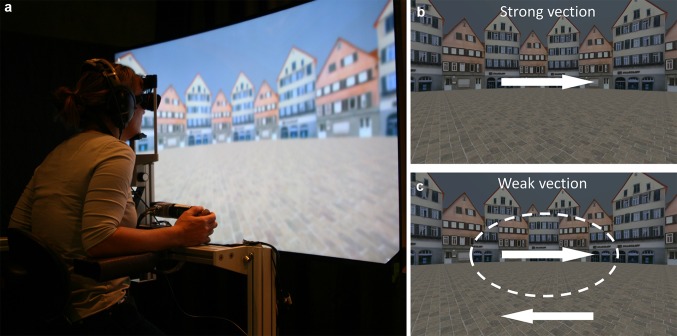
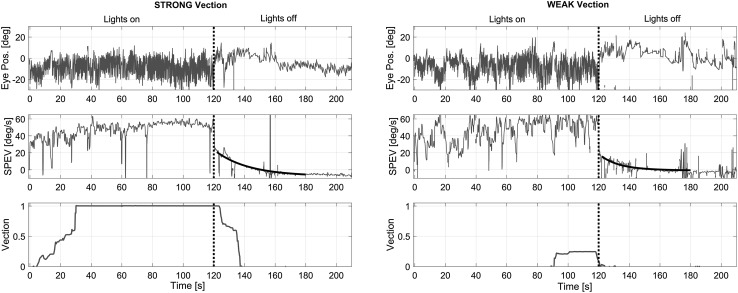
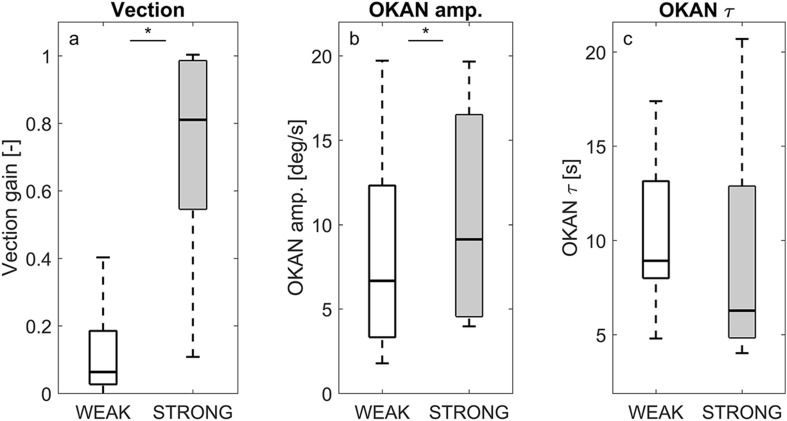
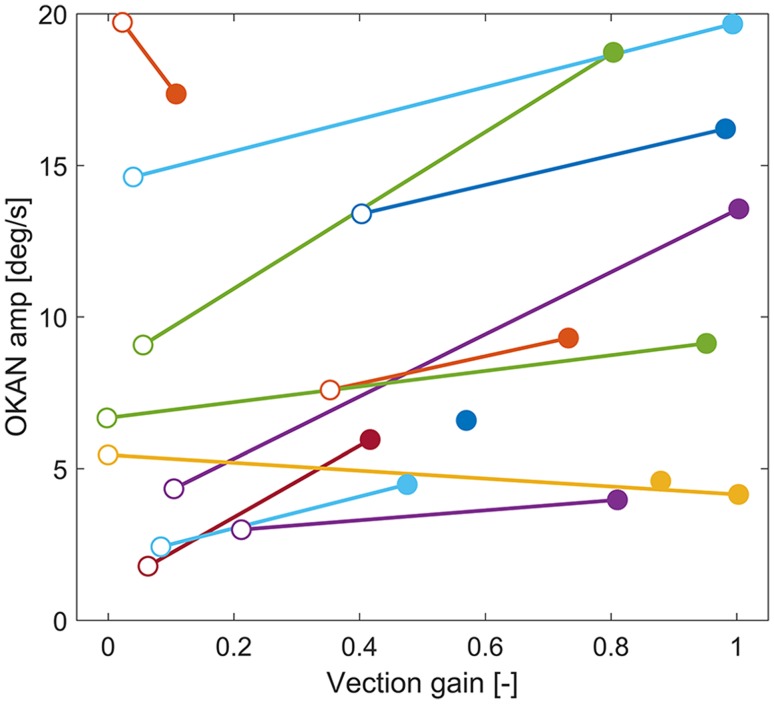
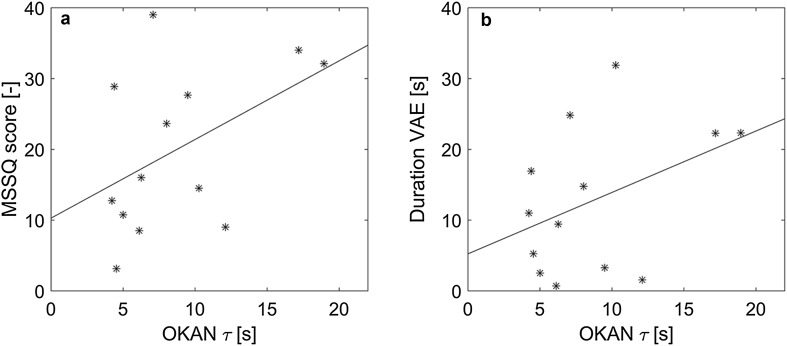
Full-field visual rotation around the vertical axis induces a sense of self-motion (vection), optokinetic nystagmus (OKN), and, eventually, also motion sickness (MS). If the lights are then suddenly switched off, optokinetic afternystagmus (OKAN) occurs. This is due to the discharge of the velocity storage mechanism (VSM), a central integrative network that has been suggested to be involved in motion sickness. We previously showed that visually induced motion sickness (VIMS) following optokinetic stimulation is dependent on vection intensity. To shed light on this relationship, the current study investigated whether vection intensity is related to VSM activity, and thus, to the OKAN. In repetitive trials (eight per condition), 15 stationary participants were exposed to 120 s of visual yaw rotation (60°/s), followed by 90 s in darkness. The visual stimulus either induced strong vection (i.e., scene rotating normally) or weak vection (central and peripheral part moving in opposite directions). Eye movements and subjective vection intensity were continuously measured. Results showed that OKAN occurred less frequently and with lower initial magnitude in the weak-vection condition compared to the strong-vection condition. OKAN decay time constants were not significantly different. The results suggest that the stimuli that produced strong vection also enhanced the charging of the VSM. As VSM activity presumably is a factor in motion sickness, the enhanced VSM activity in our strong-vection condition hints at an involvement of the VSM in VIMS, and could explain why visual stimuli producing a strong sense of vection also elicit high levels of VIMS.
Keywords: Optokinetic afternystagmus; Vection; Velocity storage mechanism; Visually induced motion sickness.
Conflict of interest statement
The authors declare that they have no conflict of interest.
Figures
References
-
- Bonato F, Bubka A, Alfieri L. Display color affects motion sickness symptoms in an optokinetic drum. Aviat Space Environ Med. 2004;75:306–311. - PubMed
MeSH terms
LinkOut - more resources
Full Text Sources
Other Literature Sources
Medical
Research Materials
