


Lower limb perfusion during robotic-assisted laparoscopic radical prostatectomy evaluated by near-infrared spectroscopy: an observational prospective study
- PMID: 30121089
- PMCID: PMC6098825
- DOI: 10.1186/s12871-018-0567-8
Lower limb perfusion during robotic-assisted laparoscopic radical prostatectomy evaluated by near-infrared spectroscopy: an observational prospective study
Abstract
Background: Decreased perfusion in the lower extremities is one of the several adverse effects of placing patients in a lithotomy or Trendelenburg position during surgery. This study aimed to evaluate the effects of patient positioning in lower limb perfusion patients undergoing robotic-assisted laparoscopic radical prostatectomy (RARP) using near-infrared spectroscopy (NIRS).
Methods: This observation study comprised 30 consenting males with American Society of Anaesthesiologists physical status classes I and II (age range, ≥20 to < 80 years). Regional saturation of oxygen measurements was obtained using an INVOS™ oximeter (Somanetics, Troy, MI, USA). A NIRS sensor was positioned on the surface of the skin at the mid-diaphyseal region of the calf muscles (the gastrocnemius and soleus), over the posterior compartment, in the right lower leg. Regional saturation of oxygen (rSO2) was sampled during the following time points: before and 5 min after induction of anaesthesia (T0,T1); 5 min after establishment of pneumoperitoneum in a 0° lithotomy position (T2); 5 min after a 25° Trendelenburg position (T3); 30, 60, 90 and 120 min after pneumoperitoneum in a Trendelenburg position (T4, T5, T6 and T7, respectively); after desufflation in a supine position (T8); and after tracheal extubation (T9).
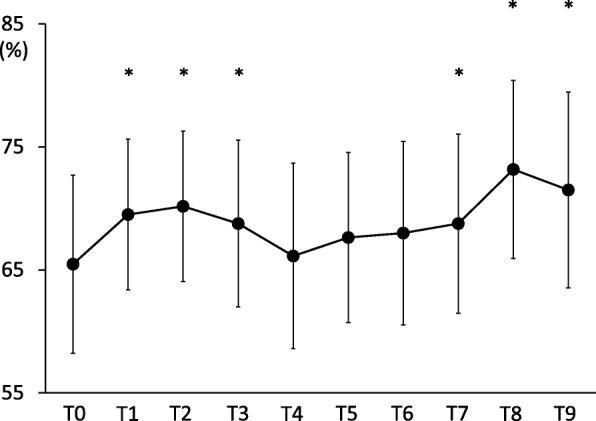
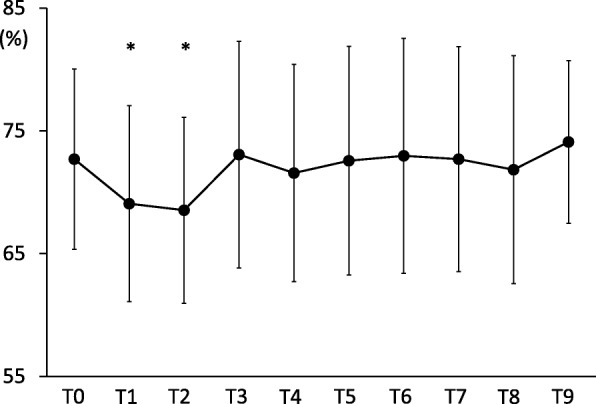
Results: Lower limb perfusion evaluated by NIRS was increased after induction of anaesthesia and maintained during steep Trendelenburg positions in RARP patients with no risk for lower limb compartment syndrome (LLCS) (T0:65 ± 7.2%, T1:69 ± 6.1%, T2:70±:6.1%, T3:68 ± 6.7%, T4:66 ± 7.5%, T5:67 ± 6.9%, T6:68 ± 7.2%, T8:73 ± 7.2%, T9:71 ± 7.9%, respectively).
Conclusions: Lower limb perfusion evaluated by NIRS was maintained during the RARP procedure. Correct patient positioning and careful assessment of risk factors such as vascular morbidity could be important for the prevention of LLCS during RARP.
Keywords: Lithotomy position; Lower limb perfusion; Robotic prostatectomy.
Conflict of interest statement
Ethics approval and consent to participate
This study was approved by the local institutional review board of the Ehime University Graduate School of Medicine (registration number 1308010). After a detailed explanation written informed consent was obtained from 30 patients scheduled for RARP.
Consent for publication
Not applicable.
Competing interests
The authors declare that they have no competing interests.
Publisher’s Note
Springer Nature remains neutral with regard to jurisdictional claims in published maps and institutional affiliations.
Figures
References
-
- Meyer RS, White KK, Smith JM, Groppo ER, Mubarak SJ, Hargens AR. Intramuscular and blood pressures in legs positioned in the hemilithotomy position: clarification of risk factors for well-leg acute compartment syndrome. J Bone Joint Surg Am. 2002;84:1829–1835. doi: 10.2106/00004623-200210000-00014. - DOI - PubMed
Publication types
MeSH terms
LinkOut - more resources
Full Text Sources
Other Literature Sources
