. 2018 Nov:75:30-41.
doi: 10.1016/j.ceca.2018.08.003. Epub 2018 Aug 9.

NAADP-dependent Ca2+ signaling regulates Middle East respiratory syndrome-coronavirus pseudovirus translocation through the endolysosomal system

Affiliations

NAADP-dependent Ca2+ signaling regulates Middle East respiratory syndrome-coronavirus pseudovirus translocation through the endolysosomal system

Gihan S Gunaratne et al. Cell Calcium. 2018 Nov.

Abstract

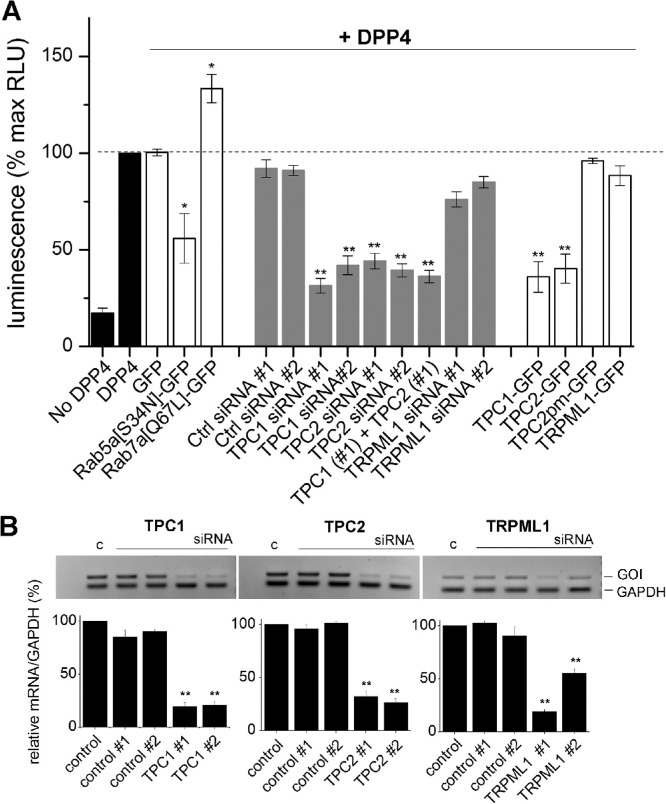
Middle East Respiratory Syndrome coronavirus (MERS-CoV) infections are associated with a significant mortality rate, and existing drugs show poor efficacy. Identifying novel targets/pathways required for MERS infectivity is therefore important for developing novel therapeutics. As an enveloped virus, translocation through the endolysosomal system provides one pathway for cellular entry of MERS-CoV. In this context, Ca2+-permeable channels within the endolysosomal system regulate both the luminal environment and trafficking events, meriting investigation of their role in regulating processing and trafficking of MERS-CoV. Knockdown of endogenous two-pore channels (TPCs), targets for the Ca2+ mobilizing second messenger NAADP, impaired infectivity in a MERS-CoV spike pseudovirus particle translocation assay. This effect was selective as knockdown of the lysosomal cation channel mucolipin-1 (TRPML1) was without effect. Pharmacological inhibition of NAADP-evoked Ca2+ release using several bisbenzylisoquinoline alkaloids also blocked MERS pseudovirus translocation. Knockdown of TPC1 (biased endosomally) or TPC2 (biased lysosomally) decreased the activity of furin, a protease which facilitates MERS fusion with cellular membranes. Pharmacological or genetic inhibition of TPC1 activity also inhibited endosomal motility impairing pseudovirus progression through the endolysosomal system. Overall, these data support a selective, spatially autonomous role for TPCs within acidic organelles to support MERS-CoV translocation.

Keywords: Ca(2+) signaling; Endosomes; Infectious disease; Lysosomes; NAADP.


Figures

None
Graphical abstract
Fig. 1
Fig. 1
MERS-pseudovirus assay validation. A, Top, schematic representation of MERS-pseudovirus infection pathway, highlighting individual processes during MERS translocation (binding, internalization, trafficking, release) that are targets for pharmacotherapy. MERS particle association with DPP4 (the host entry receptor) is followed by DPP4-dependent internalization and trafficking through acidic Ca2+ stores and release of luciferase-encoding RNA into the cytoplasm of infected cells after fusion with internal membranes. Note, the pseudovirus translocation assay used for these experiments is replication defective and reports only virus translocation. Bottom, trafficking events through the endolysosomal system are regulated by the activity of ion channels resident within these acidic Ca2+ stores, including members of the TRPML (activated by PI(3,5)P2) and TPC family (activated by NAADP and PI(3,5)P2). B, Effect of drug incubation (spanning 1 h prior to pseudovirus addition and for a 5 h co-incubation after) on MERS infectivity measured in terms of luminescence intensity measured 3 days post-infection. Drug concentrations were: ouabain (100 nM), chlorpromazine (10 μM), chloroquine (10 μM), NH4Cl (5 mM), BAPTA-AM (10 μM), bafilomycin (100 nM). Pseudovirus infectivity was unaffected by the presence of DMSO (0.1%) as drug vehicle. C, Delayed exposure to bafilomycin (†, 6 h exposure, 5 h after pseudovirus addition) attenuated the inhibitory effect of bafilomycin (100 nM) on MERS infectivity. Data from each experiment are normalized to untreated control samples, and values represent mean ± SEM from three or more independent experiments. p-values, ** p < 0.01, * p < 0.05, calculated relative to DMSO sample.
Fig. 2
Fig. 2
Knockdown of TPCs inhibits MERS pseudovirus translocation. A, Effect of construct overexpression or endogenous protein knockdown (grey bars), on MERS infectivity. All experiments were done in HEK293 cells co-transfected with the MERS entry receptor DPP4, which enhanced infectivity (black). p-values: ** p < 0.01, * p < 0.05. B, Top, representative gel images of RT-PCR samples from knockdown experiments. Samples from control cells (‘c’) and cells treated with dual control siRNAs and individual channel targeting siRNAs (gene of interest, GOI). Bottom, cumulative measurements quantifying knockdown of TPC1 (left), TPC2 (middle), and TRPML1 (right) as determined by densitometry analysis of RT-PCR samples after electrophoresis. Samples are normalized to GAPDH loading control. cells. p-values: ** p < 0.01, relative to control siRNA#1.
Fig. 3
Fig. 3
MERS-CoV spike protein colocalizes with endolysosomal ion channel positive structures. Huh7 cells were transfected with TPC1-GFP (top, green), TPC2-GFP (middle, green) and GFP-TRPML1 (bottom, green) and subsequently infected with MERS-pseudovirus (red). Cells were fixed, immunostained for MERS-CoV spike protein (spike-AF555) and visualized by confocal microscopy. White boxes in overlay panel (right) show enlarged regions to assess colocalization between the red and green channel. Scalebars, 10 μm (left column) and 1 μm (inset, right).
Fig. 4
Fig. 4
Pharmacological blockade of MERS pseudovirus infectivity. A, Single-concentration drug screening (10μM) to identify ion channel modulators that inhibit MERS pseudovirus translocation. Huh7 cells were treated with indicated drugs for 6 h, starting 1 h prior to incubation with MERS pseudovirus (i.e. a 5 h co-incubation). Drugs represent known modulators of intracellular TRPML (ML-SA1) and TPC channels (ned-19, voltage-operated channel blockers), as well as a series of structurally related bisbenzylisoquinolines encompassing the known TPC blocker tetrandrine. Screened bisbenzylisoquinolines comprised two groupings: tubocurarine-like compounds (light dashed) and tetrandrine-like compounds (heavy dashed). p-values, ** p < 0.01, * p < 0.05. B, Structures representing the two groups of bisbenzylisoquinolines highlighted in ‘A’. 3D confomers were downloaded from PubChem and displayed in PubChem 3D viewer v2.0. C, Complete concentration response relationships for inhibition of MERS translocation by fangchinoline, tetrandrine, berbamine or ned-19. Inset, selectivity index (CC50 for cellular toxicity/ IC50 for pseudovirus translocation) for indicated compounds. D, Inhibition of Ca2+ signals in U2OS cells microinjected with NAADP (100 nM pipette concentration) after drug treatment (0.1% DMSO, 50μM ned-19, 10μM tetrandrine, 10μM fangchinoline, 10 min preincubation). Traces represent average of 3 independent injections, error bars represent S.E.M.
Fig. 5
Fig. 5
TPC1 activity regulates endosomal motility and MERS pseudovirus translocation through acidic Ca2+ stores. A, Effect of incubation with fangchinoline (10 μM, right) on colocalization between TPC1 (top) or TPC2 (bottom, green channels) with MERS CoV spike protein (red) in Huh7 cells. Representative cells used to calculate Pearson’s correlation coefficient (inset, [43]) are shown. B, Colocalization analysis in immunofluorescence samples assessed using Manders’ overlap co-efficient [43], in TPC1- and TPC2- expressing cells treated with vehicle (DMSO, solid) and cells treated with fangchinoline (10 μM, hatched bars), p-values: ** p < 0.01, * p < 0.05. C, Trajectory plots representing dynamics of individual TPC1-positive structures in Huh7 cells. Traces represent projections of 20 randomly selected particles, imaged over a 1 min timeframe under different experimental conditions: control (untransfected), vehicle treated (DMSO, 0.1%), drug treated (10μM, 1 h pretreatment), TPC1-GFP or TPC1[L273 P]-GFP transfected. D, Cumulative quantification of total distance traveled from point of origin by endosomes in Huh7 cells treated with the indicated compounds, p-values: ** p < 0.01, * p < 0.05.
Fig. 6
Fig. 6
Pharmacological and molecular inhibition of TPCs reduces furin activity. A, Huh7 cells were treated with vehicle or fangchinoline (10μM), lysates were harvested from cells, and furin activity was assessed using fluorogenic substrate, Boc-RVRR-AMC. Drug was added either 4 h prior to harvesting (pretreated) or immediately before addition of substrate (acute). Representative traces are shown, linear range used to calculate furin substrate cleavage (RFU/min) is shown using dashed lines. B, Quantification of cumulative data set of furin activity in pharmacologically treated Huh7 lysates. p-values, ** p < 0.01 relative to DMSO control C, HEK293 cells were treated with the indicated siRNAs, lysates were collected and assayed for furin activity. Representative traces are shown, with linear range of substrate cleavage denoted using dashed lines. D, Quantification of cumulative data set of furin activity using siRNA treated HEK293 cells, p-values: ** p < 0.01, relative to non-targeting siRNA treated samples. E, Effect of furin or TMPRSS2 overexpression on pharmacological blockade of MERS-pseudovirus infectivity, p-values: ** p < 0.01 relative to empty vector transfected DMSO treated controls, ## p < 0.01 relative to empty vector transfected samples treated with tetrandrine or fangchinoline. F, Effect of tetrandrine or fangchinoline treatment on Huh7 cells overexpressing TMPRSS2.

References

    1. Zaki A.M., van Boheemen S., Bestebroer T.M., Osterhaus A.D., Fouchier R.A. Isolation of a novel coronavirus from a man with pneumonia in Saudi Arabia. N. Engl. J. Med. 2012;367:1814–1820. - PubMed
    1. Zumla A., Hui D.S., Perlman S. Middle East respiratory syndrome. Lancet. 2015;386:995–1007. - PMC - PubMed
    1. Chan J.F., Lau S.K., To K.K., Cheng V.C., Woo P.C., Yuen K.Y. Middle East respiratory syndrome coronavirus: another zoonotic betacoronavirus causing SARS-like disease. Clin. Microbiol. Rev. 2015;28:465–522. - PMC - PubMed
    1. Zumla A., Chan J.F., Azhar E.I., Hui D.S., Yuen K.Y. Coronaviruses - drug discovery and therapeutic options. Nat. Rev. Drug Discov. 2016;15:327–347. - PMC - PubMed
    1. Raj V.S., Mou H., Smits S.L., Dekkers D.H., Muller M.A., Dijkman R., Muth D., Demmers J.A., Zaki A., Fouchier R.A., Thiel V., Drosten C., Rottier P.J., Osterhaus A.D., Bosch B.J., Haagmans B.L. Dipeptidyl peptidase 4 is a functional receptor for the emerging human coronavirus-EMC. Nature. 2013;495:251–254. - PMC - PubMed

Publication types

MeSH terms