


Asthma-like symptoms: is it always a pulmonary issue?
- PMID: 30123502
- PMCID: PMC6091004
- DOI: 10.1186/s40248-018-0136-5
Asthma-like symptoms: is it always a pulmonary issue?
Abstract
Background: Double aortic arch is a rare congenital and complete vascular ring around trachea and esophagus. It is usually diagnosed during infancy. The symptoms are generally related to respiratory and gastroesophageal tracts.
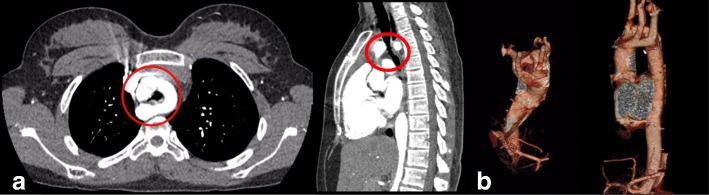
Case presentation: A 20-year-old female patient was referred to our outpatient clinic for persistent dry cough. She had a history of an episode of inhalation of food bolus as an infant and recurrent bronchitis, anorexia and allergic bronchial asthma since the childhood. Since the beginning, an intrathoracic obstruction was suspected at pulmonary function tests. After 1 month of complete asthma treatment, the cough was unchanged and the spirometry confirmed the presence of an intrathoracic obstruction. Then, she underwent a chest CT with contrast medium, a contrast transthoracic echocardiography, a fiberbronchoscopy and an esophageal radiography with contrast medium. The final diagnosis was made and a double aortic arch was found.
Conclusion: A careful observation of the flow/volume curve should always be guaranteed and the presence of congenital vascular anomalies should be suspected in case of difficult-to-treat asthma.
Keywords: Central airway; Double aortic arch; Persistent cough; Spirometry.
Conflict of interest statement
Not applicable. Written signed informed consent for publication of this Case report was obtained from the patient and a copy of the consent form is available for review by the Editor of this Journal. The authors declare that they have no competing interests. AGC is Associate Editor of Multidisciplinary Respiratory Medicine. Springer Nature remains neutral with regard to jurisdictional claims in published maps and institutional affiliations.
Figures

References
-
- Kliegman RM, Stanton B, Geme J, Schor NF, Behrman RE. Annals of Internal Medicine. Philadelphia: Elsevier; 2011.
-
- Uchida DA. Late presentation of double aortic arch in school-age children presumed to have asthma: the benefits of spirometry and examination of the flow-volume curve. Respir Care. 2009;54(10):1402–1404. - PubMed
Publication types
LinkOut - more resources
Full Text Sources
Other Literature Sources
