


Sperm cryopreservation incidence in men with testicular cancer: towards a stabilization in testicular cancer incidence? Results from the CECOS network
- PMID: 30123508
- PMCID: PMC6091093
- DOI: 10.1186/s12610-018-0075-1
Sperm cryopreservation incidence in men with testicular cancer: towards a stabilization in testicular cancer incidence? Results from the CECOS network
Abstract
Background: Testicular cancer (TC) represents 1% of all new male cancer cases but remains the most frequent cancer in adolescents and young adults in industrialized countries. In this study, we assessed time trends in use of sperm cryopreservation by men with TC from 1990 to 2013 in France.
Methods: We collected data from patients diagnosed with TC who underwent sperm cryopreservation in the French national network of sperm banks. Trends in the incidence of sperm cryopreservation were estimated through two statistical models: the commonly used Poisson regression model and the Verhulst model.
Results: Between 1990 and 2013, the overall incidence of sperm cryopreservation rose from 1.73 to 5.57 per 100,000 person-years. Poisson regression predicted an incidence of 9 per 100,000 [95% CI = 8.66-9.34] in 2020. However, since 2005, the observed sperm cryopreservation rate seems to be attenuating. The Verhulst model predicted an incidence of 6 per 100,000 after 2020.
Conclusions: Limitations include the impossibility of analyzing age-standardized incidence. Based on the Verhulst model, results suggest that it is still relevant to follow up TC incidence and sperm cryopreservation in order to confirm or refute the potential decrease already observed in this disease.
Contexte: Le cancer des testicules (CT) représente environ 1% de l’ensemble des cas de cancer chez les hommes, mais il demeure néanmoins le cancer le plus fréquent chez les adolescents et les jeunes adultes dans les pays industrialisés. Dans cette étude, nous avons évalué les variations temporelles des autoconservations de sperme réalisées par les hommes atteints d’un CT entre 1990 et 2013 en France.
Méthodes: Les données proviennent des autoconservations de sperme réalisées auprès de patients diagnostiqués avec CT, issues du réseau national français des banques de sperme. Les tendances de l’incidence des autoconservations de sperme ont été estimées à l’aide de deux modèles statistiques: la régression de Poisson, couramment utilisée, et le modèle de Verhulst.
Résultats: Entre 1990 et 2013, l’incidence globale des autoconservations de sperme est. passée de 1,73 à 5,57 pour 100,000 personnes-années. La régression de Poisson montre une estimation de l’incidence de près de 9 pour 100,000 [IC à 95% = 8,66-9,34] en 2020. Cependant, depuis 2005, le taux observé des autoconservations de sperme semble s’atténuer. Le modèle de Verhulst estime alors une incidence aux alentours de 6 pour 100,000 après 2020.
Conclusions: Les limites de cette étude comprennent l’impossibilité d’analyser l’incidence standardisée sur l’âge. Sur la base du modèle de Verhulst, les résultats suggèrent qu’il est. toujours et encore pertinent d’étudier l’évolution de l’incidence du cancer du testicule et des autoconservations de sperme afin de confirmer ou non la diminution/stagnation potentielle déjà observée dans cette maladie.
Keywords: Cancer trends; Sperm cryopreservation; Statistical models; Testicular cancer.
Conflict of interest statement
The authors declare that they have no competing interests. Not applicable. Not applicable. Springer Nature remains neutral with regard to jurisdictional claims in published maps and institutional affiliations.
Figures
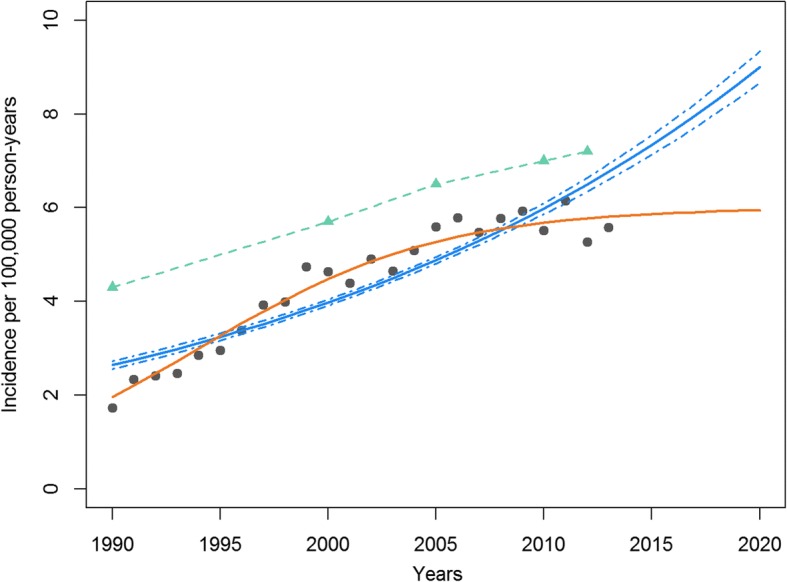
 (green triangle) Incidence of testicular cancer in France between 1990 and 2012 taken from [14].
  (orange line) Estimated incidence of sperm cryopreservation using the Verhulst model.
  (blue line/dashed lines) Estimated incidence of sperm cryopreservation with confidence intervals using the Poisson regression model.
  (gray point) Observed incidence of sperm cryopreservation provided by CECOS data
References
LinkOut - more resources
Full Text Sources
Other Literature Sources
