


Thinking about the past and future in daily life: an experience sampling study of individual differences in mental time travel
- PMID: 30123945
- PMCID: PMC6382594
- DOI: 10.1007/s00426-018-1075-7
Thinking about the past and future in daily life: an experience sampling study of individual differences in mental time travel
Abstract
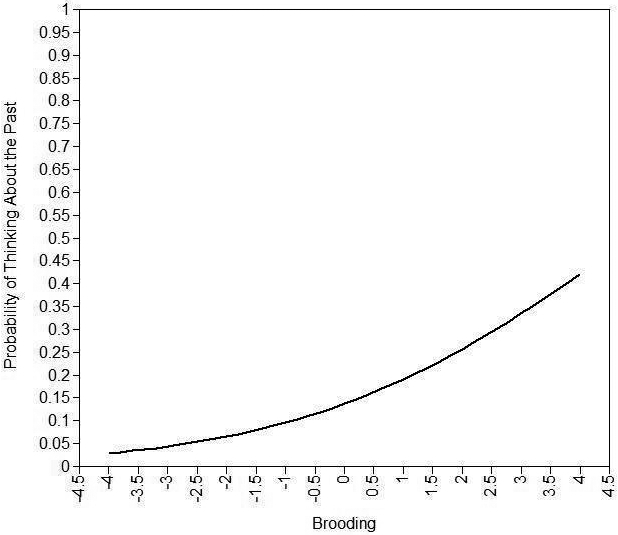
Remembering the past and imagining the future are hallmarks of mental time travel. We provide evidence that such experiences are influenced by individual differences in temporal and affective biases in cognitive style, particularly brooding rumination (a negative past-oriented bias) and optimism (a positive future-oriented bias). Participants completed a 7-day, cellphone-based experience-sampling study of temporal orientation and mental imagery. Multilevel models showed that individual differences in brooding rumination predicted less vivid and positive past- and future-oriented thoughts, even after controlling for depressed mood. People high in brooding rumination were also more likely to report thinking about a past experience when probed at random during the day. Conversely, optimists were more likely to report more vivid and positive future-oriented, but not past-oriented thoughts, although they did not report thinking more or less often about the past and future. The results suggest that temporal and affective biases in cognitive style influence how people think about the past and future in daily life.
Figures
References
-
- Addis DR, Pan L, Vu M, Laiser N, & Schacter DL (2009). Constructive episodic simulation of the future and the past: Distinct subsystems of a core brain network mediate imaging and remembering. Neuropsychologia, 47, 2222–2238. - PubMed
-
- Beaty RE, Burgin CJ, Nusbaum EC, Kwapil TR, Hodges DA, & Silvia PJ (2013). Music to the inner ears: Exploring individual differences in musical imagery. Consciousness and Cognition, 22, 1163–1173. - PubMed
-
- Beaty RE, & Schacter DL (in press). Episodic memory and cognitive control: Contributions to creative idea production In Jung R & Vartanian O (Eds.), The Cambridge handbook of the neuroscience of creativity. New York: Cambridge University Press.
MeSH terms
Grants and funding
LinkOut - more resources
Full Text Sources
Other Literature Sources
Miscellaneous
