


Patterns of Tobacco Product Use and Correlates Among Adults in the Population Assessment of Tobacco and Health (PATH) Study: A Latent Class Analysis
- PMID: 30125013
- PMCID: PMC6093445
- DOI: 10.1093/ntr/nty025
Patterns of Tobacco Product Use and Correlates Among Adults in the Population Assessment of Tobacco and Health (PATH) Study: A Latent Class Analysis
Abstract
Introduction: As the tobacco industry and market evolves, there is a growing need to understand the patterns of use of tobacco products and how they relate to demographics, dependency, withdrawal, and quit behavior.
Methods: We analyzed data from wave 1 of the PATH Study consisting of 14856 individuals. Current users were defined as consuming at least 1 of 10 tobacco products. We performed a latent class analysis (LCA) to identify patterns of tobacco use. We used multinomial regression analysis to explore the association between these patterns with covariates representing socioeconomic status dependence/addiction, past quit attempts, and withdrawal severity.
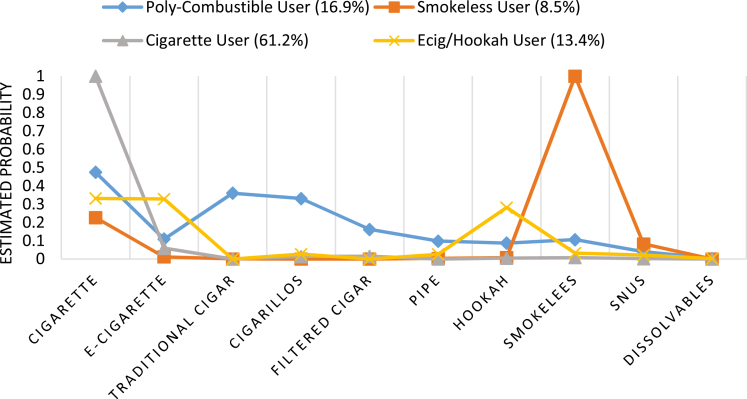
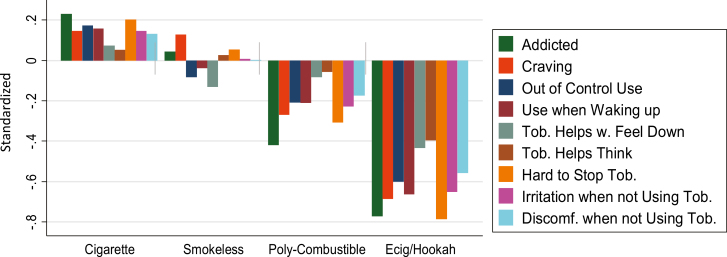
Results: We identified four groups of current tobacco users with distinct profiles: (1) 61% of the sample were identified as cigarette-only users; (2) 9% were smokeless tobacco users; (3) 17% of the sample were characterized by being current users of all types of combustible tobacco including cigars, cigarillos, filtered cigars, and smoking a pipe (4) finally, 13% were e-cig and hookah users. All classes also shared a varying frequency of cigarette use. Exclusive cigarette users were more likely to be older and female, and experienced higher dependency and withdrawal. Users of e-cigs and hookah were the younger, most educated of all four subgroups, and presented the lowest dependency and withdrawal among the four groups.
Conclusions: FDA policy makers may want to discourage the use of tobacco products associated with higher tobacco dependency, and products that may contribute to experiencing higher levels of withdrawal symptoms by the user when trying to quit.
Implications: We identified four patterns of tobacco product use that are significantly related to demographic characteristics, dependency, and withdrawal. Policies should target users more likely to use tobacco products that increase dependency and withdrawal, making quitting more difficult.
Figures
References
-
- Deeming tobacco products to be subject to the Federal Food, Drug, and Cosmetic Act, as amended by the Family Smoking Prevention and Tobacco Control Act; restrictions on the sale and distribution of tobacco products and required warning statements for tobacco products. Final rule. Fed Regist. 2016;81(90):28973–29106. - PubMed
-
- Courtney R. The health consequences of smoking-50 years of progress: a report of the surgeon general. 2014 US Department of Health and Human Services Atlanta, GA: Department of Health and Human Services, Centers for Disease Control and Prevention, National Center for. Drug & Alcohol Review. 2015;34(6):694–695.
-
- Richardson A, Xiao H, Vallone DM. Primary and dual users of cigars and cigarettes: profiles, tobacco use patterns and relevance to policy. Nicotine Tob Res. 2012;14(8):927–932. - PubMed
Publication types
MeSH terms
Grants and funding
LinkOut - more resources
Full Text Sources
Other Literature Sources
Medical
Research Materials
Miscellaneous
