Comparative Study
. 2018 Aug 20;19(1):621.
doi: 10.1186/s12864-018-4978-1.

Comparative genomic analysis of Staphylococcus lugdunensis shows a closed pan-genome and multiple barriers to horizontal gene transfer

Affiliations
Comparative Study

Comparative genomic analysis of Staphylococcus lugdunensis shows a closed pan-genome and multiple barriers to horizontal gene transfer

Xavier Argemi et al. BMC Genomics. .

Abstract

Background: Coagulase negative staphylococci (CoNS) are commensal bacteria on human skin. Staphylococcus lugdunensis is a unique CoNS which produces various virulence factors and may, like S. aureus, cause severe infections, particularly in hospital settings. Unlike other staphylococci, it remains highly susceptible to antimicrobials, and genome-based phylogenetic studies have evidenced a highly conserved genome that distinguishes it from all other staphylococci.

Results: We demonstrate that S. lugdunensis possesses a closed pan-genome with a very limited number of new genes, in contrast to other staphylococci that have an open pan-genome. Whole-genome nucleotide and amino acid identity levels are also higher than in other staphylococci. We identified numerous genetic barriers to horizontal gene transfer that might explain this result. The S. lugdunensis genome has multiple operons encoding for restriction-modification, CRISPR/Cas and toxin/antitoxin systems. We also identified a new PIN-like domain-associated protein that might belong to a larger operon, comprising a metalloprotease, that could function as a new toxin/antitoxin or detoxification system.

Conclusion: We show that S. lugdunensis has a unique genome profile within staphylococci, with a closed pan-genome and several systems to prevent horizontal gene transfer. Its virulence in clinical settings does not rely on its ability to acquire and exchange antibiotic resistance genes or other virulence factors as shown for other staphylococci.

Keywords: CRISPR; Comparative genomics; Core genome; Pan genome; Restriction-modification; Staphylococcus lugdunensis; Toxin/antitoxin.


Conflict of interest statement

Ethics approval and consent to participate

Not applicable.

Consent for publication

Not applicable.

Competing interests

The authors declare that they have no competing interests.

Publisher’s Note

Springer Nature remains neutral with regard to jurisdictional claims in published maps and institutional affiliations.

Figures

Fig. 1
Fig. 1
Pan-genome and core genome development plot projections for S. lugdunensis (Panel a and b), S. epidermidis (Panel c and d), and S. aureus (Panel e and f). All calculations were done using the EDGAR software platform. For pan-genome development plot extrapolation: the red curve shows the fitted exponential Heaps’ low function, and the blue and green curves indicate the upper and lower boundary of the 95% confidence interval. For Core genome development plot extrapolation: the red curve shows the fitted exponential decay function, and the blue and green curves indicate the upper and lower boundary of the 95% confidence interval
Fig. 2
Fig. 2
Phylogenetic tree illustrating genetic relationships between strains. The phylogenetic tree was built based on the complete core genome of the analyzed strains. Alignments of the each individual core gene set were generated using MUSCLE and subsequently concatenated to one large supermatrix. Fasttree was used to infer a maximum likelihood tree from this core gene alignment. Shimodaira-Hasegawa support values. Calculations were made for the three species and show that they form three clearly separated clusters within the phylogenetic tree
Fig. 3
Fig. 3
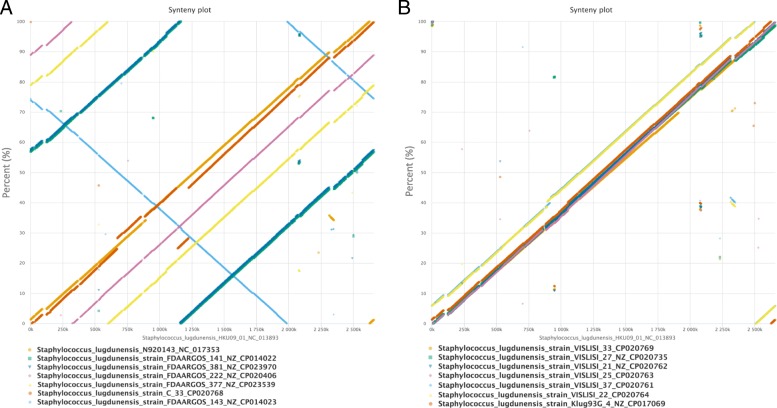
Structural genomic comparison of S. lugdunensis reference strain HKU0901 with the 14 other complete S. lugdunensis genomes. Synteny plots were produced by using EDGAR web server, showing the stop positions of orthologous gene pairs in different genomes. S. lugdunensis HKU09101 genome was compared with the 14 other genomes by splitting the analysis in two for better visual representation (panel a and b). Although some genomes have differing start positions, they all show a high degree of co-linearity, indicating a high level of relatedness and a low level of genomic rearrangement activity within the nalayzed set
Fig. 4
Fig. 4
COG functional categories from the core genome of S. lugdunensis, S. aureus, and S. epidermidis strains. Gene lists were predicted using the EDGAR web server, and COG categories obtained by loading them into the WebMGA web server. COG categories are as follows: for cellular processes and signaling, d is cell cycle control, cell division, and chromosome partitioning; m is cell wall/membrane/envelope biogenesis; n is cell motility; o is post-translational modification, protein turnover, and chaperones; t is signal transduction mechanisms; u is intracellular trafficking, secretion, and vesicular transport; v is defense mechanisms; and z is cytoskeleton. For information storage and processing, b is chromatin structure and dynamics; j is translation, ribosomal structure, and biogenesis; k is transcription; and l is replication, recombination, and repair. For metabolism, c is energy production and conversion; e is amino acid transport and metabolism; f is nucleotide transport and metabolism; g is carbohydrate transport and metabolism; h is coenzyme transport and metabolism; i is lipid transport and metabolism; p is inorganic ion transport and metabolism; and q is secondary metabolite biosynthesis, transport, and catabolism. r is for general function prediction only, and s for unknown function
Fig. 5
Fig. 5
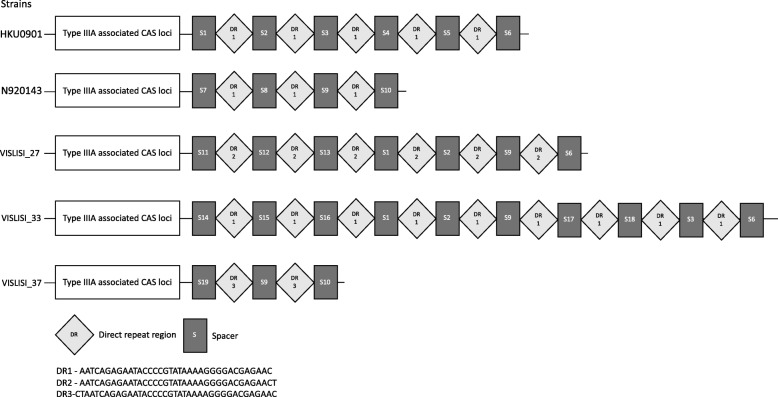
DR sequences and spacers in type IIIA CRISPR/Cas systems from S. lugdunensis
Fig. 6
Fig. 6
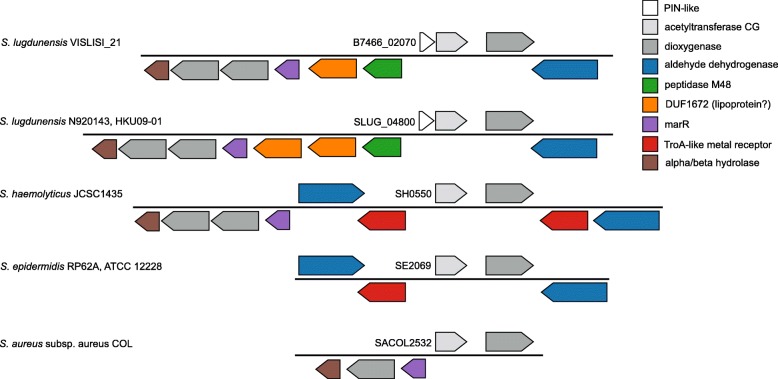
Genomic context of the PIN-like domain coding sequence of S. lugdunensis and other staphylococci

References

    1. Argemi X, Hansmann Y, Riegel P, Prévost G. Is Staphylococcus lugdunensis significant in clinical samples? J Clin Microbiol. 2017;55(11):3167–3174. doi: 10.1128/JCM.00846-17. - DOI - PMC - PubMed
    1. Argemi X, Riegel P, Lavigne T, Lefebvre N, Grandpré N, Hansmann Y, et al. Implementation of MALDI-TOF MS in routine clinical laboratories improves identification of coagulase negative staphylococci and reveals the pathogenic role of Staphylococcus lugdunensis. J Clin Microbiol. 2015;53(7):2030–2036. doi: 10.1128/JCM.00177-15. - DOI - PMC - PubMed
    1. Argemi X, Prévost G, Riegel P, Keller D, Meyer N, Baldeyrou M, et al. VISLISI trial, a prospective clinical study allowing identification of a new metalloprotease and putative virulence factor from Staphylococcus lugdunensis. Clin Microbiol Infect Off Publ Eur Soc Clin Microbiol Infect Dis. 2017;23:334. - PubMed
    1. Foster TJ, Geoghegan JA, Ganesh VK, Höök M. Adhesion, invasion and evasion: the many functions of the surface proteins of Staphylococcus aureus. Nat Rev Microbiol. 2014;12:49–62. doi: 10.1038/nrmicro3161. - DOI - PMC - PubMed
    1. Argemi X, Martin V, Loux V, Dahyot S, Lebeurre J, Guffroy A, et al. Whole-genome sequencing of seven strains of Staphylococcus lugdunensis allows identification of mobile genetic elements. Genome Biol Evol. 2017;9 - PMC - PubMed

Publication types

Substances

LinkOut - more resources