Review
. 2018 Sep;21(9):1148-1160.
doi: 10.1038/s41593-018-0210-5. Epub 2018 Aug 20.

Cognitive computational neuroscience

Affiliations
Review

Cognitive computational neuroscience

Nikolaus Kriegeskorte et al. Nat Neurosci. 2018 Sep.

Abstract

To learn how cognition is implemented in the brain, we must build computational models that can perform cognitive tasks, and test such models with brain and behavioral experiments. Cognitive science has developed computational models that decompose cognition into functional components. Computational neuroscience has modeled how interacting neurons can implement elementary components of cognition. It is time to assemble the pieces of the puzzle of brain computation and to better integrate these separate disciplines. Modern technologies enable us to measure and manipulate brain activity in unprecedentedly rich ways in animals and humans. However, experiments will yield theoretical insight only when employed to test brain-computational models. Here we review recent work in the intersection of cognitive science, computational neuroscience and artificial intelligence. Computational models that mimic brain information processing during perceptual, cognitive and control tasks are beginning to be developed and tested with brain and behavioral data.


Conflict of interest statement

Competing interests

The authors declare no competing interests.

Figures
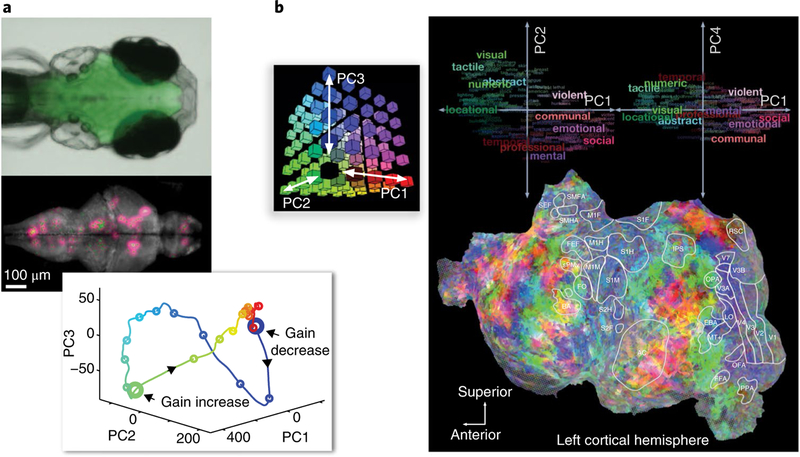
Fig. 1 |
Fig. 1 |. Modern imaging techniques provide unprecedentedly detailed information about brain activity, but data-driven analyses support only limited insights.
a, Two-photon calcium imaging results show single-neuron activity for a large population of cells measured simultaneously in larval zebrafish while the animals interact with a virtual environment. b, Human fMRI results reveal a detailed map of semantically selective responses while a subject listened to a story. These studies illustrate, on the one hand, the power of modern brain-activity measurement techniques at different scales (a,b) and, on the other, the challenge of drawing insights about brain computation from such datasets. Both studies measured brain activity during complex, time-continuous, naturalistic experience and used principal component analysis (a, bottom; b, top) to provide an overall view of the activity patterns and their representational significance. PC, principal component.
Fig. 2 |
Fig. 2 |. What does it mean to understand how the brain works?
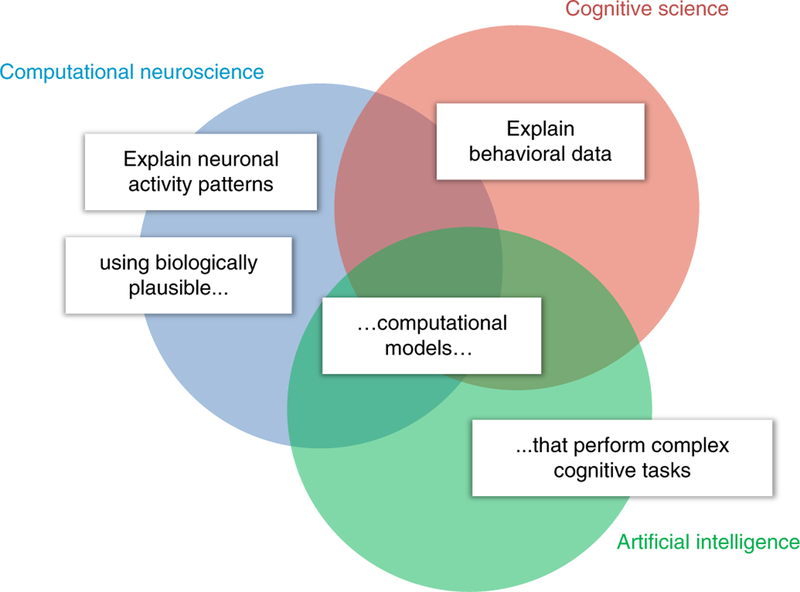
The goal of cognitive computational neuroscience is to explain rich measurements of neuronal activity and behavior in animals and humans by means of biologically plausible computational models that perform real-world cognitive tasks. Historically, each of the disciplines (circles) has tackled a subset of these challenges (white labels). Cognitive computational neuroscience strives to meet all the challenges simultaneously.
Fig. 3 |
Fig. 3 |. The space of process models.
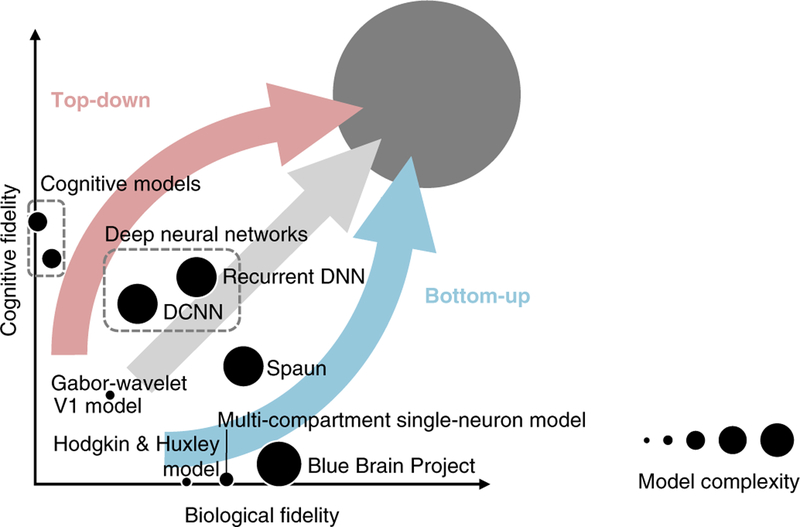
Models of the processes taking place in the brain can be defined at different levels of description and can vary in their parametric complexity (dot size) and in their biological (horizontal axis) and cognitive (vertical axis) fidelity. Theoreticians approach modeling with a range of primary goals. The bottom-up approach to modeling (blue arrow) aims first to capture characteristics of biological neural networks, such as action potentials and interactions among multiple compartments of single neurons. This approach disregards cognitive function so as to focus on understanding the emergent dynamics of small parts of the brain, such as cortical columns and areas, and to reproduce biological network phenomena, such as oscillations. The top-down approach (red arrow) aims first to capture cognitive functions at the algorithmic level. This approach disregards the biological implementation so as to focus on decomposing the information processing underlying task performance into its algorithmic components. The two approaches form the extremes of a continuum of paths toward the common goal of explaining how our brains give rise to our minds. Overall, there is tradeoff (negative correlation) between cognitive and biological fidelity. However, the tradeoff can turn into a synergy (positive correlation) when cognitive constraints illuminate biological function and when biology inspires models that explain cognitive feats. Because intelligence requires rich world knowledge, models of human brain information processing will have high parametric complexity (large dot in the upper right corner). Even if models that abstract from biological details can explain task performance, biologically detailed models will still be needed to explain the neurobiological implementation. This diagram is a conceptual cartoon that can help us understand the relationships between models and appreciate their complementary contributions. However, it is not based on quantitative measures of cognitive fidelity, biological fidelity and model complexity. Definitive ways to measure each of the three variables have yet to be developed. Figure inspired by ref..

References

    1. Newell A You can’t play 20 questions with nature and win: projective comments on the papers of this symposium. Technical Report, School of Computer Science, Carnegie Mellon University (1973).
    1. Lake BM, Ullman TD, Tenenbaum JB & Gershman SJ Building machines that learn and think like people. Behav. Brain Sci 40, e253 (2017). - PubMed
    1. Kriegeskorte N & Mok RM Building machines that adapt and compute like brains. Behav. Brain Sci 40, e269 (2017). - PubMed
    1. Simon HA & Newell A Human problem solving: the state of the theory in 1970. Am. Psychol 26, 145–159 (1971).
    1. Anderson JR The Architecture of Cognition (Harvard Univ. Press, Cambridge, MA, USA, 1983).

LinkOut - more resources