Multicenter Study
. 2018 Sep;3(9):1063-1073.
doi: 10.1038/s41564-018-0217-4. Epub 2018 Aug 20.

Dynamics of antimicrobial resistance in intestinal Escherichia coli from children in community settings in South Asia and sub-Saharan Africa

Affiliations
Multicenter Study

Dynamics of antimicrobial resistance in intestinal Escherichia coli from children in community settings in South Asia and sub-Saharan Africa

Danielle J Ingle et al. Nat Microbiol. 2018 Sep.

Abstract

The dynamics of antimicrobial resistance (AMR) in developing countries are poorly understood, especially in community settings, due to a sparsity of data on AMR prevalence and genetics. We used a combination of phenotyping, genomics and antimicrobial usage data to investigate patterns of AMR amongst atypical enteropathogenic Escherichia coli (aEPEC) strains isolated from children younger than five years old in seven developing countries (four in sub-Saharan Africa and three in South Asia) over a three-year period. We detected high rates of AMR, with 65% of isolates displaying resistance to three or more drug classes. Whole-genome sequencing revealed a diversity of known genetic mechanisms for AMR that accounted for >95% of phenotypic resistance, with comparable rates amongst aEPEC strains associated with diarrhoea or asymptomatic carriage. Genetic determinants of AMR were associated with the geographic location of isolates, not E. coli lineage, and AMR genes were frequently co-located, potentially enabling the acquisition of multi-drug resistance in a single step. Comparison of AMR with antimicrobial usage data showed that the prevalence of resistance to fluoroquinolones and third-generation cephalosporins was correlated with usage, which was higher in South Asia than in Africa. This study provides much-needed insights into the frequency and mechanisms of AMR in intestinal E. coli in children living in community settings in developing countries.


Conflict of interest statement

The authors declare no competing interests.

Figures
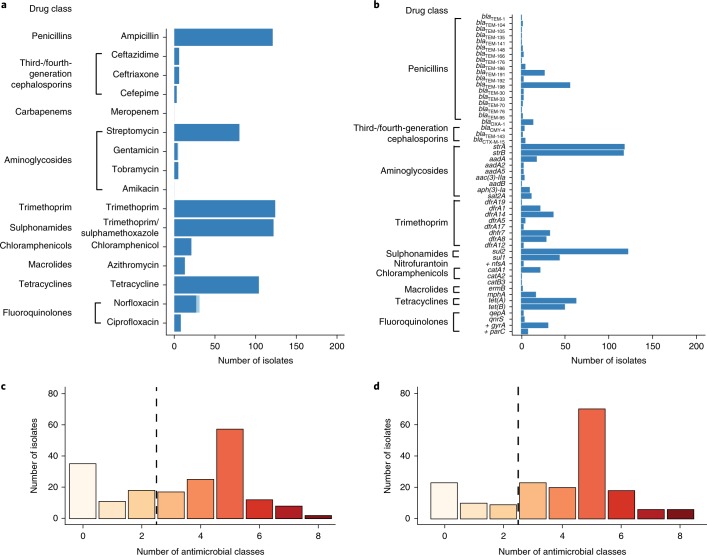
Fig. 1
Fig. 1. Prevalence of AMR-associated gene content and AMR phenotypes in 185 aEPEC isolates.
a,c AMR phenotypes of the aEPEC isolates. a, AMR profiles grouped by the drug class to which aEPEC strains were phenotypically resistant. c, Histogram illustrating the number of drug classes to which aEPEC strains were phenotypically resistant. b,d AMR-associated gene content of aEPEC strains. b, Genes detected in the genomes associated with AMR are shown to the left of the graph and are grouped by drug class. Gene that contain point mutations that result in AMR and that are not acquired through horizontal gene transfer are indicated with a cross. d, Histogram illustrating the number of classes to which aEPEC strains were detected as having AMR-associated gene content.
Fig. 2
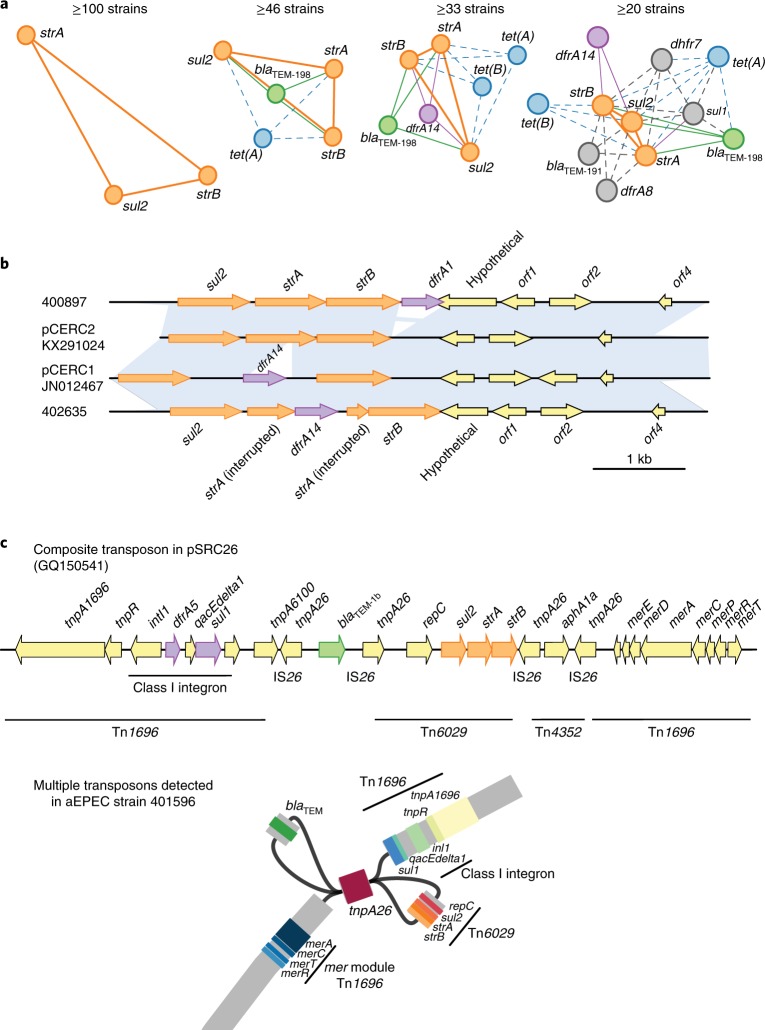
Fig. 2. Co-occurrence and characterization of common mobile elements of AMR-associated genes in aEPEC strains.
a, Visualization of AMR gene co-occurrence networks among GEMS aEPEC strains, using different frequency thresholds. Solid lines join genes that occur together on known mobile elements at a high frequency; dashed lines join genes that occur together on known mobile elements at a lower frequency. The mean frequency of co-occurrence in strains was 6.4, with standard deviation 13.1. b, BLAST comparison of pCERC1 and pCERC2 to representative plasmids from two GEMS aEPEC strains (400897 and 402635). Blue shading indicates regions of sequence homology. c, Gene arrangement in composite transposons previously identified in Salmonella plasmid pSRC26 and assembly graph for GEMS aEPEC strain 401596, showing how this composite transposon appears in assemblies inferred from short-read Illumina data. The assembly graph was visualized in Bandage; coloured blocks indicate BLAST hits to AMR genes as labelled.
Fig. 3
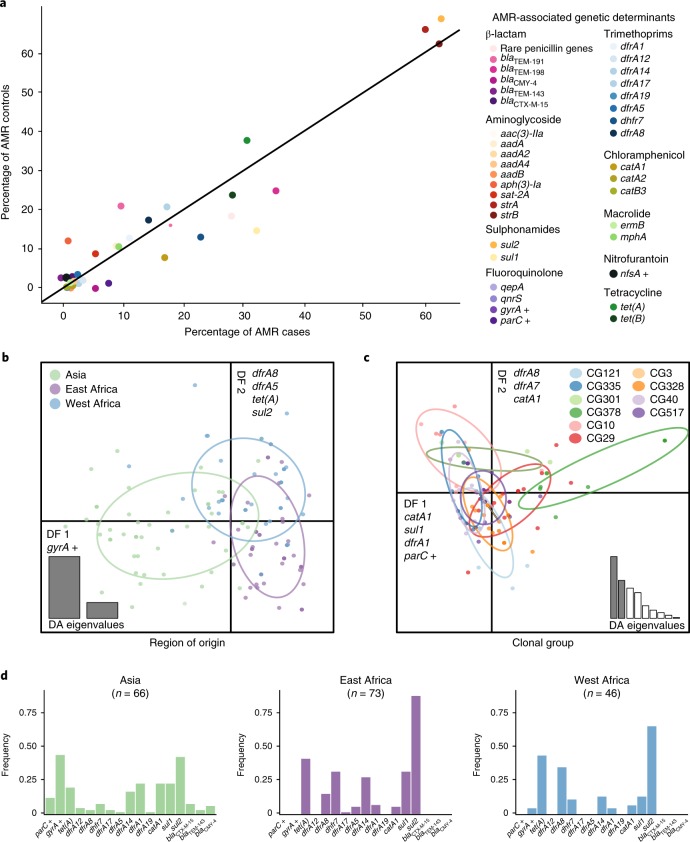
Fig. 3. AMR gene content is explained by region of isolation, not disease status or clonal group.
a, Frequencies of AMR-associated genes in aEPEC by case or control status. Genes encoding AMR are shown to the right of the graph and are grouped by drug class. b,c, Discriminant analysis of principal components based on known genetic determinants of AMR. The graphs display the discriminant functions (DF) that best discriminate isolates into region of isolation (b, n = 185) or clonal group (c, n = 137). Data points are coloured coded according to their demographic group (see legend) and the genetic determinants most correlated with the DFs are labelled on the DF axes. Eigenvalues, corresponding to the ratio of the variance between groups over the variance within groups for each principal component in the discriminant function, are displayed in the insets. d, Frequency of AMR genetic determinants that differed between Asia, East Africa and West Africa. Genes that contain point mutations that result in AMR and that are not acquired through horizontal gene transfer are indicated with a cross.
Fig. 4
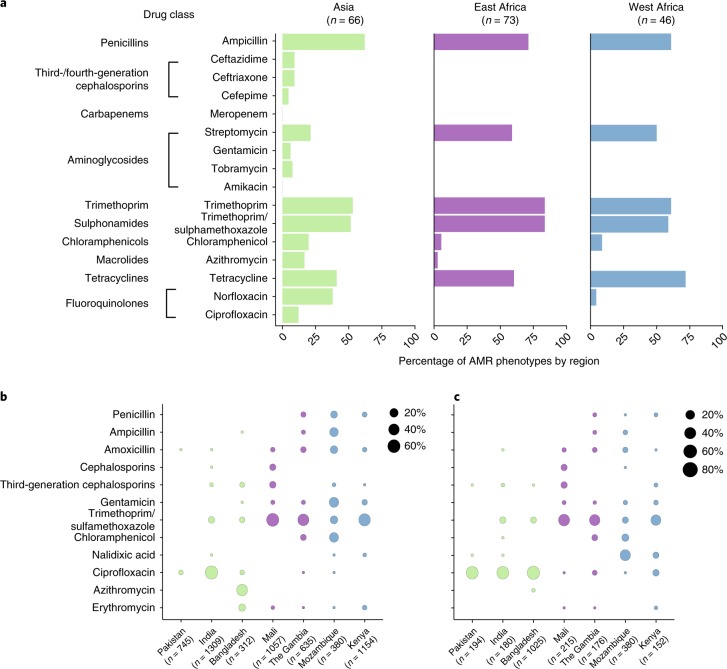
Fig. 4. AMR phenotypes by region and antimicrobial use at study sites.
a, AMR phenotypes of GEMS isolates, stratified by region of isolation. b,c, Percentage of antimicrobials prescribed to patients with watery diarrhoea (b) or dysentery (c) at each of the seven study sites.
Fig. 5
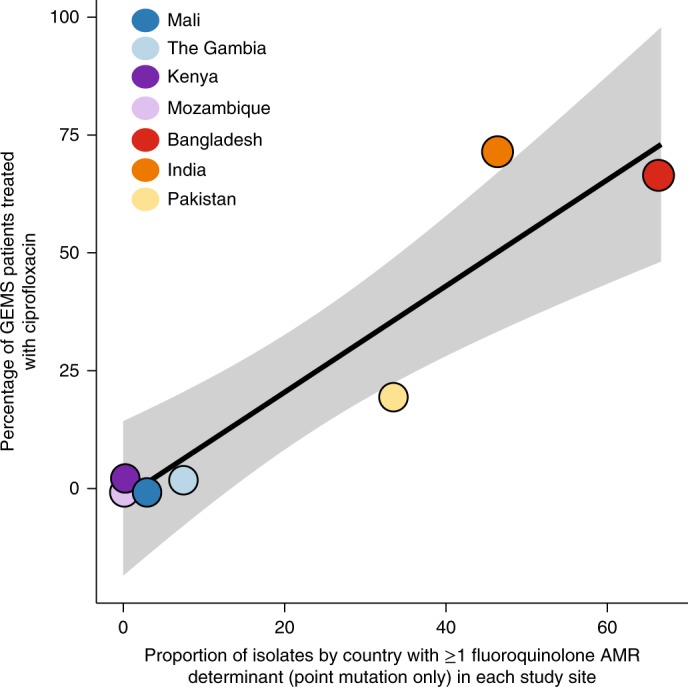
Fig. 5. Relationship between the use of ciprofloxacin at GEMS study sites and ciprofloxacin resistance in aEPEC.
Linear regression (mean ± 95% confidence interval shaded in grey) of the proportion of aEPEC containing genetic determinants of ciprofloxacin resistance (from point mutations only) versus the proportion of watery diarrhoea and dysentery cases treated with ciprofloxacin at GEMS study sites.

References

    1. Kotloff KL, et al. Burden and aetiology of diarrhoeal disease in infants and young children in developing countries (the Global Enteric Multicenter Study, GEMS): a prospective, case-control study. Lancet. 2013;382:209–222. - PubMed
    1. Robins-Browne RM, et al. Are Escherichia coli pathotypes still relevant in the era of whole-genome sequencing? . Front. Cell. Infect. Microb. 2016;6:5222–5229. - PMC - PubMed
    1. Afset JE, Bevanger L, Romundstad P, Bergh K. Association of atypical enteropathogenic Escherichia coli (EPEC) with prolonged diarrhoea. J. Med. Microbiol. 2004;53:1137–1144. - PubMed
    1. Nguyen RN, Taylor LS, Tauschek M, Robins-Browne RM. Atypical enteropathogenic Escherichia coli infection and prolonged diarrhea in children. Emerg. Infect. Dis. 2006;12:597–603. - PMC - PubMed
    1. Vieira MA, et al. Atypical enteropathogenic Escherichia coli as aetiologic agents of sporadic and outbreak-associated diarrhoea in Brazil. J. Med. Microbiol. 2016;65:998–1006. - PubMed

Publication types

MeSH terms

Substances