Review
. 2018 Aug;54(3):139-149.
doi: 10.1016/j.jdsr.2018.03.005. Epub 2018 May 7.

Application of computer-assisted navigation systems in oral and maxillofacial surgery

Affiliations
Review

Application of computer-assisted navigation systems in oral and maxillofacial surgery

Shintaro Sukegawa et al. Jpn Dent Sci Rev. 2018 Aug.

Abstract

The oral and maxillofacial region has a complicated anatomy with critical contiguous organs, including the brain, eyes, vital teeth, and complex networks of nerves and blood vessels. Therefore, advances in basic scientific research within the field of intraoperative oral and maxillofacial surgery have enabled the introduction of the features of these techniques into routine clinical practice to ensure safe and reliable surgery. A navigation system provides a useful guide for safer and more accurate complex in oral and maxillofacial surgery. The effectiveness of a navigation system for oral and maxillofacial surgery has been indicated by clinical applications in maxillofacial trauma surgery including complex midfacial fractures and orbital trauma reconstruction, foreign body removal, complex dentoalveolar surgery, skull base surgery including surgery of the temporomandibular joint (TMJ), and orthognathic surgery. However, some fundamental issues remain involving the mobility of the mandible and difficulty in updating images intraoperatively. This report presents an overview and feasible applications of available navigation systems with a focus on the clinical feasibility of the application of navigation systems in the field of oral and maxillofacial surgery and solutions to current problems.

Keywords: Navigation systems; Oral and maxillofacial surgery; Review.


Figures
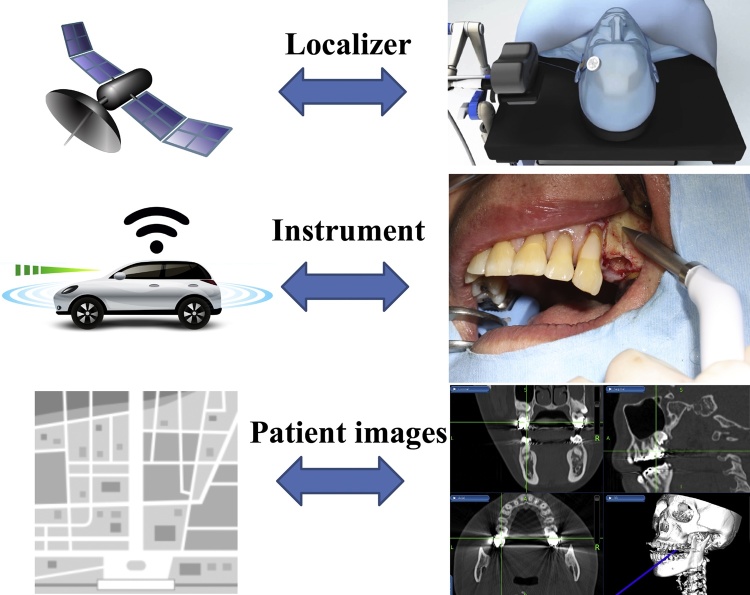
Figure 1
Figure 1
Components of a surgical navigation system. Navigation system is comparable to a global positioning system (GPS) commonly used in automobiles and is composed of three primary components: a localizer, which is analogous to a satellite in space; an instrument or surgical probe, which represents the track waves emitted by the GPS unit in the vehicle; and a CT scan data set, which is analogous to a road map.
Figure 2
Figure 2
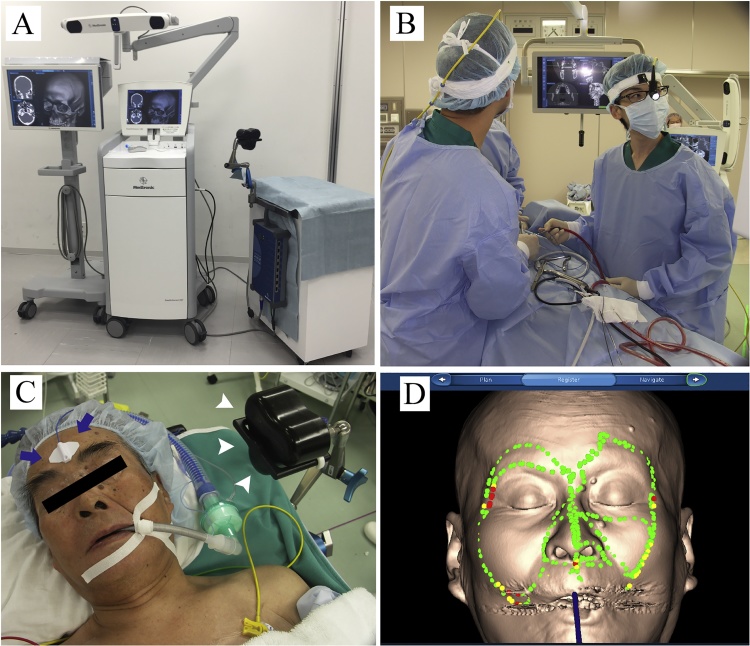
(A) The StealthStation surgical navigation system. This system has accurate patient registration software and advanced visualization to navigate the maxillofacial area. (B) Intraoperative referencing and image-to-patient registration of the image-guided visualization display and the navigation unit. (C) Preparation for registration using the reference points (arrows) and magnetic field generator (arrowheads) in place before final draping. (D) Marker-free registration with the tracer probe.
Figure 3
Figure 3
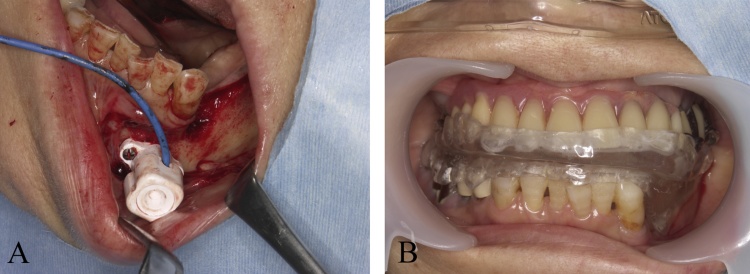
The application of navigation in the mandible. (A) The direct tracking of the mandible via a sensor frame and tooth/mandible-supported fiducial markers. (B) The mandibular position in a reproducible posture or a defined position against the maxilla using an occlusion splint.
Figure 4
Figure 4
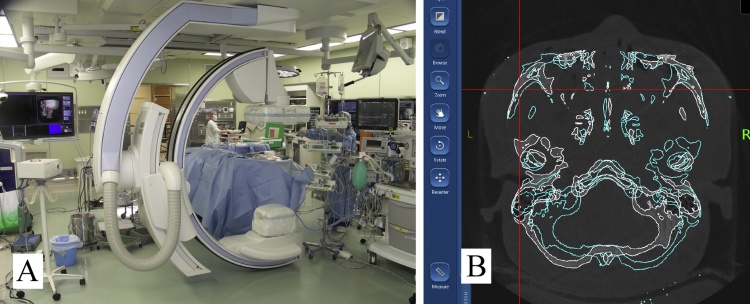
(A) An intraoperative C-arm CT system. (B) Use of navigation system with updated CT images acquired intraoperatively.
Figure 5
Figure 5
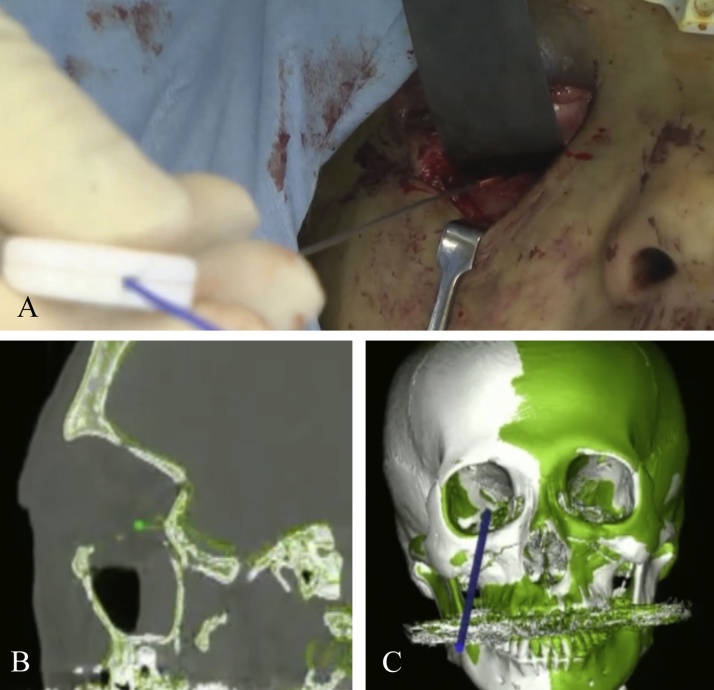
A navigation-assisted orbital floor reconstruction using the mirroring technique. (A) The reconstructed site was confirmed to match the mirror image using a tip pointer with a navigation system. (B) Screenshot of the navigation system showing a multiplane view of the position of the navigation probe in relation to the reconstructed orbit at the time of location. The white line shows the reconstructed orbital planning image created using the mirroring technique. (C) Confirming the accuracy of the reconstructed orbital floor on the mirrored 3D image.
Figure 6
Figure 6
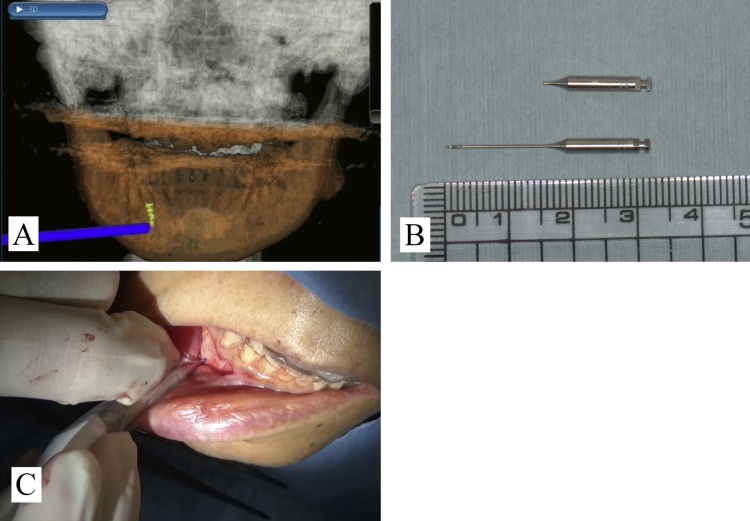
Removal of a foreign body (adapted and modified from Ref. [5]). (A) Screenshot of the navigation system showing the position of the navigation probe in relation to the broken endodontic instrument fragment at the time of its location in the mandible. (B) A broken endodontic instrument. (C) The location of the broken instrument was accurately confirmed using a navigation system.
Figure 7
Figure 7
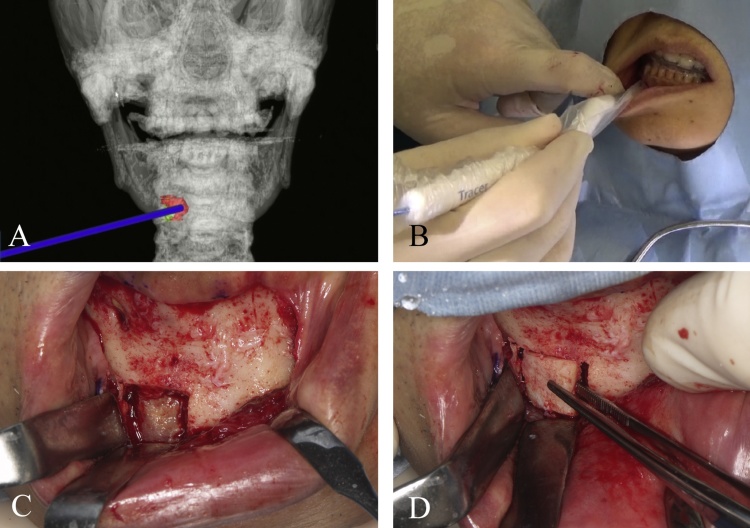
Dental alveolar surgery for bone lid surgery (adapted and modified from Ref. [26]). (A) Screenshot of the intraoperative real-time navigation system showing a 3D view of the position of the navigation probe in relation to the mandibular lesion at the time of location. (B) The location of the mandibular lesion was accurately confirmed using a navigation system. (C) Accurate removal of the bone lid provided precise access to the lesion in the mandible. (D) The bone lid was completely replaced in its former position.
Figure 8
Figure 8
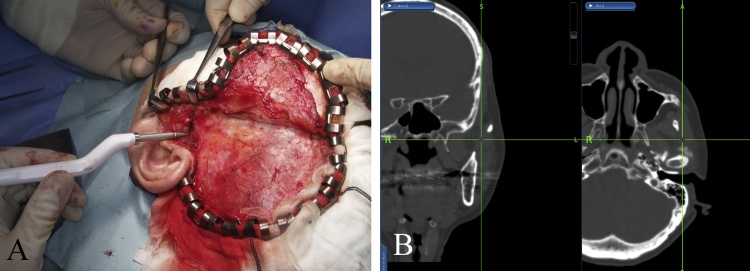
(A) Intraoperative photograph demonstrating the approach for surgical resection to include composite resection of the TMJ via the coronal approach. (B) Navigation used to assist in safe and accurate TMJ resection.

References

    1. Hannen E.J.M. Recreating the original contour in tumor deformed mandibles for plate adapting. Int J Oral Maxillofac Surg. 2006;35:183–185. - PubMed
    1. Azarmehr I., Stokbro K., Bell R.B., Thygesen T. Surgical navigation: a systematic review of indications, treatments, and outcomes in oral and maxillofacial surgery. J Oral Maxillofac Surg. 2017;75:1987–2005. - PubMed
    1. Barnett G.H. Surgical management of convexity and falcine meningiomas using interactive image-guided surgery systems. Neurosurg Clin N Am. 1996;7:279–284. - PubMed
    1. Berger M., Nova I., Kallus S., Ristow O., Eisenmann U., Freudlsperger C. Electromagnetic navigated positioning of the maxilla after Le Fort I osteotomy in preclinical orthognathic surgery cases. Oral Surg Oral Med Oral Pathol Oral Radiol. 2017;123:298–304. - PubMed
    1. Sukegawa S., Kanno T., Shibata A., Matsumoto K., Sukegawa-Takahashi Y., Sakaida K. Use of an intraoperative navigation system for retrieving a broken dental instrument in the mandible: a case report. J Med Case Rep. 2017;11:14. - PMC - PubMed

LinkOut - more resources