


Systematic review of pharmacoeconomic models for schizophrenia
- PMID: 30128087
- PMCID: PMC6095033
- DOI: 10.1080/20016689.2018.1508272
Systematic review of pharmacoeconomic models for schizophrenia
Abstract
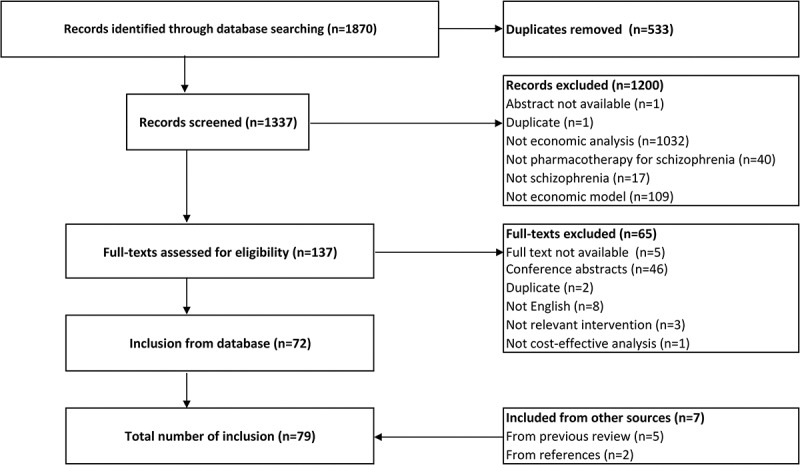
Background: Economic models are broadly used in the economic evaluation of antipsychotics in schizophrenia. Our objective was to summarize the structure of these models. Methods: Model-based economic evaluations of antipsychotics in schizophrenia were identified through Medline and Embase. General information was extracted including analysis type, model type, perspective, population, comparator, outcome, and timeframe. Model-specific structures for decision tree (DT), cohort- and patient-level Markov model (CLMM, PLMM), and discrete-event simulation (DES) models were extracted. Results: A screen of 1870 records identified 79 studies. These were mostly cost-utility analyses (n = 48) with CLMM (n = 32) or DT models (n = 29). They mostly applied payer perspective (n = 68), focused on general schizophrenia for relapse prevention (n = 73), compared pharmacotherapies as first-line (n = 71), and evaluated incremental cost per quality-adjusted life year (QALY) gained (n = 40) with a 1-year (n = 32) or 5-year (n = 26) projection. DT models progressed with the branching points of response, relapse, discontinuation, and adherence. CLMM models transitioned between disease states, whereas PLMM models transitioned between adverse event states with/without disease state. DES models moved forward with times to remission, relapse, psychiatrist visit, and death. Conclusions: A pattern of pharmacoeconomic models for schizophrenia was identified. More subtle structures and patient-level models are suggested for a future modelling exercise.
Keywords: Schizophrenia; antipsychotics; economic model; model structure; pharmacoeconomics; pharmacotherapy.
Similar articles
-
Systematic review of utility values used in the pharmacoeconomic evaluations for schizophrenia: implications on cost-effectiveness results.J Mark Access Health Policy. 2019 Aug 22;7(1):1648973. doi: 10.1080/20016689.2019.1648973. eCollection 2019. J Mark Access Health Policy. 2019. PMID: 31489150 Free PMC article. Review.
-
[Comparison of medical and economic benefits of antipsychotics in the treatment of schizophrenia in France].Encephale. 2017 Aug;43(4):311-320. doi: 10.1016/j.encep.2016.02.021. Epub 2016 Sep 9. Encephale. 2017. PMID: 27623123 French.
-
Cost Effectiveness of Paliperidone Long-Acting Injectable Versus Other Antipsychotics for the Maintenance Treatment of Schizophrenia in France.Pharmacoeconomics. 2016 Apr;34(4):363-91. doi: 10.1007/s40273-015-0348-x. Pharmacoeconomics. 2016. PMID: 26883132 Free PMC article.
-
A Systematic Review of Methods and Study Quality of Economic Evaluations for the Treatment of Schizophrenia.Front Public Health. 2021 Oct 20;9:689123. doi: 10.3389/fpubh.2021.689123. eCollection 2021. Front Public Health. 2021. PMID: 34746073 Free PMC article.
-
When does economic model type become a decisive factor in health technology appraisals? Learning from the expanding treatment options for relapsing-remitting multiple sclerosis.J Med Econ. 2018 Oct;21(10):983-992. doi: 10.1080/13696998.2018.1491007. Epub 2018 Jul 5. J Med Econ. 2018. PMID: 29923439
Cited by
-
Systematic review of utility values used in the pharmacoeconomic evaluations for schizophrenia: implications on cost-effectiveness results.J Mark Access Health Policy. 2019 Aug 22;7(1):1648973. doi: 10.1080/20016689.2019.1648973. eCollection 2019. J Mark Access Health Policy. 2019. PMID: 31489150 Free PMC article. Review.
-
A systematic review of whole disease models for informing healthcare resource allocation decisions.PLoS One. 2023 Sep 14;18(9):e0291366. doi: 10.1371/journal.pone.0291366. eCollection 2023. PLoS One. 2023. PMID: 37708188 Free PMC article.
-
Cost-effectiveness of early intervention in psychosis in low- and middle-income countries: economic evaluation from São Paulo, Brazil.Epidemiol Psychiatr Sci. 2024 Apr 5;33:e21. doi: 10.1017/S2045796024000222. Epidemiol Psychiatr Sci. 2024. PMID: 38576239 Free PMC article.
-
Cost-effectiveness of ten commonly used antipsychotics in first-episode schizophrenia in the UK: economic evaluation based on a de novo discrete event simulation model.Br J Psychiatry. 2025 Aug;227(2):545-552. doi: 10.1192/bjp.2024.251. Br J Psychiatry. 2025. PMID: 39721946 Free PMC article.
-
Systematic review of the methods of health economic models assessing antipsychotic medication for schizophrenia.PLoS One. 2020 Jul 10;15(7):e0234996. doi: 10.1371/journal.pone.0234996. eCollection 2020. PLoS One. 2020. PMID: 32649663 Free PMC article.
References
-
- Jin H, Mosweu I.. The societal cost of schizophrenia: A systematic review. Pharmacoeconomics. 2017;35:25–10. - PubMed
-
- Leucht S, Cipriani A, Spineli L, et al. Comparative effi cacy and tolerability of 15 antipsychotic drugs in schizophrenia: a multiple-treatments meta-analysis. The Lancet. 2013;382:951–962. - PubMed
-
- Revicki DA, Luce BR, Weschler JM, et al. Cost-effectiveness of clozapine for treatment-resistant schizophrenic patients. Hospital and Community Psychiatry. 1990;41:850–854. - PubMed
-
- Achilla E, McCrone P. The cost effectiveness of long-acting/extended-release antipsychotics for the treatment of schizophrenia: a systematic review of economic evaluations. Appl Health Econ Health Policy. 2013;11:95–106. - PubMed
Publication types
LinkOut - more resources
Full Text Sources
Other Literature Sources