. 2018 Aug 17;4(8):eaar8602.
doi: 10.1126/sciadv.aar8602. eCollection 2018 Aug.

Genome mapping of seed-borne allergens and immunoresponsive proteins in wheat

Affiliations

Genome mapping of seed-borne allergens and immunoresponsive proteins in wheat

Angéla Juhász et al. Sci Adv. .

Abstract

Wheat is an important staple grain for humankind globally because of its end-use quality and nutritional properties and its adaptability to diverse climates. For a small proportion of the population, specific wheat proteins can trigger adverse immune responses and clinical manifestations such as celiac disease, wheat allergy, baker's asthma, and wheat-dependent exercise-induced anaphylaxis (WDEIA). Establishing the content and distribution of the immunostimulatory regions in wheat has been hampered by the complexity of the wheat genome and the lack of complete genome sequence information. We provide novel insights into the wheat grain proteins based on a comprehensive analysis and annotation of the wheat prolamin Pfam clan grain proteins and other non-prolamin allergens implicated in these disorders using the new International Wheat Genome Sequencing Consortium bread wheat reference genome sequence, RefSeq v1.0. Celiac disease and WDEIA genes are primarily expressed in the starchy endosperm and show wide variation in protein- and transcript-level expression in response to temperature stress. Nonspecific lipid transfer proteins and α-amylase trypsin inhibitor gene families, implicated in baker's asthma, are primarily expressed in the aleurone layer and transfer cells of grains and are more sensitive to cold temperature. The study establishes a new reference map for immunostimulatory wheat proteins and provides a fresh basis for selecting wheat lines and developing diagnostics for products with more favorable consumer attributes.


Figures
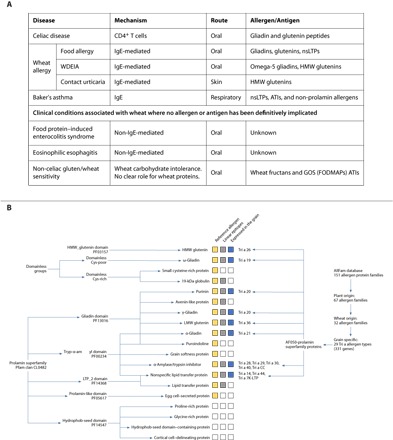
Fig. 1
Fig. 1. The prolamin superfamily and its relation to clinical diseases and allergen protein families.
(A) Clinical syndromes associated with wheat ingestion or exposure. Mechanisms of wheat-related clinical syndromes, route of exposure, and major allergens and antigens are presented. (B) Protein groups primarily expressed in the seed are highlighted in yellow. Protein types with immunoreactive peptides in their sequence are highlighted in gray, and reference allergen homologs identified based on the AllFam database are highlighted in blue. “Tri a” labeling of the individual groups follows the nomenclature system of the World Health Organization/International Union of Immunological Societies (WHO/IUIS) Allergen Nomenclature Database.
Fig. 2
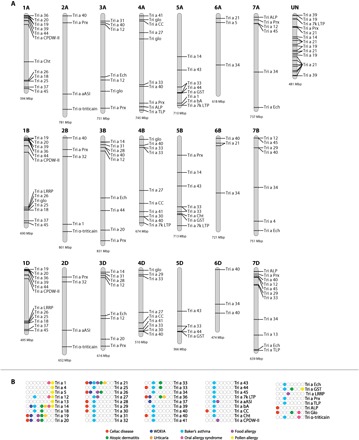
Fig. 2. Reference allergen map of bread wheat.
(A) Genome distribution of food disease–related reference allergens in the wheat genome. Only genes with presence of multiple disease-associated epitopes and over 70% sequence homology to reference allergens are presented. (B) Disease association of reference allergens.
Fig. 3
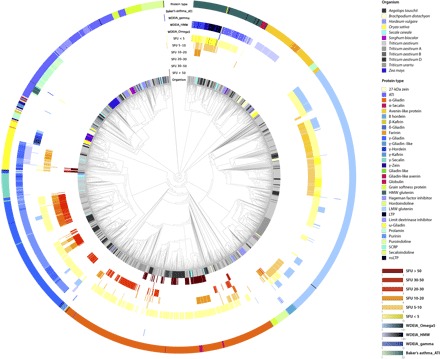
Fig. 3. Epitope mapping and phylogenetic analysis in Prolamin clan (CL0482) protein families, HMW glutenins, and ω-gliadins.
Protein sequences with gliadin (PF13016), protease inhibitor, seed storage and lipid transfer (PF00234), HMW glutenin (PF03157) domains, and ω-gliadins were used to analyze the expansion of the epitope content and composition. Protein sequences were retrieved from UniProt and used along with the reference genome sequence data of bread wheat, T. urartu, A. tauschii, barley, rye, and other grasses such as rice, Brachypodium, maize, and sorghum for phylogenetic analysis. Peptides that induce IFN-γ responses were grouped into six immune response groups (based on median SFU) and colored separately. Linear epitopes related to WDEIA and baker’s asthma are also labeled. The number of peptides per sequence is highlighted by color intensity changes. Linear epitopes related to WDEIA and baker’s asthma are also labeled. SCRP, small cysteine-rich protein.
Fig. 4
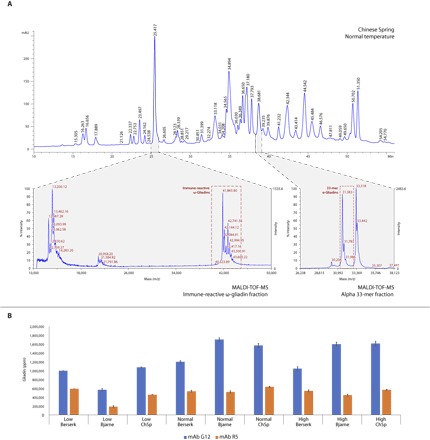
Fig. 4. Quantification and protein profiling of major immunoreactive protein types in Chinese Spring, Bjarne, and Berserk.
(A) MALDI-TOF analysis of major immunoreactive protein fractions using fractions collected in the RP-HPLC analysis. (B) Peptides measured by R5 and G12 mAbs are characteristic of main immunoreactive proteins related to celiac disease and WDEIA. Expression changes of these proteins were measured in three temperature regimes. m/z, mass/charge ratio.
Fig. 5
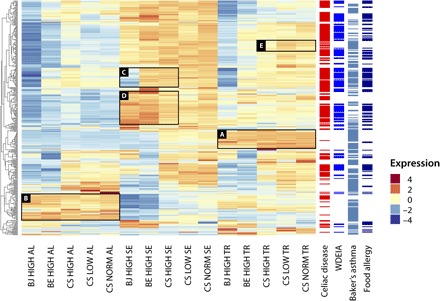
Fig. 5. Effect of cell type, genotype, and temperature on transcript levels of genes encoding grain allergens.
Heat map showing relative transcript levels of genes encoding reference allergens across cell types, genotypes (BJ, Bjarne; BE, Berserk; and CS, Chinese Spring), and temperatures (CS only). Association of reference allergen transcripts with celiac disease, WDEIA, Baker’s asthma, and food allergy.
Fig. 6
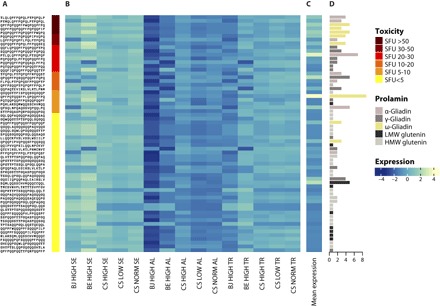
Fig. 6. Expression profile of the 54 genes encoding the 63 identified immunoreactive gliadin and glutenin peptides in the cells of the endosperm of Bjarne and Berserk at high temperature and Chinese Spring at high, low, and normal temperatures.
(A) Peptide identity and IFNγ-ELISPOT responses in median SFU values representing the immunoreactivity of peptides against patients’ blood sera according to Tye-Din et al. (15). Dark red represents strong immunoreactivity values, and yellow represents weak values. (B) Heat map showing the relative cumulative expression of the genes encoding each peptide across cell types, genotypes (BJ, Bjarne; BE, Berserk; and CS, Chinese Spring), and temperatures. (C) Heat map showing the scaled average expression level of the immunoreactive peptides across all endosperm cell types. (D) Number and identity of proteins containing the individual immunoreactive peptides.

References

    1. International Wheat Genome Sequencing Consortium , Shifting the limits in wheat research and breeding through a fully annotated and anchored reference genome sequence. Science (2018) 10.1126/science.aar7191.
    1. Larré C., Lupi R., Gombaud G., Brossard C., Branlard G., Moneret-Vautrin D. A., Rogniaux H., Denery-Papini S., Assessment of allergenicity of diploid and hexaploid wheat genotypes: Identification of allergens in the albumin/globulin fraction. J. Proteomics 74, 1279–1289 (2011). - PubMed
    1. Ludvigsson J. F., Leffler D. A., Bai J., Biagi F., Fasano A., Green P. H., Hadjivassilou M., Kaukinen K., Kelly C. P., Leonard J. N., Lundin K. E. A., Murray J. A., Sanders D. S., Walker M. M., Zingone F., Ciacci C., The Oslo definitions for coeliac disease and related terms. Gut 62, 43–52 (2013). - PMC - PubMed
    1. Hardy M. Y., Tye-Din J. A., Coeliac disease: A unique model for investigating broken tolerance in autoimmunity. Clin. Transl. Immunology 5, e112 (2016). - PMC - PubMed
    1. Singh P., Arora A., Strand T. A., Leffler D. A., Catassi C., Green P. H., Kelly C. P., Ahuja V., Makharia G. K., Global prevalence of celiac disease: Systematic review and meta-analysis. Clin. Gastroenterol. Hepatol. 16, 832–836.e2 (2018). - PubMed

Publication types

MeSH terms

LinkOut - more resources