


Digital Characteristics and Dissemination Indicators to Optimize Delivery of Internet-Supported Mindfulness-Based Interventions for People With a Chronic Condition: Systematic Review
- PMID: 30131317
- PMCID: PMC6123540
- DOI: 10.2196/mental.9645
Digital Characteristics and Dissemination Indicators to Optimize Delivery of Internet-Supported Mindfulness-Based Interventions for People With a Chronic Condition: Systematic Review
Abstract
Background: Internet-supported mindfulness-based interventions (MBIs) are increasingly being used to support people with a chronic condition. Characteristics of MBIs vary greatly in their mode of delivery, communication patterns, level of facilitator involvement, intervention period, and resource intensity, making it difficult to compare how individual digital features may optimize intervention adherence and outcomes.
Objective: The aims of this review were to (1) provide a description of digital characteristics of internet-supported MBIs and examine how these relate to evidence for efficacy and adherence to the intervention and (2) gain insights into the type of information available to inform translation of internet-supported MBIs to applied settings.
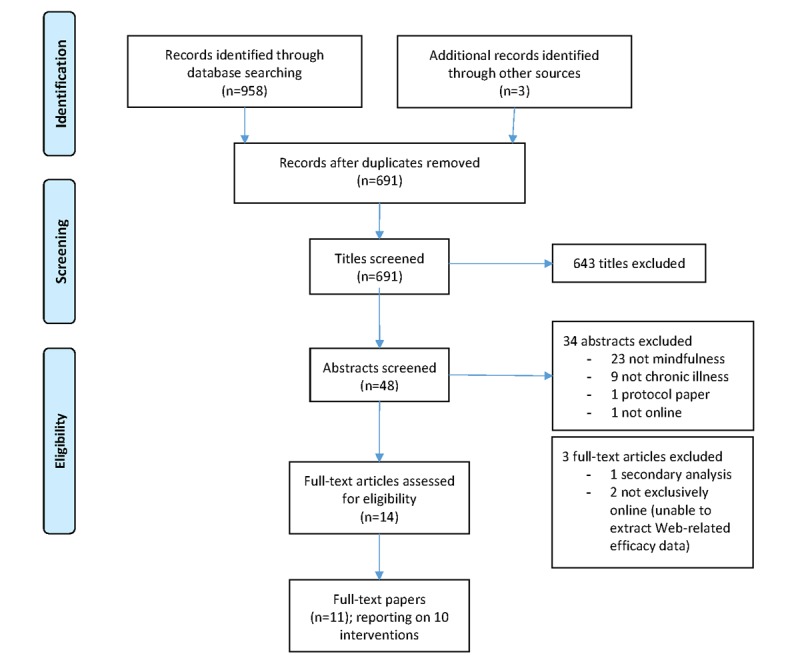
Methods: MEDLINE Complete, PsycINFO, and CINAHL databases were searched for studies assessing an MBI delivered or accessed via the internet and engaging participants in daily mindfulness-based activities such as mindfulness meditations and informal mindfulness practices. Only studies using a comparison group of alternative interventions (active compactor), usual care, or wait-list were included. Given the broad definition of chronic conditions, specific conditions were not included in the original search to maximize results. The search resulted in 958 articles, from which 11 articles describing 10 interventions met the inclusion criteria.
Results: Internet-supported MBIs were more effective than usual care or wait-list groups, and self-guided interventions were as effective as facilitator-guided interventions. Findings were informed mainly by female participants. Adherence to interventions was inconsistently defined and prevented robust comparison between studies. Reporting of factors associated with intervention dissemination, such as population representativeness, program adoption and maintenance, and costs, was rare.
Conclusions: More comprehensive descriptions of digital characteristics need to be reported to further our understanding of features that may influence engagement and behavior change and to improve the reproducibility of MBIs. Gender differences in determinants and patterns of health behavior should be taken into account at the intervention design stage to accommodate male and female preferences. Future research could compare MBIs with established evidence-based therapies to identify the population groups that would benefit most from internet-supported programs.
Trial registration: PROSPERO CRD42017078665; https://www.crd.york.ac.uk/prospero/display_record.php?RecordID=78665 (Archived by WebCite at http://www.webcitation.org/71ountJpu).
Keywords: chronic condition; internet; mindfulness.
©Lahiru Russell, Anna Ugalde, Donna Milne, David Austin, Patricia M Livingston. Originally published in JMIR Mental Health (http://mental.jmir.org), 21.08.2018.
Conflict of interest statement
Conflicts of Interest: None declared.
Figures
References
-
- Gotink RA, Chu P, Busschbach JJ, Benson H, Fricchione GL, Hunink MG. Standardised mindfulness-based interventions in healthcare: an overview of systematic reviews and meta-analyses of RCTs. PLoS One. 2015 Apr;10(4):e0124344. doi: 10.1371/journal.pone.0124344. http://dx.plos.org/10.1371/journal.pone.0124344 PONE-D-14-43410 - DOI - PMC - PubMed
-
- Boggs JM, Beck A, Felder JN, Dimidjian S, Metcalf CA, Segal ZV. Web-based intervention in mindfulness meditation for reducing residual depressive symptoms and relapse prophylaxis: a qualitative study. J Med Internet Res. 2014 Mar 24;16(3):e87. doi: 10.2196/jmir.3129. http://www.jmir.org/2014/3/e87/ v16i3e87 - DOI - PMC - PubMed
-
- Waelde LC, Thompson JM, Robinson A, Iwanicki S. Trauma therapists' clinical applications, training, and personal practice of mindfulness and meditation. Mindfulness (N Y) 2016;7:622–9. doi: 10.1007/s12671-016-0497-9. http://europepmc.org/abstract/MED/27217842 497 - DOI - PMC - PubMed
-
- Wahbeh H, Svalina MN, Oken BS. Group, one-on-one, or internet? Preferences for mindfulness meditation delivery format and their predictors. Open Med J. 2014 Nov 28;1:66–74. doi: 10.2174/1874220301401010066. http://europepmc.org/abstract/MED/27057260 - DOI - PMC - PubMed
Publication types
LinkOut - more resources
Full Text Sources
Other Literature Sources
Miscellaneous
