


Primary Ovarian Insufficiency and Adolescent Vaccination
- PMID: 30131438
- PMCID: PMC6719304
- DOI: 10.1542/peds.2018-0943
Primary Ovarian Insufficiency and Adolescent Vaccination
Abstract
Background: Published case series have suggested a potential association between human papillomavirus (HPV) vaccination and primary ovarian insufficiency (POI). We describe POI incidence and estimate POI risk after HPV; tetanus toxoid, reduced diphtheria toxoid, and acellular pertussis, adsorbed (Tdap); inactivated influenza (II); and meningococcal conjugate (MenACWY) vaccination.
Methods: We searched Kaiser Permanente Northwest electronic health records for outpatient diagnoses suggestive of POI in female patients aged 11 to 34 years between 2006 and 2014. We reviewed and adjudicated the medical record to confirm diagnoses and estimate symptom onset dates. We excluded cases with known causes and calculated the incidence of idiopathic POI. We estimated risk by calculating hazard ratios and 95% confidence intervals (CIs).
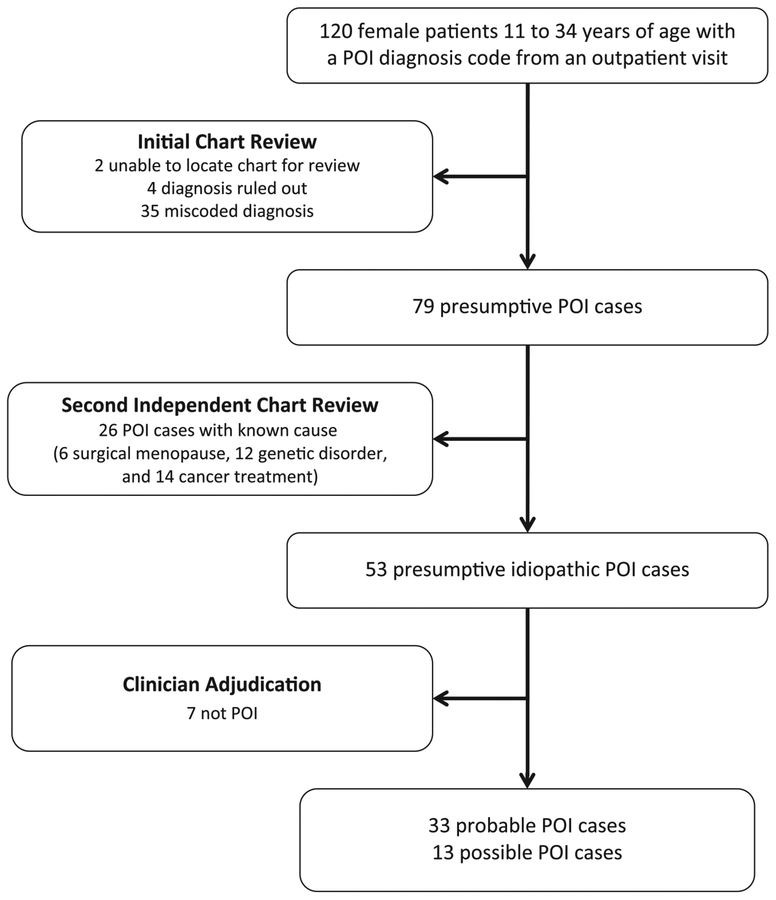
Results: From a cohort of 199 078 female patients, we identified 120 with diagnoses suggestive of POI. After adjudication and exclusion of 26 POI cases with known causes, we confirmed 46 idiopathic POI cases. POI incidence was low in 11- to 14-year-olds (0.87 per 1 000 000 person-months) and increased with age. One confirmed case patient received the HPV vaccine 23 months before the first clinical evaluation for delayed menarche. The adjusted hazard ratio was 0.30 (95% CI: 0.07-1.36) after HPV, 0.88 (95% CI: 0.37-2.10) after Tdap, 1.42 (95% CI: 0.59-3.41) after II, and 0.94 (95% CI: 0.27-3.23) after MenACWY vaccination.
Conclusions: We did not find a statistically significant elevated risk of POI after HPV, Tdap, II, or MenACWY vaccination in this population-based retrospective cohort study. These findings should lessen concern about POI risk after adolescent vaccination.
Copyright © 2018 by the American Academy of Pediatrics.
Conflict of interest statement
POTENTIAL CONFLICT OF INTEREST: Dr Naleway has received research funding from Pfizer, MedImmune AstraZeneca, and Merck for unrelated studies. Ms Irving has received research support from MedImmune AstraZeneca for an unrelated study. Dr Henninger has received research funding from Pfizer for an unrelated study; the other authors have indicated they have no potential conflicts of interest to disclose.
Figures
References
-
- Satterwhite CL, Torrone E, Meites E, et al. Sexually transmitted infections among US women and men: prevalence and incidence estimates, 2008. Sex Transm Dis. 2013;40(3):187–193 - PubMed
-
- Bingham A, Drake JK, LaMontagne DS. Sociocultural issues in the introduction of human papillomavirus vaccine in low-resource settings. Arch Pediatr Adolesc Med. 2009;163(5):455–461 - PubMed
-
- Verhoeven V, Baay MF, Baay PE, Lardon F, Van Royen P, Vermorken JB. Everything you always wanted to know about HPV (but could not ask your doctor). Patient Educ Couns. 2010;81(1):101–105 - PubMed
Publication types
MeSH terms
Substances
Grants and funding
LinkOut - more resources
Full Text Sources
Other Literature Sources
Medical
