Review
. 2018 Aug 20:4:17.
doi: 10.1038/s41522-018-0062-5. eCollection 2018.

Towards standardized mechanical characterization of microbial biofilms: analysis and critical review

Affiliations
Review

Towards standardized mechanical characterization of microbial biofilms: analysis and critical review

Héloïse Boudarel et al. NPJ Biofilms Microbiomes. .

Abstract

Developing reliable anti-biofilm strategies or efficient biofilm-based bioprocesses strongly depends on having a clear understanding of the mechanisms underlying biofilm development, and knowledge of the relevant mechanical parameters describing microbial biofilm behavior. Many varied mechanical testing methods are available to assess these parameters. The mechanical properties thus identified can then be used to compare protocols such as antibiotic screening. However, the lack of standardization in both mechanical testing and the associated identification methods for a given microbiological goal remains a blind spot in the biofilm community. The pursuit of standardization is problematic, as biofilms are living structures, i.e., both complex and dynamic. Here, we review the main available methods for characterizing the mechanical properties of biofilms through the lens of the relationship linking experimental testing to the identification of mechanical parameters. We propose guidelines for characterizing biofilms according to microbiological objectives that will help the reader choose an appropriate test and a relevant identification method for measuring any given mechanical parameter. The use of a common methodology for the mechanical characterization of biofilms will enable reliable analysis and comparison of microbiological protocols needed for improvement of engineering process and screening.


Conflict of interest statement

The authors declare no competing interests.

Figures
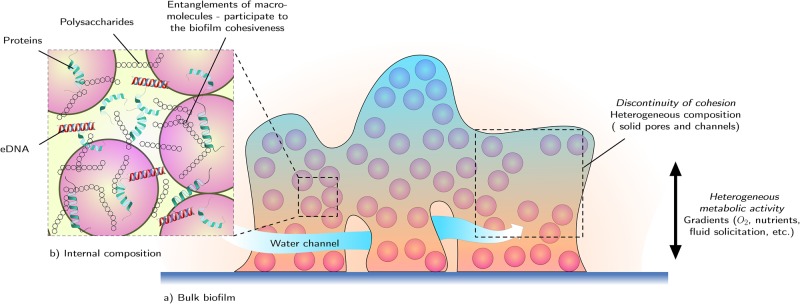
Fig. 1
Fig. 1
Physical heterogeneities of biofilms: biofilms are heterogeneous in their composition. a Biofilms are made of reinforcements (bacteria) surrounded with matrix (EPS). The influence of the scale of the mechanical study is not insignificant. Moreover, metabolic gradients (oxygen, nutrient, physical stress, etc.) result in heterogeneity in mechanical parameters. b A focus on the internal composition reveals that EPS matrix is made of many components. Entanglements of molecules within the EPS matrix have a key role in the biofilm behavior
Fig. 2
Fig. 2
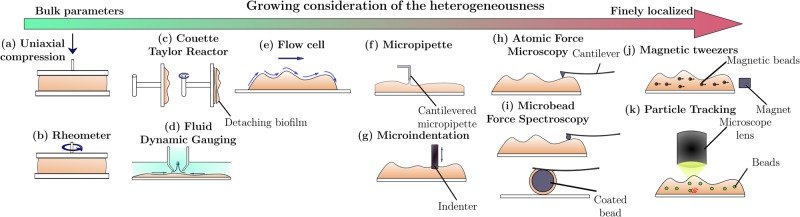
Illustrations of the most popular mechanical tests on biofilms available in the literature. a Uniaxial compression test; b Shear stress in a rheometer; c Hydrodynamic shear stress imposed with a Couette-Taylor reactor; d Fluid dynamic gauging; e Microirrigation condition in a flow cell; f Microscale tensile test with a micropipette cantilever; g Microscale indentation test; h Atomic force spectroscopy—nanoindentation; i Microbead force spectroscopy; j Microrheology with magnetic tweezers; k Particle tracking
Fig. 3
Fig. 3
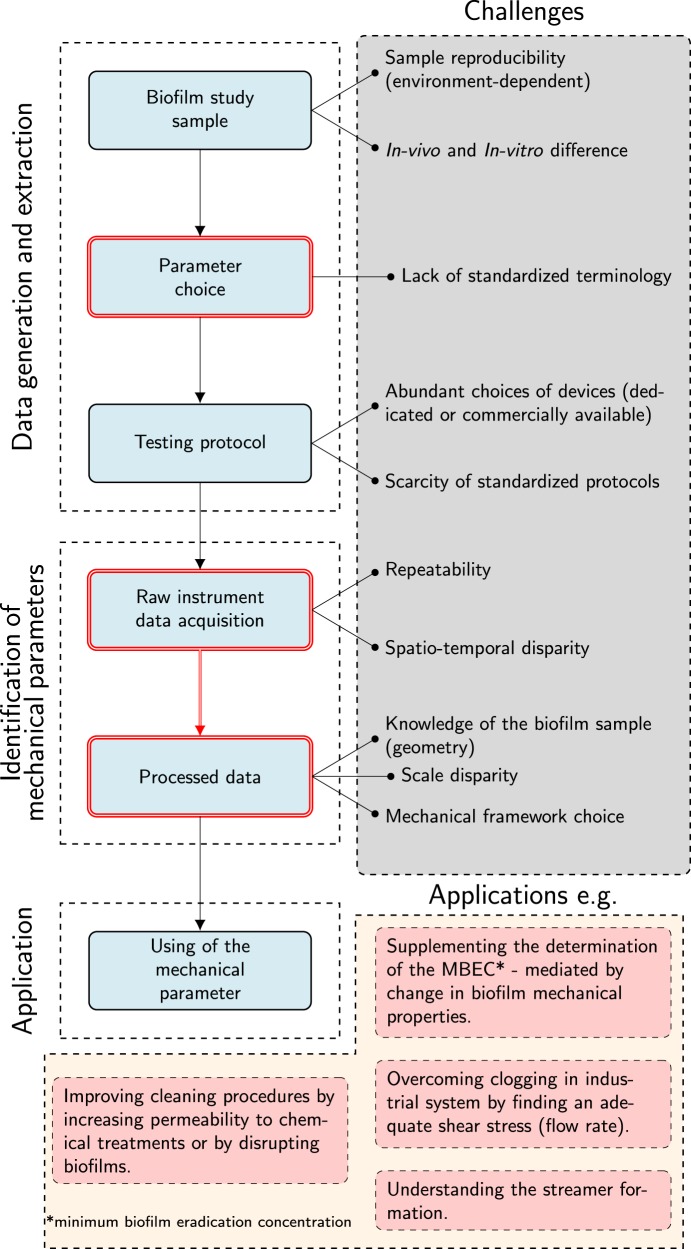
Global life cycle of biofilm mechanical studies: due to the complex structure and living properties of biofilms, challenges exist in each step of the identification of mechanical parameters. The red double lines indicate the points that are addressed in this manuscript. Overcoming these challenges is appealing as the applications of the mechanical properties must be of particular interest
Fig. 4
Fig. 4
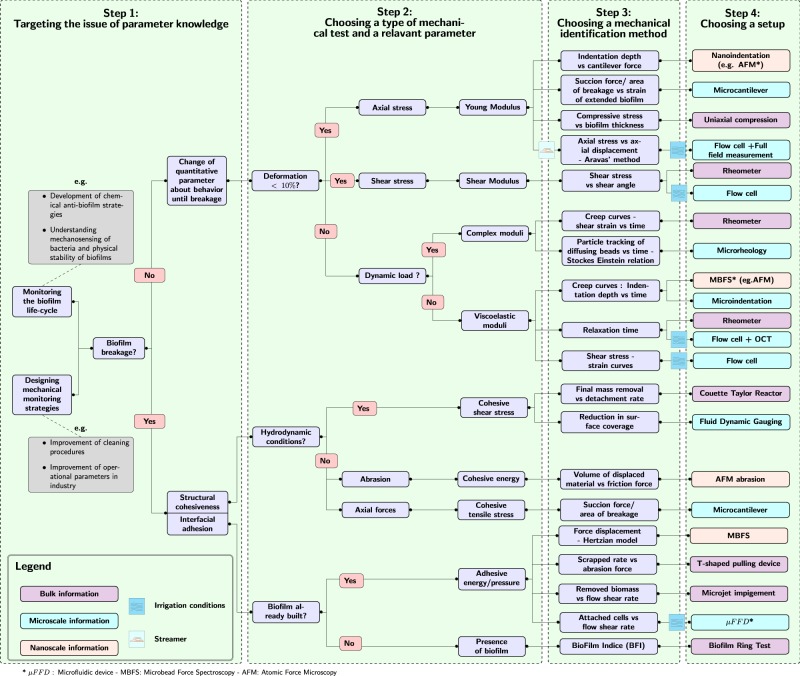
Guidelines for helping the choice of mechanical parameter, testing method and identification method. From left to right, the reader is invited to follow the different steps of the identification of mechanical parameters. In the first step, the microbiological target is determined. Then, a relevant mechanical parameter is advocated according to the conditions of solicitation of the biofilm sample. Final steps 3 and 4 suggest the reader, a choice for a mechanical setup and an identification method, which are relevant with its microbiological issues. Step 3 and 4 can be reversed depending on the circumstances

References

    1. Stewart PS, Costerton JW. Antibiotic resistance of bacteria in biofilms. Lancet. 2001;358:135–138. doi: 10.1016/S0140-6736(01)05321-1. - DOI - PubMed
    1. Kragh K, et al. Role of multicellular aggregates in biofilm formation. mBio. 2016;7:e00237-16. doi: 10.1128/mBio.00237-16. - DOI - PMC - PubMed
    1. Høiby N. A personal history of research on microbial biofilms and biofilm infections. Pathog. Dis. 2014;70:205–211. doi: 10.1111/2049-632X.12165. - DOI - PubMed
    1. Fisher RA, Gollan B, Helaine S. Persistent bacterial infections and persister cells. Nat. Rev. Microbiol. 2017;15:453–464. doi: 10.1038/nrmicro.2017.42. - DOI - PubMed
    1. Busscher HJ, et al. Biomaterial-associated infection: locating the finish line in the race for the surface. Sci. Transl. Med. 2012;4:153rv10. doi: 10.1126/scitranslmed.3004528. - DOI - PubMed

LinkOut - more resources