


UAB30, a novel RXR agonist, decreases tumorigenesis and leptomeningeal disease in group 3 medulloblastoma patient-derived xenografts
- PMID: 30132166
- PMCID: PMC6239946
- DOI: 10.1007/s11060-018-2950-1
UAB30, a novel RXR agonist, decreases tumorigenesis and leptomeningeal disease in group 3 medulloblastoma patient-derived xenografts
Abstract
Background: Group 3 tumors account for approximately 25-30% of medulloblastomas and have the worst prognosis. UAB30 is a novel synthetic rexinoid shown to have limited toxicities in humans and significant efficacy in the pediatric neuroectodermal tumor, neuroblastoma. We hypothesized that treatment with UAB30 would decrease tumorigenicity in medulloblastoma patient-derived xenografts (PDXs).
Methods: Three group 3 medulloblastoma PDXs (D341, D384 and D425) were utilized. Cell viability, proliferation, migration and invasion assays were performed after treatment with UAB30 or 13-cis-retinoic acid (RA). Cell cycle analysis was completed using flow cytometry. A flank model, a cerebellar model, and a model of leptomeningeal metastasis using human medulloblastoma PDX cells was used to assess the in vivo effects of UAB30 and RA.
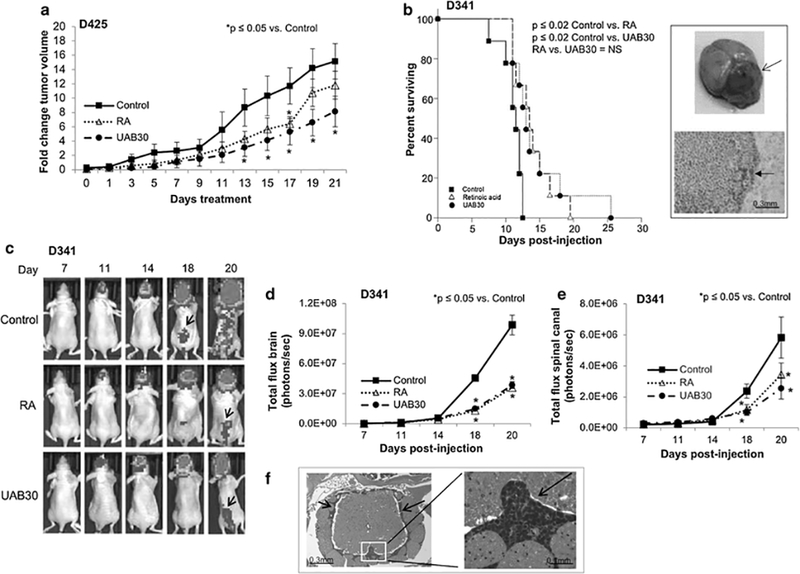
Results: UAB30 treatment led to cell differentiation and decreased medulloblastoma PDX cell viability, proliferation, migration and invasion and G1 cell cycle arrest in all three PDXs similar to RA. UAB30 and RA treatment of mice bearing medulloblastoma PDX tumors resulted in a significant decrease in tumor growth and metastasis compared to vehicle treated animals.
Conclusions: UAB30 decreased viability, proliferation, and motility in group 3 medulloblastoma PDX cells and significantly decreased tumor growth in vivo in a fashion similar to RA, suggesting that further investigations into the potential therapeutic application of UAB30 for medulloblastoma are warranted.
Keywords: Medulloblastoma; PDX; Retinoic acid; UAB30.
Conflict of interest statement
Figures


References
-
- Kool M, Korshunov A, Remke M, Jones DT, Schlanstein M, Northcott PA, Cho YJ, Koster J, Schouten-van Meeteren A, van Vuurden D, Clifford SC, Pietsch T, von Bueren AO, Rutkowski S, McCabe M, Collins VP, Bäcklund ML, Haberler C, Bourdeaut F, Delattre O, Doz F, Ellison DW, Gilbertson RJ, Pomeroy SL, Taylor MD, Lichter P, Pfister SM (2012) Molecular subgroups of medulloblastoma: an international meta-analysis of transcriptome, genetic aberrations, and clinical data of WNT, SHH, Group 3, and Group 4 medulloblastomas. Acta Neuropathol 123:473–484. - PMC - PubMed
-
- Cho YJ, Tsherniak A, Tamayo P, Santagata S, Ligon A, Greulich H, Berhoukim R, Amani V, Goumnerova L, Eberhart CG, Lau CC, Olson JM, Gilbertson RJ, Gajjar A, Delattre O, Kool M, Ligon K, Meyerson M, Mesirov JP, Pomeroy SL (2011) Integrative genomic analysis of medulloblastoma identifies a molecular subgroup that drives poor clinical outcome. J Clin Oncol 29:1424–1430. - PMC - PubMed
-
- Palmer SL, Reddick WE, Gajjar A (2007) Understanding the cognitive impact on children who are treated for medulloblastoma. J Pediatr Psychol 2:1040–1049. - PubMed
MeSH terms
Substances
Grants and funding
LinkOut - more resources
Full Text Sources
Other Literature Sources
