


Iodine Intake is Associated with Thyroid Function in Mild to Moderately Iodine Deficient Pregnant Women
- PMID: 30132420
- PMCID: PMC6157349
- DOI: 10.1089/thy.2018.0305
Iodine Intake is Associated with Thyroid Function in Mild to Moderately Iodine Deficient Pregnant Women
Abstract
Background: Studies indicate that mild to moderate iodine deficiency in pregnancy may have a long-term negative impact on child neurodevelopment. These effects are likely mediated via changes in maternal thyroid function, since iodine is essential for the production of thyroid hormones. However, the impact of iodine availability on thyroid function during pregnancy and on thyroid function reference ranges are understudied. The aim of this study was to investigate the association between iodine intake and thyroid function during pregnancy.
Design: In a population-based pregnancy cohort including 2910 pregnant women participating in The Norwegian Mother and Child Cohort Study, we explored cross sectional associations of maternal iodine intake measured (1) by a food frequency questionnaire and (2) as iodine concentration in a spot urine sample, with plasma thyroid hormones and antibodies.
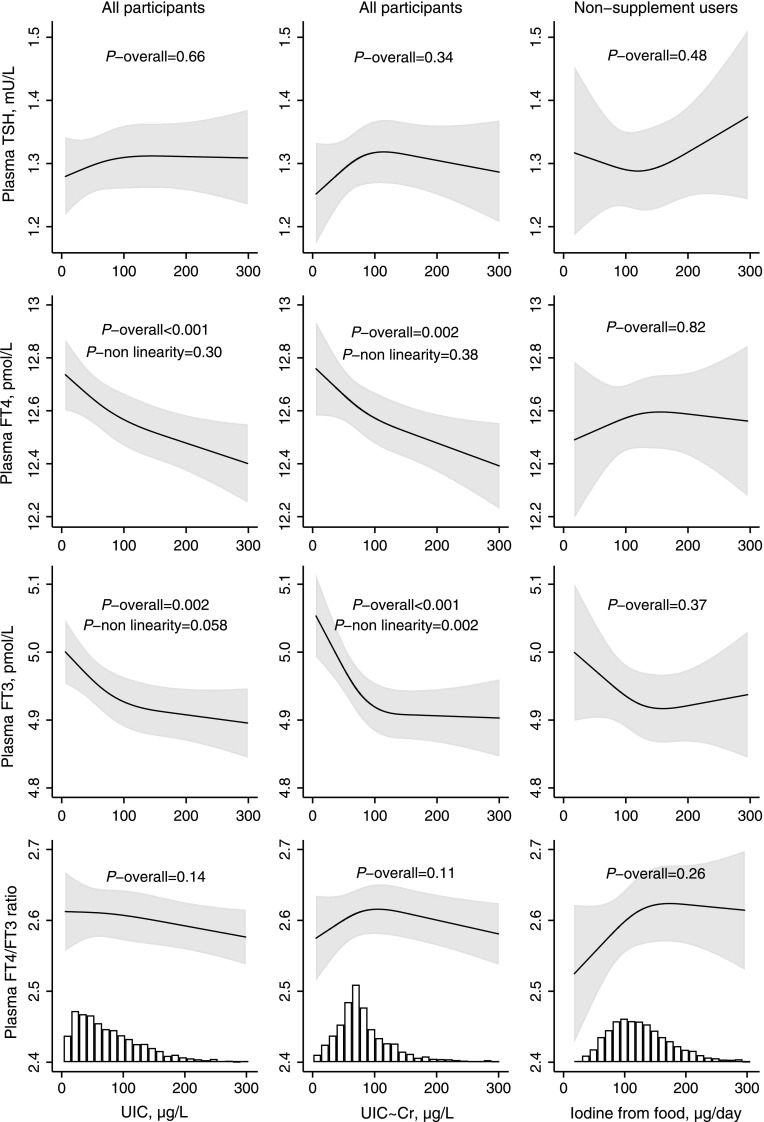
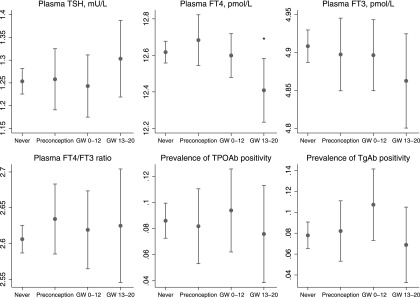
Results: Biological samples were collected in mean gestational week 18.5 (standard deviation 1.3) and diet was assessed in gestational week 22. Median iodine intake from food was 121 μg/day (interquartile range 90, 160), and 40% reported use of iodine-containing supplements in pregnancy. Median urinary iodine concentration (UIC) was 59 μg/L among those who did not use supplements and 98 μg/L in the women reporting current use at the time of sampling, indicating mild to moderate iodine deficiency in both groups. Iodine intake as measured by the food frequency questionnaire was not associated with the outcome measures, while UIC was inversely associated with FT3 (p = 0.002) and FT4 (p < 0.001). Introduction of an iodine-containing supplement after gestational week 12 was associated with indications of lower thyroid hormone production (lower FT4, p = 0.027, and nonsignificantly lower FT3, p = 0.17). The 2.5th and 97.5th percentiles of TSH, FT4, and FT3 were not significantly different by groups defined by calculated iodine intake or by UIC.
Conclusion: The results indicate that mild to moderate iodine deficiency affect thyroid function in pregnancy. However, the differences were small, suggesting that normal reference ranges can be determined based on data also from mildly iodine deficient populations, but this needs to be further studied. Introducing an iodine-containing supplement might temporarily inhibit thyroid hormone production and/or release.
Keywords: MoBa; The Norwegian Mother and Child Cohort Study; dietary supplements; iodine; pregnancy; thyroid function.
Conflict of interest statement
M.H. Abel is employed by a Norwegian dairy company (TINE SA), and she participates in this project as an industrial PhD student financed partly by the dairy company and partly by The Research Council of Norway. This project is designed, owned, and administered by The Norwegian Institute of Public Health and analysis of the data follow from protocol. All results of analyses in the project are to be published regardless of the results. The dairy company supports the study to raise awareness on the importance of iodine and to gain more knowledge about the potential health effects of milk in the Norwegian diet. Apart from M.H.A., no one from the dairy company has been involved in the study, and in itself, the company had no direct influence on the analysis and interpretation of the results. All remaining authors declare no competing financial interests.
Figures
References
-
- Bath SC, Steer CD, Golding J, Emmett P, Rayman MP. 2013. Effect of inadequate iodine status in UK pregnant women on cognitive outcomes in their children: results from the Avon Longitudinal Study of Parents and Children (ALSPAC). Lancet 382:331–337 - PubMed
-
- Hynes KL, Otahal P, Burgess JR, Oddy WH, Hay I. 2017. Reduced educational outcomes persist into adolescence following mild iodine deficiency in utero, despite adequacy in childhood: 15-Year follow-up of the Gestational Iodine Cohort investigating auditory processing speed and working memory. Nutrients 9:pii: - PMC - PubMed
-
- Abel MH, Caspersen IH, Meltzer HM, Haugen M, Brandlistuen RE, Aase H, Alexander J, Torheim LE, Brantsaeter AL. 2017. Suboptimal maternal iodine intake is associated with impaired child neurodevelopment at 3 years of age in the Norwegian Mother and Child Cohort Study. J Nutr 147:1314–1324 - PubMed
Publication types
MeSH terms
Substances
Grants and funding
LinkOut - more resources
Full Text Sources
Other Literature Sources
