. 2019 Jan;33(1):1389-1400.
doi: 10.1096/fj.201800697RRR. Epub 2018 Aug 22.

Plasma membrane cholesterol trafficking in steroidogenesis

Affiliations

Plasma membrane cholesterol trafficking in steroidogenesis

Bing Deng et al. FASEB J. 2019 Jan.

Abstract

Cholesterol is an important component of plasma membranes (PMs) and the precursor of all steroid hormones. In steroidogenic tissues, upon hormone stimulation, there is a rapid transfer of cholesterol to the mitochondria, which is the site of the initial step in steroidogenesis. In the current study, we examined PM cholesterol trafficking for steroidogenesis. In a mitochondrial reconstitution assay, adrenal PMs supported steroidogenesis in the absence of additional transport proteins. Depletion of cholesterol in PMs by 50% eliminated the membranes' ability to support steroidogenesis in vitro and reduced steroid production in intact Y1 adrenocortical cells. Syntaxin (STX)-5 and α-soluble N-ethylmaleimide-sensitive factor attachment protein (α-SNAP) are enriched in adrenal PMs, and adrenocorticotropic hormone treatment of rats recruited STX5 and α-SNAP to adrenal PMs and mitochondria. Immunodepletion of STX5 and α-SNAP from PMs decreased steroidogenesis supported by PMs in vitro. Protease digestion of PMs decreased, whereas recombinant STX5 or α-SNAP restored, the PMs' ability to support steroidogenesis. Knockdown of either STX5 or α-SNAP in Y1 cells decreased stimulated steroidogenesis. These results indicate that STX5 and α-SNAP facilitate cholesterol trafficking from PMs to mitochondria for adrenal steroid synthesis and underscore the importance of vesicular trafficking of PM cholesterol for steroidogenesis.-Deng, B., Shen, W.-J., Dong, D., Azhar, S., Kraemer, F. B. Plasma membrane cholesterol trafficking in steroidogenesis.

Keywords: SNARE proteins; adrenal gland; mitochondria.


Conflict of interest statement

This work was supported by Merit Review Awards I01BX001923 (to S.A.) and I01BX000398 (to F.B.K.); and Senior Research Career Scientist Award IK6B004200 (to S.A.) from the U.S. Department of Veterans Affairs, Biomedical Laboratory Research Development Program. The authors declare no conflicts of interest.

Figures
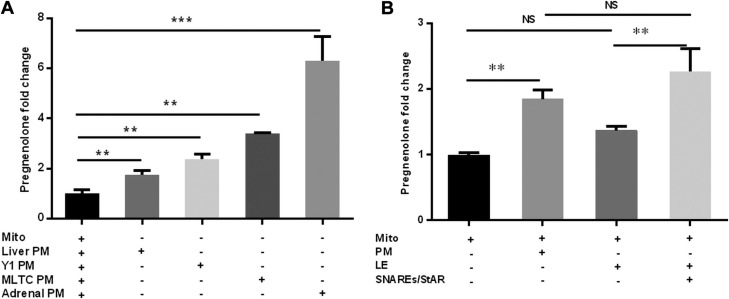
Figure 1
Figure 1
Plasma membranes can support steroidogenesis. PMs from rat adrenals, MLTCs, Y1 adrenocortical cells, and liver were purified and added to the in vitro mitochondrial reconstitution assay, in the absence of any other sources of cholesterol or accessory proteins. Pregnenolone production was measured by ELISA. A) The relative pregnenolone production was measured with rat adrenal PMs, MLTC, Y1 adrenocortical cell, and liver PMs as the sources of cholesterol. The basal pregnenolone production for mitochondria without PMs ranged from 0.5 to 3 ng/ml. B) Comparison of rat adrenal PMs and lipid emulsion as cholesterol sources for pregnenolone production in the absence or presence of accessory proteins. LE, lipid emulsion; Mito, mitochondria; NS, not significant; SNAREs/StAR, a cocktail containing recombinant SNAP23, SNAP25, α-SNAP, STX17, and N62-StAR. Results are representative of 3 independent experiments (n = 3). **P < 0.01, ***P < 0.001.
Figure 2
Figure 2
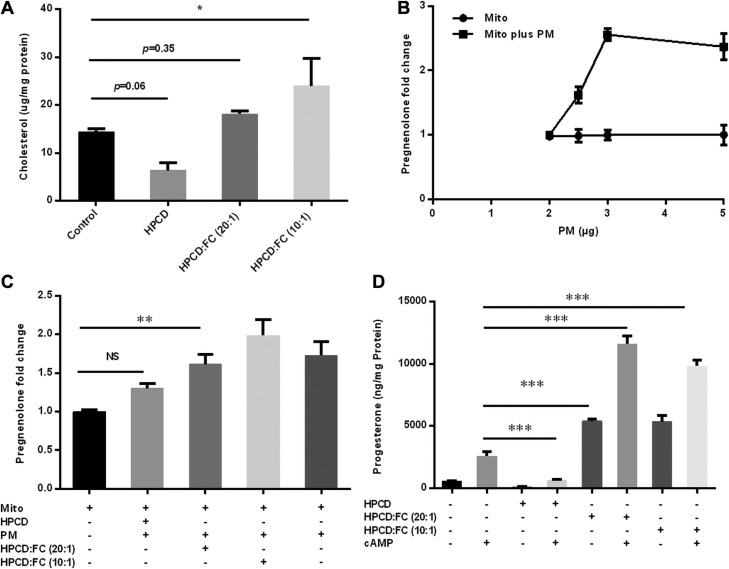
PM cholesterol affects steroidogenesis. Y1 adrenocortical cells were treated with HPCD to deplete PM cholesterol or cells treated with HPCD-loaded cholesterol to increase PM cholesterol. A) PMs were isolated from HPCD-treated Y1 adrenocortical cells, and cholesterol content was analyzed. B) Dose response of Y1 adrenocortical cell PMs in the mitochondrial reconstitution assay. C) Effect of cholesterol-manipulated PMs on steroid production in the mitochondrial reconstitution assay. D) Production of progesterone in Y1 adrenocortical cells pretreated with HPCD or with cholesterol-loaded HPCD complex for 1 h and then treated with cAMP. Mito, mitochondria. NS, not significant. Results are representative of 3 independent experiments (n = 3). *P < 0.05, **P < 0.01, ***P < 0.001.
Figure 3
Figure 3
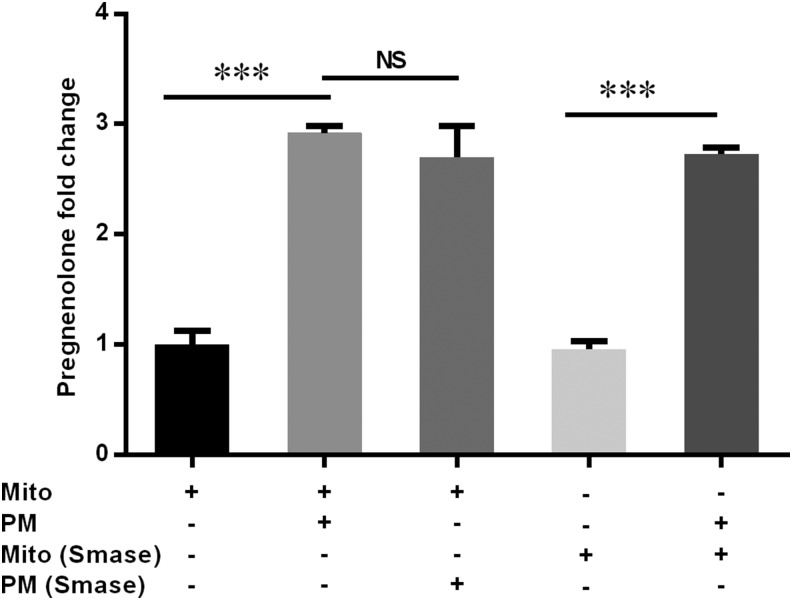
Effects of SM on steroid production. Rat PMs were digested with 100 mU/ml SMase for 30 min at 37°C and added to the mitochondrial reconstitution assay, and pregnenolone production was analyzed. The basal pregnenolone production for mitochondria without PM was 1.8 ± 0.2 ng/ml. Results are representative of 3 independent experiments (n = 3). ***P < 0.001.
Figure 4
Figure 4
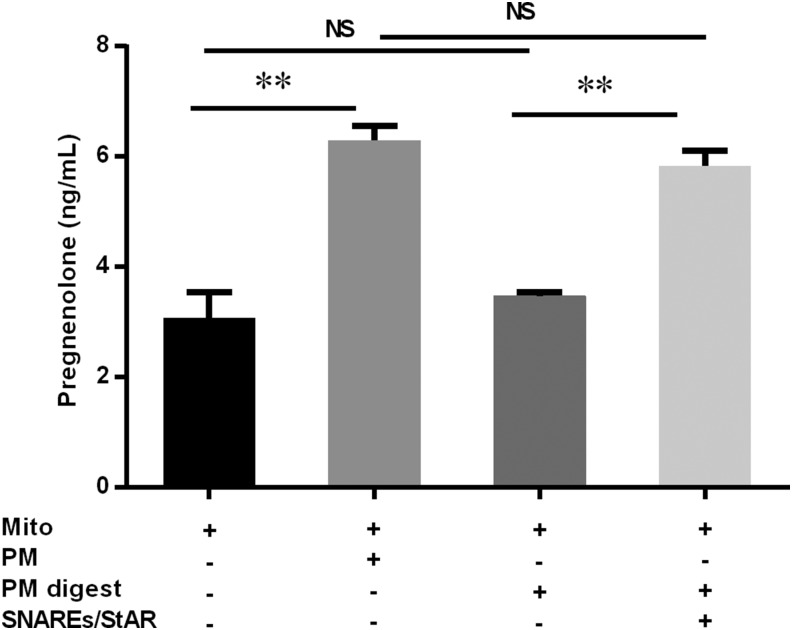
Protein components of PMs are necessary for steroidogenesis. Rat adrenal PM preparations were treated with proteinase K before they were added to the mitochondrial reconstitution assay system. Mito, mitochondria; PM digest, proteinase K-digested PM; SNAREs/StAR, a cocktail containing recombinant SNAP23, SNAP25, α-SNAP, STX17, and N62-StAR; NS, not significant. Results are representative of 3 independent experiments (n = 3). **P < 0.01.
Figure 5
Figure 5
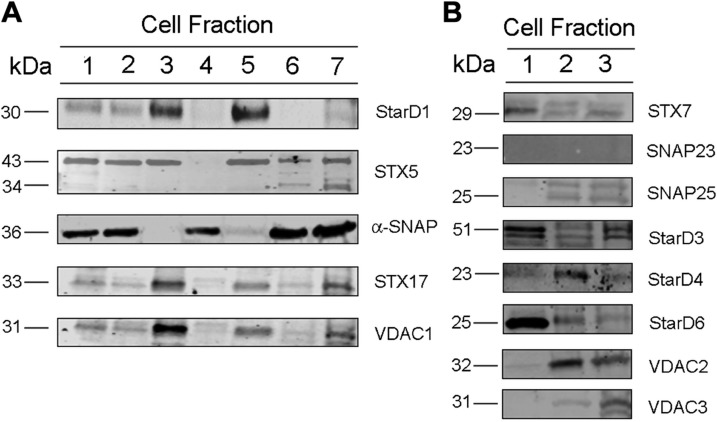
Distribution of proteins in cellular compartments. A) Subcellular fractions were isolated from rat adrenals and an immunoblot assay was conducted for StarD1, STX5, α-SNAP, STXx17, and VDAC1. Lane 1: total cell lysate; lane 2: total cell lysate minus nuclear fraction; lane 3: nuclear fraction and nonlysed cells; lane 4: cytosol; lane 5: mitochondria; lane 6: light membrane fraction (PM); lane 7: heavy membrane fraction (ER). B) Lane 1: whole-cell lysate; lane 2: PM; and lane 3: ER were assayed for STX7, SNAP23, SNAP25, StarD3, StarD4, StarD6, VDAC2 and VDAC3.
Figure 6
Figure 6
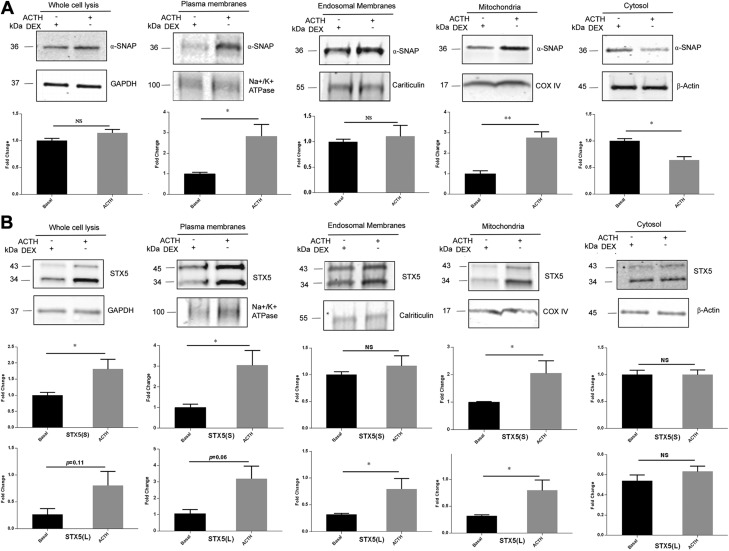
STX5 and α-SNAP move to PMs and mitochondria after ACTH stimulation. Rats were injected with ACTH 1 h before euthanasia. Basal rats were injected with dexamethasone 12 h before euthanasia to prevent any stress-induced ACTH secretion. Rat adrenals were isolated for subcellular fractionation by differential sucrose gradient centrifugation, and 10 µg whole-cell lysate, PMs, endosomal membranes, mitochondria, and cytosol were subjected to immunoblot analysis for α-SNAP and STX5. GAPDH, NA+/K+-ATPase, calreticulin, cytochrome c oxidase IV, and β-actin were used as markers for whole-cell lysate, PMs, ER, mitochondria, and cytosol, respectively. A) Distribution of α-SNAP among subcellular fractions under basal conditions and after ACTH treatment. B) Distribution of STX5 among subcellular fractions under basal conditions and after ACTH treatment. NS, not significant. *P < 0.05, **P < 0.01, basal vs. ACTH treated.
Figure 7
Figure 7
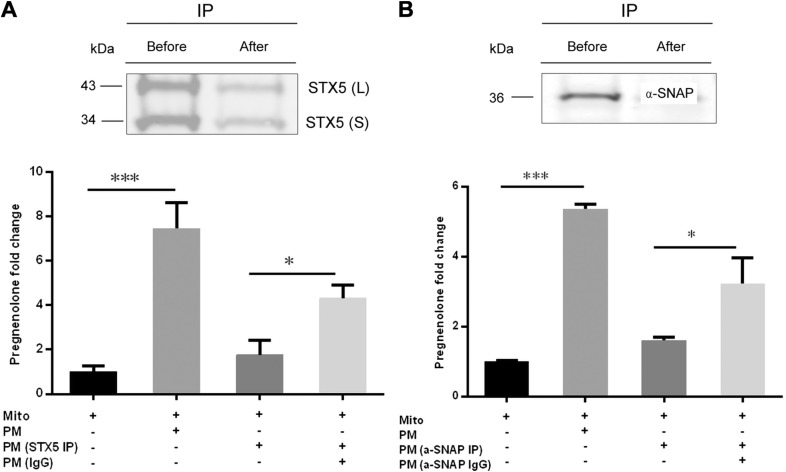
STX5 and α-SNAP associated with PMs are essential for cholesterol trafficking. Rat adrenal PMs were immunodepleted using STX5 or α-SNAP antibodies and then added to the mitochondrial reconstitution assay. A) Rat adrenal PMs before and after STX5 IP were analyzed by immunoblot assay. B) Rat adrenal PMs before and after α-SNAP IP were analyzed by immunoblot assay. C) STX5 depleted PMs (STX5 IP) were added to the mitochondrial reconstitution assay. D) α-SNAP depleted PM (α-SNAP IP) were added to the mitochondrial reconstitution assay. IP, immunoprecipitated; L, long form of STX5; S, short form of STX5; Mito, mitochondria. Results are representative of 3 independent experiments (n = 3). *P < 0.05; ***P < 0.001.
Figure 8
Figure 8
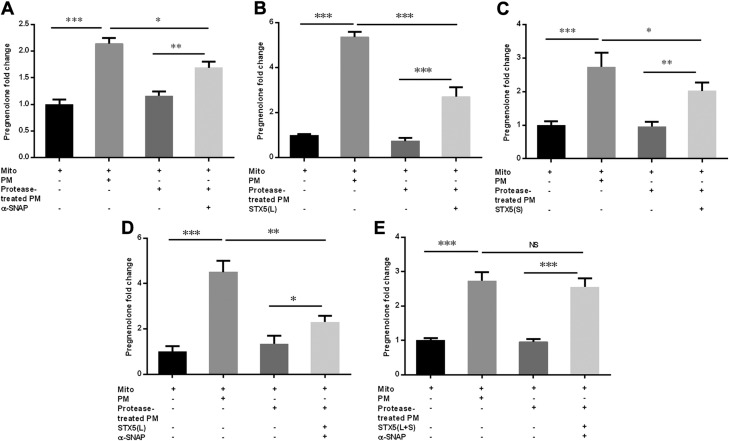
Addition of STX5 and α-SNAP was sufficient to restore steroidogenesis in protease-treated PMs. Rat adrenal PMs were treated with proteinase K and then incubated with purified recombinant STX5, α-SNAP protein, or both, before their ability to support steroidogenesis was examined in a mitochondrial reconstitution assay. A) The effect of α-SNAP protein in restoring steroidogenesis in protease-treated PM. B) Effect of STX5 long-form protein in restoring steroidogenesis in protease-treated PM. C) Effect of STX5 short-form protein in restoring steroidogenesis in protease-treated PMs. D) Effect of STX5 long-form and α-SNAP protein together in restoring steroidogenesis in protease-treated PMs. E) Effect of STX5 long-form, STX5 short-form and α-SNAP protein together in restoring steroidogenesis in protease-treated PMs. The basal pregnenolone production for mitochondria without PM ranged from 0.5 to 1.9 ng/ml. L, long form of STX5; Mito, mitochondria; NS, not significant; S, short form of STX5. Results are representative of 3 independent experiments (n = 3). *P < 0.05, **P < 0.01, ***P < 0.001.
Figure 9
Figure 9
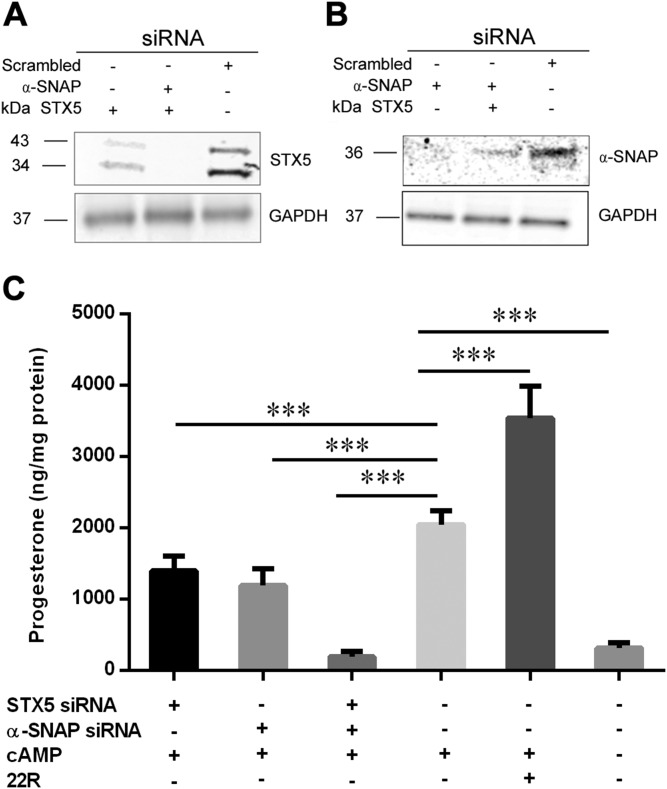
Knockdown of STX5 and α-SNAP decreases production of progesterone in Y1 adrenocortical cells. Y1 adrenocortical cells were transfected with siRNAs for STX5 and α-SNAP individually or in combination for 48 h. Y1 adrenocortical cells were then treated with cAMP for 3 h, and media were analyzed for progesterone production. 22(R)-hydroxycholesterol was used as a positive control. A, B) Immunoblot analysis for STX5 (A) and α-SNAP (B). GAPDH was used as the loading control. C) Progesterone production in cells transfected with scrambled (control) or STX5 and α-SNAP siRNAs, individually or in combination. ***P < 0.001.

References

    1. Lindzey J., Korach K. S. (1997) Steroid hormones. In Endocrinology: Basic and Clinical Principles (Conn P. M., and Melmed S., eds.), pp. 47–62, Humana Press, Totowa, NJ, USA: 10.1007/978-1-59259-641-6_4 - DOI
    1. Miller W. L., Bose H. S. (2011) Early steps in steroidogenesis: intracellular cholesterol trafficking. J. Lipid Res. 52, 2111–2135 10.1194/jlr.R016675 - DOI - PMC - PubMed
    1. Payne A. H., Hales D. B. (2004) Overview of steroidogenic enzymes in the pathway from cholesterol to active steroid hormones. Endocr. Rev. 25, 947–970 10.1210/er.2003-0030 - DOI - PubMed
    1. Das A., Brown M. S., Anderson D. D., Goldstein J. L., Radhakrishnan A. (2014) Three pools of plasma membrane cholesterol and their relation to cholesterol homeostasis. eLife 3, 02882 10.7554/eLife.02882 - DOI - PMC - PubMed
    1. Horvath S. E., Daum G. (2013) Lipids of mitochondria. Prog. Lipid Res. 52, 590–614 10.1016/j.plipres.2013.07.002 - DOI - PubMed

Publication types

LinkOut - more resources