. 2018 Aug 22;13(8):e0201961.
doi: 10.1371/journal.pone.0201961. eCollection 2018.

Acinetobacter baumannii maintains its virulence after long-time starvation

Affiliations

Acinetobacter baumannii maintains its virulence after long-time starvation

Itziar Chapartegui-González et al. PLoS One. .

Abstract

Acinetobacter baumannii is a cause of healthcare-associated infections. Although A. baumannii is an opportunistic pathogen, its infections are notoriously difficult to treat due to intrinsic and acquired antimicrobial resistance, often limiting effective therapeutic options. A. baumannii can survive for long periods in the hospital environment, particularly on inanimate surfaces. Such environments may act as a reservoir for cross-colonization and infection outbreaks and should be considered a substantial factor in infection control practices. Moreover, clothing of healthcare personnel and gadgets may play a role in the spread of nosocomial bacteria. A link between contamination of hospital surfaces and A. baumannii infections or between its persistence in the environment and its virulence has not yet been established. Bacteria under stress (i.e., long-term desiccation in hospital setting) could conserve factors that favor infection. To investigate whether desiccation and/or starvation may be involved in the ability of certain strains of A. baumannii to retain virulence factors, we have studied five well-characterized clinical isolates of A. baumannii for which survival times were determined under simulated hospital conditions. Despite a considerable reduction in the culturability over time (up to 88% depending on strain and the condition tested), some A. baumannii strains were able to maintain their ability to form biofilms after rehydration, addition of nutrients, and changing temperature. Also, after long-term desiccation, several clinical strains were able to grow in the presence of non-immune human serum as fine as their non-stressed homologs. Furthermore, we also show that the ability of bacterial strains to kill Galleria mellonella larvae does not change although A. baumannii cells were stressed by long-term starvation (up to 60 days). This means that A. baumannii can undergo a rapid adaptation to both the temperature shift and nutrients availability, conditions that can be easily found by bacteria in a new patient in the hospital setting.


Conflict of interest statement

The authors have declared that no competing interests exist.

Figures
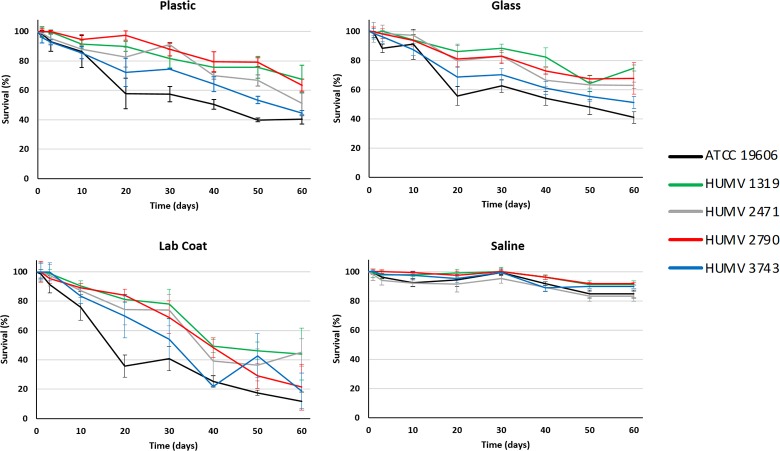
Fig 1
Fig 1. Survival of A. baumannii strains in different environments.
Survival times of strains inoculated onto white lab coat, plastic, or in glass coverslips (54% relative humidity), or suspended in sterile saline solution, and kept at room temperature. Colony counts on LA determined cell survival. Each point represents the mean of three independent experiments expressed as a reduction in culturability with respect to day 0 (100%). Error bars show the standard error of the mean.
Fig 2
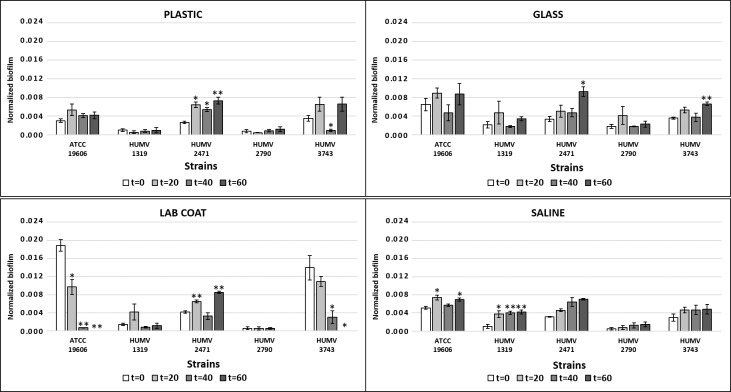
Fig 2. Quantification of biofilm formation.
Biofilm formation by A. baumannii strains after desiccation and rehydration with LB. Quantification of biofilm formation was performed after crystal violet extraction and measurement (OD620). Normalized biofilm formation, calculated as the total biofilm (expressed as the OD620) divided by growth (expressed in CFUs). Time is indicated in days. Values are presented as the mean ± standard error (SE) of three independent experiments. Asterisks indicate: *, p<0.05; **, p<0.01.
Fig 3
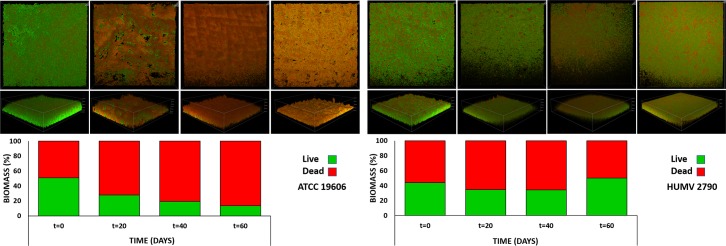
Fig 3. Confocal Laser Scanning Microscopy of live/dead cells.
CLSM images of two A. baumannii strains after survival onto glass coverslips at different times (up to 60 days). Representative examples of strain A. baumannii ATCC® 19606T (the worst survivor, left), and of HUMV-2790 (the best survivor, right) are shown. Bacteria were stained with the BacLight LIVE/DEAD viability kit. Live cells fluoresce in green with Syto 9 dye, and dead cells are stained red with propidium iodide. Original magnification: ×400. Lower panel: fluorescence (live/dead) for each strain represented in the upper panel, expressed as a percentage.
Fig 4
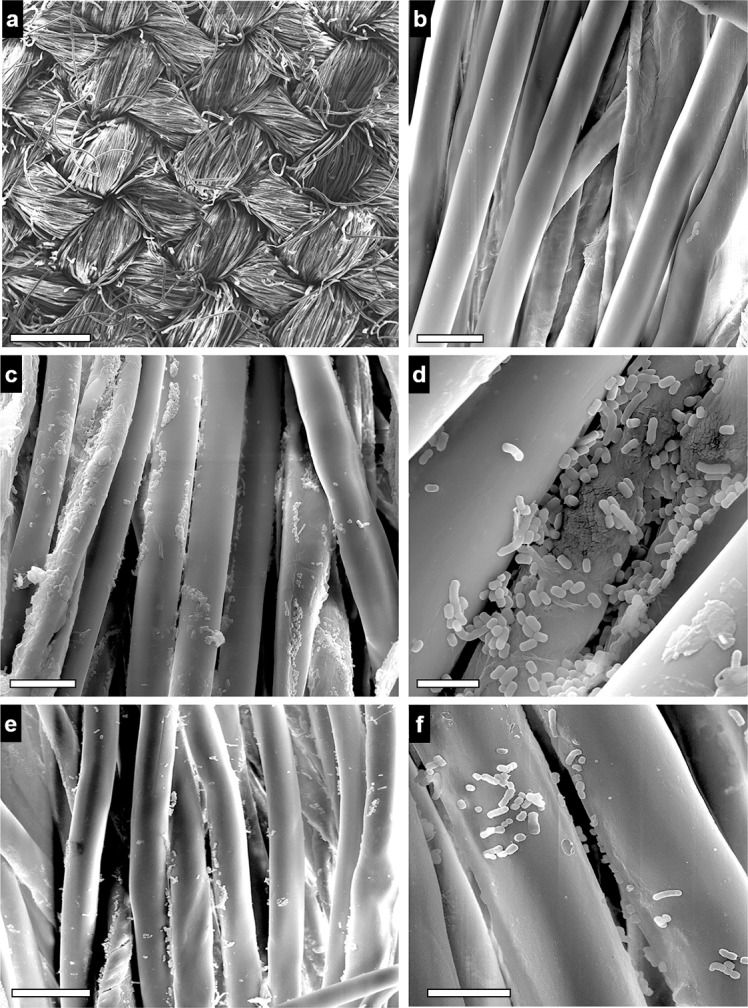
Fig 4. SEM analysis.
Scanning electron microscopy analysis of the morphology of A. baumannii (strain ATCC® 19606T) cells maintained on white lab coat fragments for up to 60 days. Panel shows random microscopy fields observed at different magnifications. a,b, control samples, and c,d, infected samples at the beginning of the experiments (day 0). e,f, infected samples after 60 days at 22ºC. Original Magnification: a, ×100; b,c,e, ×2.500; d, ×10.000; f, ×5.000. Scale bars: a, 0,5 mm; b, 20 μm; c,e, 25 μm; d, 5 μm; f, 10 μm.
Fig 5
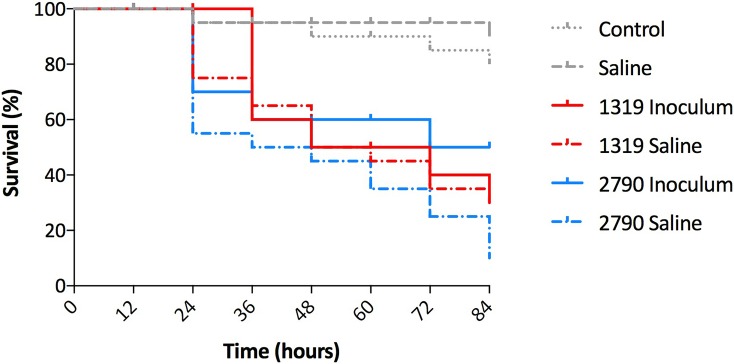
Fig 5. Galleria mellonella killing assays.
Survival rate of worms after challenge with two A. baumannii strains. Ten larvae were infected with saline alone, with 105 CFU of each strain or uninoculated (no manipulation control), incubated at 37°C for 84 h and the time of the death of the larvae was recorded. Results are the mean of two separate experiments.
Fig 6
Fig 6. Effect of stress conditions on A. baumannii survival in human serum.
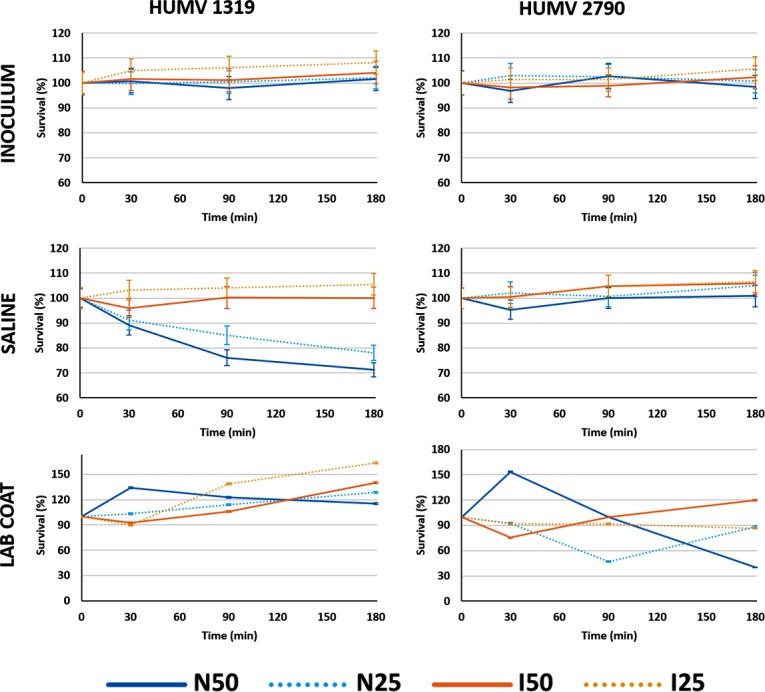
Survival ability of A. baumannii strains from fresh cultures or different stress conditions in 50% (N50, solid lines) and 25% (N25, dotted lines) non-immune human serum (blue) or in inactivated serum (orange). Results are presented as percentage survival relative to 100% of the initial inoculum. Values shown are means of three replicates from three independent experiments.

References

    1. Roca I, Espinal P, Vila-Farres X, Vila J. The Acinetobacter baumannii Oxymoron: Commensal Hospital Dweller Turned Pan-Drug-Resistant Menace. Front Microbiol. 2012;3:148 10.3389/fmicb.2012.00148 . - DOI - PMC - PubMed
    1. Harding CM, Hennon SW, Feldman MF. Uncovering the mechanisms of Acinetobacter baumannii virulence. Nat Rev Microbiol. 2017. 10.1038/nrmicro.2017.148 . - DOI - PMC - PubMed
    1. Choi CH, Hyun SH, Lee JY, Lee JS, Lee YS, Kim SA, et al. Acinetobacter baumannii outer membrane protein A targets the nucleus and induces cytotoxicity. Cell Microbiol. 2008;10(2):309–19. 10.1111/j.1462-5822.2007.01041.x . - DOI - PubMed
    1. Russo TA, Luke NR, Beanan JM, Olson R, Sauberan SL, MacDonald U, et al. The K1 capsular polysaccharide of Acinetobacter baumannii strain 307–0294 is a major virulence factor. Infect Immun. 2010;78(9):3993–4000. 10.1128/IAI.00366-10 . - DOI - PMC - PubMed
    1. Vila-Farres X, Ferrer-Navarro M, Callarisa AE, Marti S, Espinal P, Gupta S, et al. Loss of LPS is involved in the virulence and resistance to colistin of colistin-resistant Acinetobacter nosocomialis mutants selected in vitro. J Antimicrob Chemother. 2015;70(11):2981–6. 10.1093/jac/dkv244 . - DOI - PubMed

Publication types