


An X-ray Tomographic Study of Rechargeable Zn/MnO₂ Batteries
- PMID: 30134522
- PMCID: PMC6164811
- DOI: 10.3390/ma11091486
An X-ray Tomographic Study of Rechargeable Zn/MnO₂ Batteries
Abstract
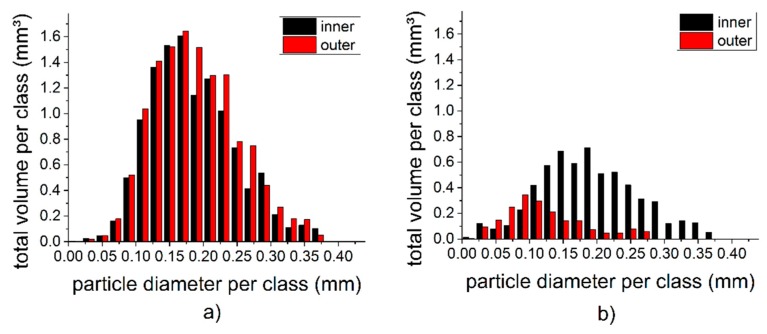
We present non-destructive and non-invasive in operando X-ray tomographic investigations of the charge and discharge behavior of rechargeable alkaline-manganese (RAM) batteries (Zn-MnO₂ batteries). Changes in the three-dimensional structure of the zinc anode and the MnO₂ cathode material after several charge/discharge cycles were analyzed. Battery discharge leads to a decrease in the zinc particle sizes, revealing a layer-by-layer dissolving behavior. During charging, the particles grow again to almost their initial size and shape. After several cycles, the particles sizes slowly decrease until most of the particles become smaller than the spatial resolution of the tomography. Furthermore, the number of cracks in the MnO₂ bulk continuously increases and the separator changes its shape. The results are compared to the behavior of a conventional primary cell that was also charged and discharged several times.
Keywords: X-ray tomography; alkaline manganese batteries; in operando; in situ; zinc powder.
Conflict of interest statement
The authors declare no conflicts of interest.
Figures




References
-
- Linden D., Reddy T.B. Handbook of Batteries. 3rd ed. McGraw-Hill; New York, NY, USA: 2002.
-
- Harting K., Kunz U., Turek T. Zinc-Air Batteries: Prospects and Challenges for Future Improvement. Z. Phys. Chem. 2012;226:151–166. doi: 10.1524/zpch.2012.0152. - DOI
-
- Lee D.U., Park H.W., Higgins D., Nazar L., Chen Z.W. Highly Active Graphene Nanosheets Prepared via Extremely Rapid Heating as Efficient Zinc-Air Battery Electrode Material. J. Electrochem. Soc. 2013;160:F910–F915. doi: 10.1149/2.016309jes. - DOI
-
- Chen Z., Choi J.Y., Wang H.J., Li H., Chen Z.W. Highly durable and active non-precious air cathode catalyst for zinc air battery. J. Power Sources. 2011;196:3673–3677. doi: 10.1016/j.jpowsour.2010.12.047. - DOI
LinkOut - more resources
Full Text Sources
Other Literature Sources
