


Cash transfers to enhance TB control: lessons from the HIV response
- PMID: 30134870
- PMCID: PMC6106939
- DOI: 10.1186/s12889-018-5962-z
Cash transfers to enhance TB control: lessons from the HIV response
Abstract
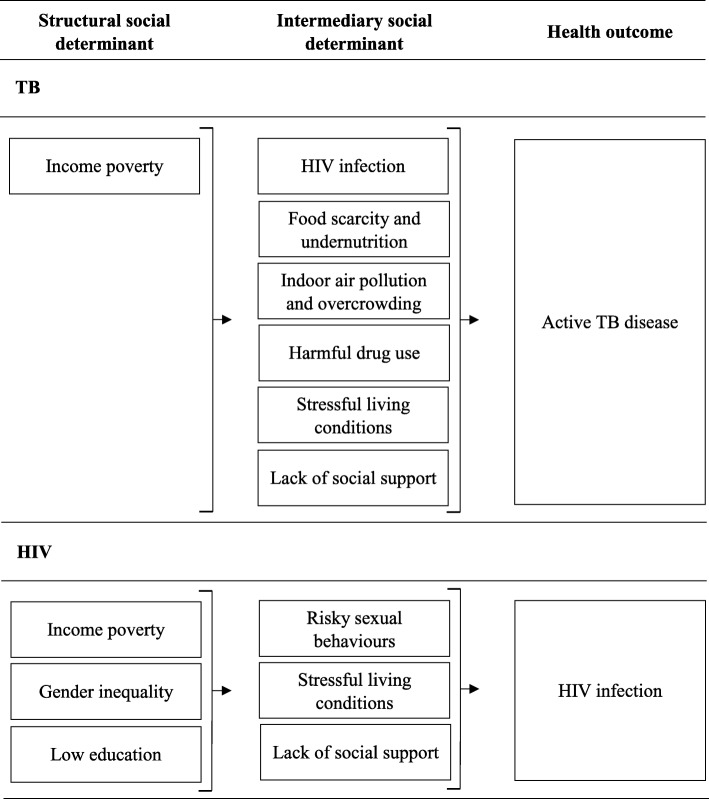
Background: The World Health Organization prioritises a more holistic global response to end the tuberculosis (TB) epidemic by 2030. Based on experiences in the HIV response, social protection, and in particular cash transfers, show promise for contributing to this. Currently, individual-level evidence for the potential of cash transfers to prevent TB by addressing the structural social determinants of disease is lacking. To identify priority actions for the TB research agenda, we appraised efforts by the HIV response to establish the role of cash transfers in preventing HIV infection.
Main body: The HIV response has evaluated the effects of cash transfers on risky sexual behaviours and HIV incidence. Work has also evaluated the added effects of supplementing cash transfers with psychosocial support. The HIV response has focused research on populations with disproportionate HIV risk, and used a mix of explanatory evaluations, which use ideal conditions, and pragmatic evaluations, which use operational conditions, to generate evidence that is both causally valid and applicable to the real world. It has always collaborated with multiple stakeholders in funding and evaluating projects. Learning from the HIV response, priority actions for the TB response should be to investigate the effect of cash transfers on intermediary social determinants of active TB disease, and TB incidence, as well as the added effects of supplementing cash transfers with psychosocial support. Work should be focused on key groups in high burden settings, and look to build a combination of explanatory and pragmatic evidence to inform policy decisions in this field. To achieve this, there is an urgent need to facilitate collaborations between groups interested in evaluating the impact of cash transfers on TB risk.
Conclusions: The HIV response highlights several priority actions necessary for the TB response to establish the potential of cash transfers to prevent TB by addresing the structural social determinants of disease.
Keywords: And cash transfer; HIV; Prevention; Social determinants; Social protection; Tuberculosis.
Conflict of interest statement
Ethics approval and consent to participate
Not applicable.
Consent for publication
Not applicable.
Competing interests
All authors have declared that they have no competing interests.
Publisher’s Note
Springer Nature remains neutral with regard to jurisdictional claims in published maps and institutional affiliations.
Figures
References
-
- World Health Organization. Global tuberculosis report 2017. 2017. http://apps.who.int/iris/bitstream/10665/259366/1/9789241565516-eng.pdf?.... Accessed 24 Nov 2017.
-
- United Nations. Sustainable Development Goal 3: Ensure healthy lives and promote well-being for all at all ages. https://www.un.org/sustainabledevelopment/health/. Accessed 26 Jul 2018.
-
- World Health Organization. End TB Strategy. 2015. http://www.who.int/entity/tb/post2015_TBstrategy.pdf. Accessed 1 Dec 2017.
-
- Carter DJ, Glaziou P, Lönnroth K, Siroka A, Floyd K, Weil D, et al. The impact of social protection and poverty elimination on global tuberculosis incidence: a statistical modelling analysis of sustainable development goal 1. Lancet Glob Health. 2018;6:e514–e522. doi: 10.1016/S2214-109X(18)30195-5. - DOI - PMC - PubMed
MeSH terms
Grants and funding
LinkOut - more resources
Full Text Sources
Other Literature Sources
Medical
