Review
. 2018 Sep;67(9):1720-1728.
doi: 10.2337/dbi17-0007.

Targeting FXR and FGF19 to Treat Metabolic Diseases-Lessons Learned From Bariatric Surgery

Affiliations
Review

Targeting FXR and FGF19 to Treat Metabolic Diseases-Lessons Learned From Bariatric Surgery

Nadejda Bozadjieva et al. Diabetes. 2018 Sep.

Abstract

Bariatric surgery procedures, such as Roux-en-Y gastric bypass (RYGB) and vertical sleeve gastrectomy (VSG), are the most effective interventions available for sustained weight loss and improved glucose metabolism. Bariatric surgery alters the enterohepatic bile acid circulation, resulting in increased plasma bile levels as well as altered bile acid composition. While it remains unclear why both VSG and RYGB can alter bile acids, it is possible that these changes are important mediators of the effects of surgery. Moreover, a molecular target of bile acid synthesis, the bile acid-activated transcription factor FXR, is essential for the positive effects of VSG on weight loss and glycemic control. This Perspective examines the relationship and sequence of events between altered bile acid levels and composition, FXR signaling, and gut microbiota after bariatric surgery. We hypothesize that although bile acids and FXR signaling are potent mediators of metabolic function, unidentified downstream targets are the main mediators behind the benefits of weight-loss surgery. One of these targets, the gut-derived peptide FGF15/19, is a potential molecular and therapeutic marker to explain the positive metabolic effects of bariatric surgery. Focusing research efforts on identifying these complex molecular mechanisms will provide new opportunities for therapeutic strategies to treat obesity and metabolic dysfunction.


Figures

Figure 1
Figure 1
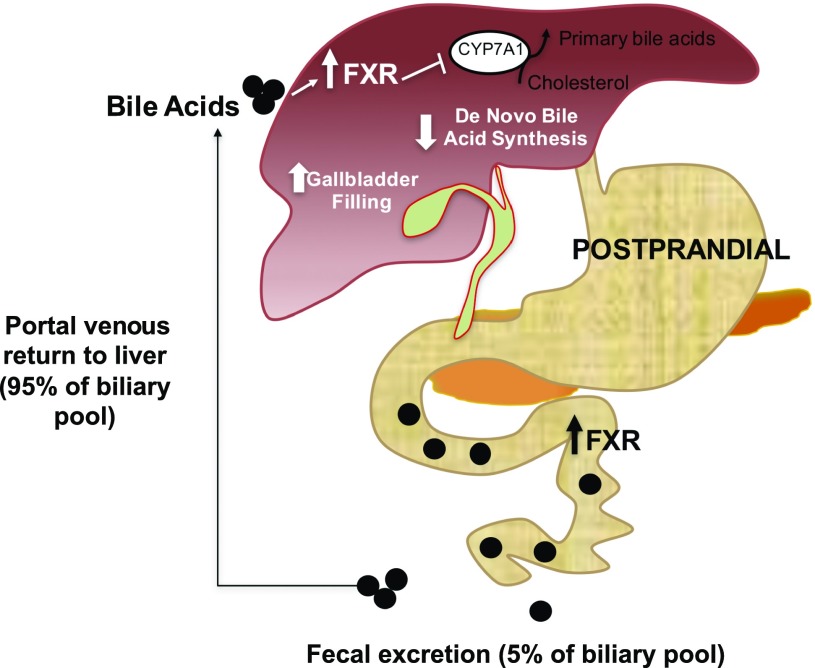
Bile acid and FXR signaling. The ingestion of food causes bile acids to be released from the gallbladder into the duodenum through the common bile duct. Bile acids aid the absorption of lipids in the small intestine and activate signaling pathways to regulate the bile acid synthesis or gallbladder filling through the repression of CYP7A1, the cholesterol 7a-hydroxylase, an enzyme that governs the rate-limiting step in converting cholesterol to bile acids. Upon reaching the ileum, 95% of bile acids are recycled back through the reabsorption via specific transport proteins back into portal circulation and the remaining 5% are excreted through the stool.
Figure 2
Figure 2
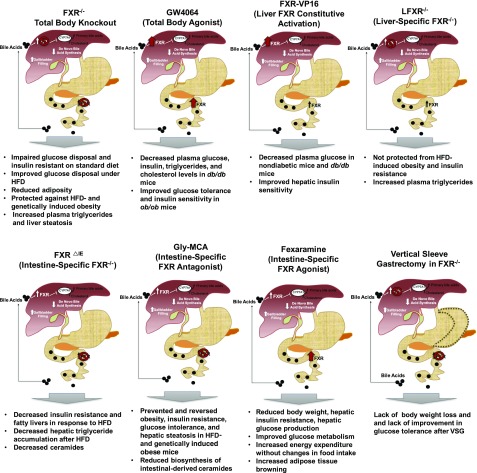
Comparison of genetic and pharmacological mouse models examining liver and intestinal FXR signaling in glucose metabolism and weight management. FXR controls the enterohepatic cycling of bile acids by inhibiting hepatic bile acid synthesis and intestinal absorption. Bile acids serve as a ligand for FXR and are involved in regulating glucose metabolism via FXR-related pathways. Genetic and pharmacological mouse models have revealed differential roles of liver and intestinal FXR signaling in glucose metabolism and weight management.
Figure 3
Figure 3
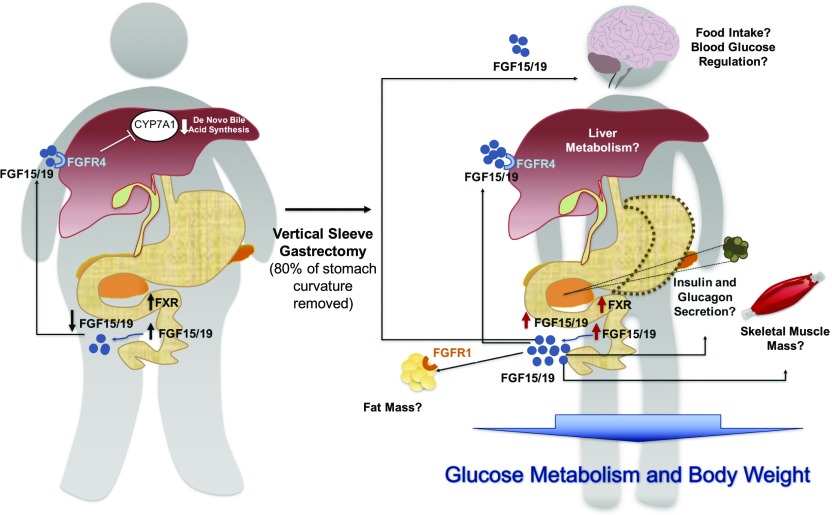
Endocrine actions of FGF15/19 after VSG. Bile acids aid the absorption of lipids in the small intestine and activate FXR’s downstream target FGF15 (in mouse and human ortholog FGF19). FGF15/19 is expressed in ileal enterocytes of the small intestine and is released postprandially in response to bile acid absorption. Once released from the ileum, FGF15/19 enters the portal venous circulation and travels to the liver where FGF15/19 binds to its receptor FGFR4 and represses de novo bile acid synthesis through suppression of cholesterol 7a-hydroxylase (CYP7A1) and gallbladder filling. Circulating FGF19 levels are reduced in individuals with metabolic disorders and NAFLD. Most importantly, circulating FGF19 levels increase after bariatric surgery, pointing to FGF15/19 as a potential target to mediate the positive effects of weight-loss surgeries. Future studies are needed to examine whether increased FGF15/19 levels after VSG play a role on regulating food intake, adipose mass, muscle mass, insulin and glucagon levels, and liver metabolism.

References

    1. Schauer PR, Bhatt DL, Kirwan JP, et al. .; STAMPEDE Investigators . Bariatric surgery versus intensive medical therapy for diabetes - 5-year outcomes. N Engl J Med 2017;376:641–651 - PMC - PubMed
    1. le Roux CW, Bueter M. The physiology of altered eating behaviour after Roux-en-Y gastric bypass. Exp Physiol 2014;99:1128–1132 - PubMed
    1. Myronovych A, Kirby M, Ryan KK, et al. . Vertical sleeve gastrectomy reduces hepatic steatosis while increasing serum bile acids in a weight-loss-independent manner. Obesity (Silver Spring) 2014;22:390–400 - PMC - PubMed
    1. Kohli R, Kirby M, Setchell KD, et al. . Intestinal adaptation after ileal interposition surgery increases bile acid recycling and protects against obesity-related comorbidities. Am J Physiol Gastrointest Liver Physiol 2010;299:G652–G660 - PMC - PubMed
    1. Patti ME, Houten SM, Bianco AC, et al. . Serum bile acids are higher in humans with prior gastric bypass: potential contribution to improved glucose and lipid metabolism. Obesity (Silver Spring) 2009;17:1671–1677 - PMC - PubMed

Publication types

MeSH terms

Substances