Review
. 2018 Aug 22;7(3):79.
doi: 10.3390/antibiotics7030079.

Silver and Antibiotic, New Facts to an Old Story

Affiliations
Review

Silver and Antibiotic, New Facts to an Old Story

Frédéric Barras et al. Antibiotics (Basel). .

Abstract

The therapeutic arsenal against bacterial infections is rapidly shrinking, as drug resistance spreads and pharmaceutical industry are struggling to produce new antibiotics. In this review we cover the efficacy of silver as an antibacterial agent. In particular we recall experimental evidences pointing to the multiple targets of silver, including DNA, proteins and small molecules, and we review the arguments for and against the hypothesis that silver acts by enhancing oxidative stress. We also review the recent use of silver as an adjuvant for antibiotics. Specifically, we discuss the state of our current understanding on the potentiating action of silver ions on aminoglycoside antibiotics.

Keywords: ROS; adjuvant; antibiotics; combinatorial; metal; silver.


Conflict of interest statement

The authors declare no conflict of interest. The funders had no role in the design of the study; in the collection, analyses, or interpretation of data; in the writing of the manuscript, and in the decision to publish the results.

Figures
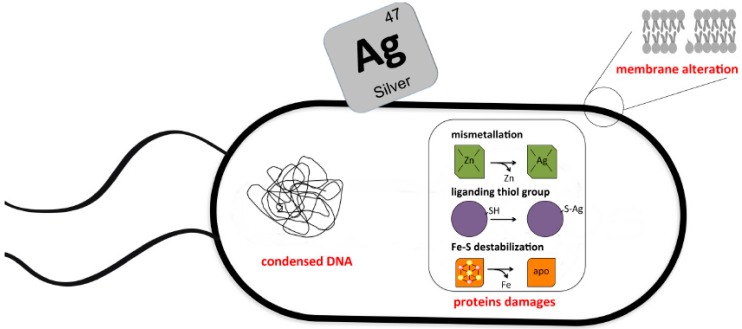
Figure 1
Figure 1
Pleiotropic molecular basis of antimicrobial effects of silver. Silver targets different macromolecules in bacteria. Here are depicted modifications observed in silver-treated bacteria such as DNA condensation, membrane alteration and protein damages. In this latter case, several situations were reported wherein silver ions interacted with thiol group, destabilised Fe-S clusters or substituted to metals in metalloproteins.
Figure 2
Figure 2
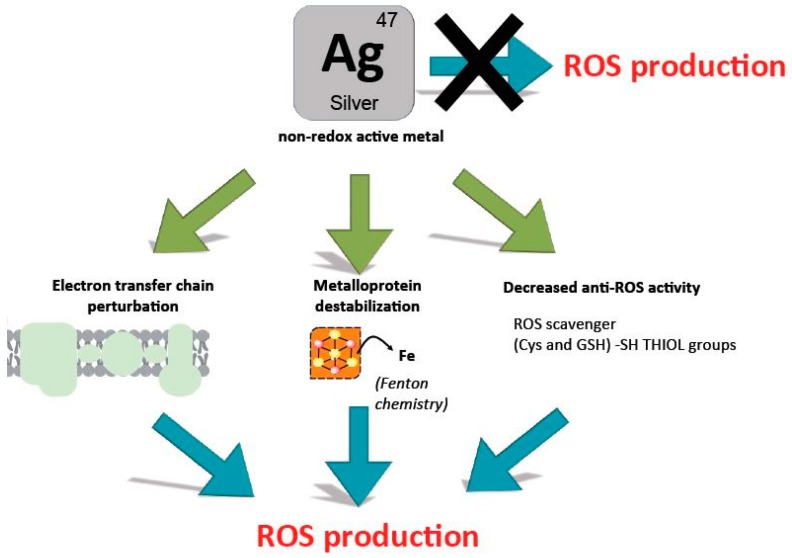
Searching for the causal link between silver ions and ROS production. Silver is a non-redox active metal that cannot directly produce ROS. Some experimental evidences however pointed to the enhanced production of ROS in the presence of silver ions. Depicted here are possible indirect ways silver ions could participate to ROS production: Perturbation of respiratory electron transfer chain, Fenton chemistry following destabilization of Fe-S clusters, or displacement of iron, inhibition of anti-ROS defences by thiol-silver bond formation.
Figure 3
Figure 3
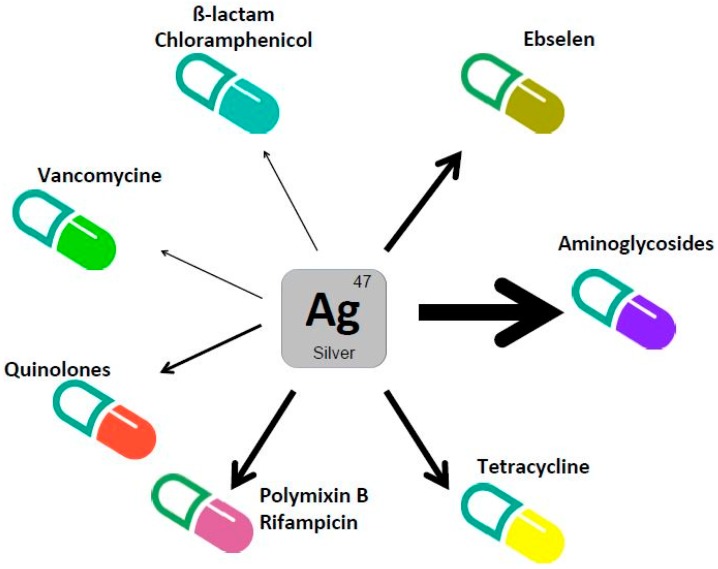
Silver potentiates antibiotics toxicity. The capacity of silver ions to enhance the toxicity of antibiotics from different family is represented. The size of the arrows line reflects the extent of the synergistic effect.
Figure 4
Figure 4
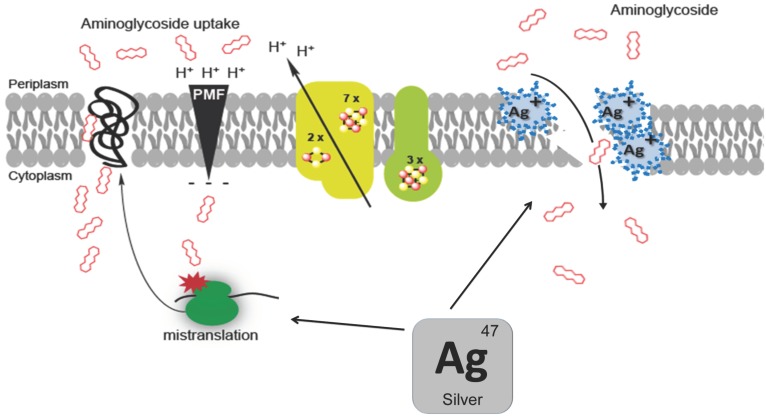
A molecular mechanism model for aminoglycoside and silver synergy. Silver enhances aminoglycoside toxicity by enhancing their uptake. Silver could destabilise the membrane either directly by altering intrinsic membrane proteins or indirectly by acting on ribosomes, which would produce misfolded aborted polypeptides that would eventually go to the inner membrane. Increased permeability of membrane would provoke massive aminoglycoside uptake.

References

    1. Mijnendonckx K., Leys N., Mahillon J., Silver S., Van Houdt R. Antimicrobial silver: Uses, toxicity and potential for resistance. BioMetals. 2013;26:609–621. doi: 10.1007/s10534-013-9645-z. - DOI - PubMed
    1. Brochado A.R., Telzerow A., Bobonis J., Banzhaf M., Mateus A., Selkrig J., Huth E., Bassler S., Beas J.Z., Zietek M., et al. Species-specific activity of antibacterial drug combinations. Nature. 2018;559:259–263. doi: 10.1038/s41586-018-0278-9. - DOI - PMC - PubMed
    1. Morones-Ramirez J.R., Winkler J.A., Spina C.S., Collins J.J. Silver enhances antibiotic activity against gram-negative bacteria. Sci. Transl. Med. 2013;5:1–11. doi: 10.1126/scitranslmed.3006276. - DOI - PMC - PubMed
    1. Herisse M., Duverger Y., Martin-Verstraete I., Barras F., Ezraty B. Silver potentiates aminoglycoside toxicity by enhancing their uptake. Mol. Microbiol. 2017;105:115–126. doi: 10.1111/mmi.13687. - DOI - PubMed
    1. Bartłomiejczyk T., Lankoff A., Kruszewski M., Szumiel I. Silver nanoparticles—Allies or adversaries? Ann. Agric. Environ. Med. 2013;20:48–54. - PubMed