


Influence of T Cell Coinhibitory Molecules on CD8+ Recall Responses
- PMID: 30135685
- PMCID: PMC6092517
- DOI: 10.3389/fimmu.2018.01810
Influence of T Cell Coinhibitory Molecules on CD8+ Recall Responses
Abstract
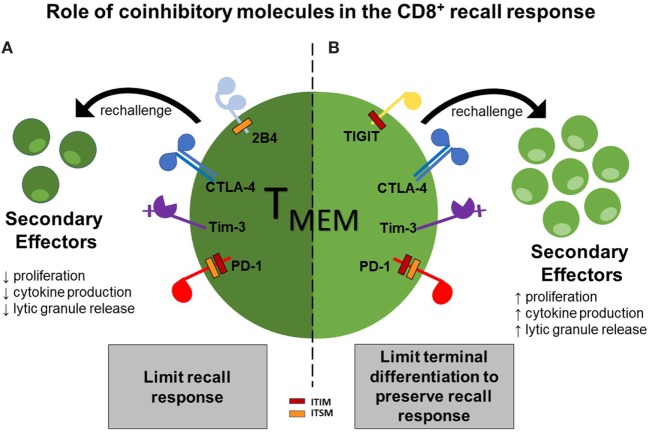
T cell co-signaling molecules play an important role in fine-tuning the strength of T cell activation during many types of immune responses, including infection, cancer, transplant rejection, and autoimmunity. Over the last few decades, intense research into these cosignaling molecules has provided rich evidence to suggest that cosignaling molecules may be harnessed for the treatment of immune-related diseases. In particular, coinhibitory molecules such as programmed-death 1, 2B4, BTLA, TIGIT, LAG-3, TIM-3, and CTLA-4 inhibit T cell responses by counteracting TCR and costimulatory signals, leading to the inhibition of proliferation and effector function and the downregulation of activation and adhesion molecules at the cell surface. While many reviews have focused on the role of coinhibitory molecules in modifying primary CD8+ T cell responses, in this review, we will consider the complex role of coinhibitory molecules in altering CD8+ T cell recall potential. As memory CD8+ T cell responses are critical for protective memory responses in infection and cancer and contribute to potentially pathogenic memory responses in transplant rejection and autoimmunity, understanding the role of coinhibitory receptor control of memory T cells may illuminate important aspects of therapeutically targeting these pathways.
Keywords: CD8; autoimmunity; cancer; coinhibitory; memory; recall; transplant; vaccine.
Figures
References
Publication types
MeSH terms
Substances
Grants and funding
LinkOut - more resources
Full Text Sources
Other Literature Sources
Research Materials
